Ready For The Challenge'
pp. 45-46 · Read in the full issue
New Fiji Development Chief Ready For The Challenge'
By a Staff Writer
A tall, well-built quietly-spoken Englishman spent 34 hours in Sydney on March 22 and 23 talking to top business men closely associated with Islands trade. The information he gleaned will serve as a useful background in a key post he is now filling in Fiji as Development Commissioner. He is Mr. W.
B. Rogers, former soldier with a brilliant career in World War II who became a colonel in the Bth Army at the age of 29.
LTR. ROGERS frankly confesses that he is a stranger to the Paci ic and only aware of the problems acing Fiji through reading and con ersations with men who know the Colony well. He has plenty of ideas or future development, and spoke reely to PIM about what he would
like to achieve. But, he emphasised, until he had first hand knowledge, he was “only guessing”. He is ready to face the challenge Fiji offers.
While waiting in London to go out to Fiji, and aboard the Oranje, he read the Burns Report, which is now the emasculated blueprint for Fiji’s future; Professor Spate’s voluminous report on the Fijian people; and Der rick’s History of Fiji up to Cession.
He also read the 1960 Colonial Office report on Fiji.
Six-Year Contract Mr. Rogers is going to Fiji on con tract for six years to fill a post simi lar to one he held in Tanganyika for a couple of years in the late 1950’5.
That post was Tanganyika Trade Commissioner for Southern Africa, While holding that post he was able to develop the export trade in about 15 different commodities in territories to the south.
From that post he became Per manent Secretary for External Affairs and Defence in Tanganyika, working directly through the Prime Minister, Mr. Macmillan, on foreign affairs. He retired from the Colonial Service from that post and was living in the south of France when he was offered the appointment of Fiji Development Commissioner.
“It seemed most attractive to me,” he said.
Import Gaps
“I have made plans only in the broadest outline. There is the busi ness of increasing production and establishing markets, which is elemen tary. There are gaps in imports which we might be able to fill in. I notice there are large imports of rice, and could we not catch more fish?
“It struck me there was a gap of £2,000,000 or so in imports which it might be possible to reduce, but I am
only guessing. I know the business of establishing markets only too well.
There is always the difficulty of breaking into markets, and then get ting deliveries to sample and sche dule. You can trade efficiently to start, but it can be an uphill struggle.”
Mr. Rogers suggested that cotton was a good peasant crop, and had done well in Tanganyika, but that ter ritory’s great competitor was the United States. He had found strong US competition in selling cotton to Rhodesia.
Oil Palms Mr. Rogers said that he had in spected a Colonial Development Cor poration oil palm seed project at Singapore on the way out. He under stood that this palm produced more oil to the acre than coconuts, and might be well worth a try in Fiji.
Touching briefly on sugar, Mr.
Rogers said it would be a wonderful thing for Fiji if the export quota could be increased. The capacity was there and the production could be in creased rapidly.
At ports of call along the Austra lian coast Mr. Rogers called on a number of business houses and De partment of Trade officials to talk about Fiji trade.
“I met some very interesting people in Melbourne,” he said.
At Sydney his host for the day was Mr. Hugh Sullivan, Australian Gov ernment Trade Commissioner for the Pacific Islands. Mr. Sullivan intro duced Mr. Rogers at business houses which trade with Fiji. He lunched on the day of his arrival with Mr. H. G.
Nicholls, chief inspector of the CSR Co. Ltd. for Fiji and chairman of South Pacific Sugar Mills Ltd., Mr.
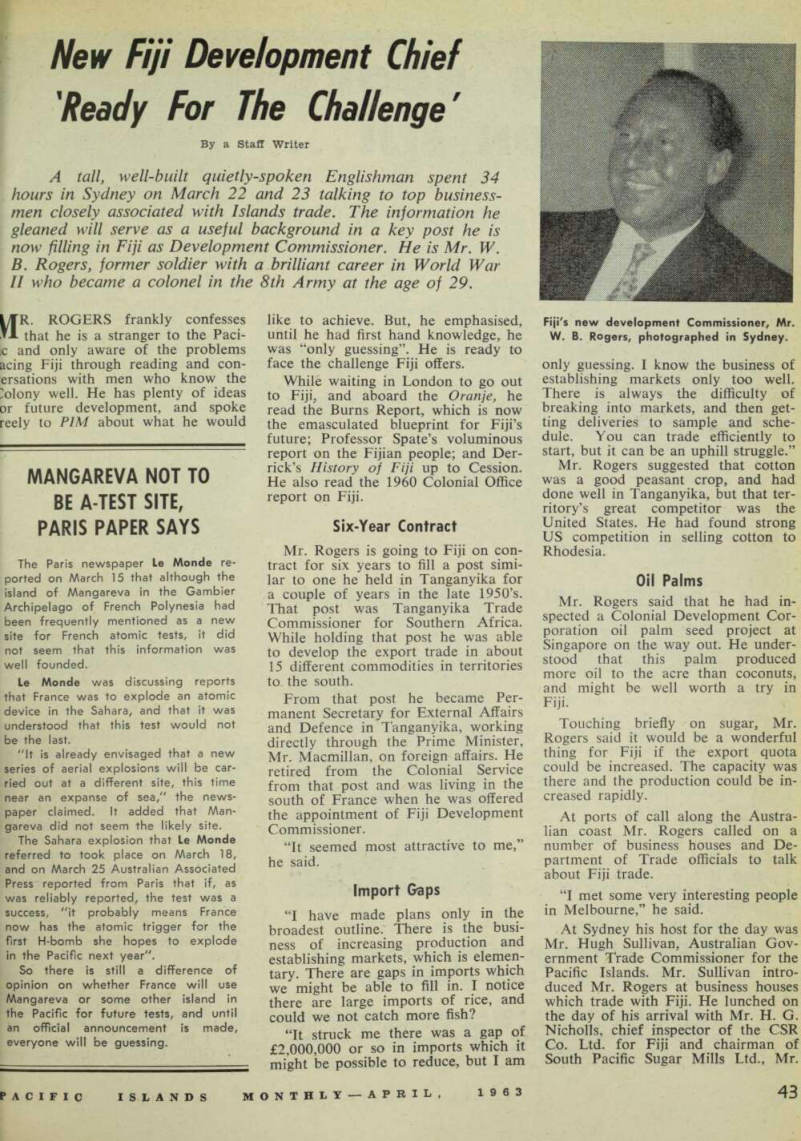
Fiji's new development Commissioner, Mr.
W. B. Rogers, photographed in Sydney.
R. B. Carpenter, chairman and jo managing director of W. R. Carp ter and Co. Ltd. and Mr. C. H. C penter, vice-chairman and joint m aging director of the same organi tion.
Those He Met At a Trade Department functi Mr. Rogers met the following o cials and representatives of busin firms: Messrs. H. K. K. Cook, Regioj Director, Trade Department; B.
Perriman, and Eric Spring, of W.
Carpenter and Co. Ltd.; J. C.
Harper and J. C. Moreing, Bui Philp and Co. Ltd.; C. O. Hand!
CSR Co. Ltd.; Chamber of Mai factures; R. Hetherington, Hetherii ton Kingsbury Pty. Ltd., shippi agents and brokers; W. J. Holm Sydney manager of the USS Co.
NZ Ltd.; E. R. Fordham, exp< manager for Pacific area of Rii growers Co-operative Mills Ltd.; L. Hynds, export manager, Gord Edgell and Sons Pty. Ltd.; T.
Playfair, export manager mason sales division, CSR Fibreboa Group; J. E. Beveridge and R. L.
Allen, Industrial Public Relatic Service of Australia Pty. Ltd.; C.
Jeeves, export sales manager, AW Ltd.; C. Sullivan, C. Sullivan P Ltd.; R. Law, Nelson and Pty. Ltd.; W. G. E. Parry, cha man, NSW Flour Millers Council; T. M. Rose, associate director, Gol] and Co. Ltd.; Peter Campbell, mana ing director, John Campbell and C Pty. Ltd.; W. Johnston, manag< trade and commerce, internatior division of Bank of NSW; R. > Probert, sales director, Vincer Chemical Co. Pty. Ltd.; R. Wrigl manager, Young and Co. (Aust Ltd.: Arthur Dash, senior manage foreign division, Commonweal Bank head office; T. Metcalfe, W liam Angliss and Co. (Aust.) Pt Ltd.; A. Ottawa, export divisia William Angliss and Co. (Aust.) Pt Ltd.; R. W. Mann, vice-president, e port development group, Chamber Commerce and a director of Ge Kellaway and Sons (Eastern) Pt Ltd.; L. W. Clarke, overseas tradii division (Fiji Government section Dalgety Trading Co. Pty. Ltd.; R. I McAlpine, manager for Pacil Islands sales. Nestle Co. (Aust.) Lto A. E. Strachan, export manager.
Kitchen and Sons Pty. Ltd. tt The first census in the Gilbe: and Ellice Islands Colony will be he; in April. The Census Commissione: Mr. J. B. McCaig, has recently visits all GEIC islands to train enumer tors.