"Confidence Und " As Land Comes
pp. 41-43 · Read in the full issue
Land Comes Into Dispute
By a Staff Correspondent
Heavy rain in mid-March did something to ease the three months long drought in Rabaul, New Guinea, but did not obliterate the fire scars on the sides of Namanula Hill and elsewhere where natives, who have claimed these areas back from the Administration, are burning off for new gardens.
IN this they are probably jumping the gun as up to March 20 no final orders had been made pending survey, and decisions of the Titles Commissioner are also subject to appeal to the Supreme Court.
During the hearing of claims some months ago, the Titles Commissioner indicated that he would restore to the Administration title to the Botanical Gardens and reserve, also police barracks and gaol area and the flat on the top of Namanula Hill; but he indicated that the balance of Nama nula, excluding the road and two Methodist Mission blocks, would be
restored to the Director of Native Affairs as trustee for claimant natives.
After the claims were made, advice was sought both privately and by Administration from old German citizens now living in West Germany but who were in New Britain at the time Rabaul was established as the German New Guinea capital between 1903 and 1910. These people were of the opinion that because these areas were entered in the German Groundbook it proved that they had been acquired legitimately by the then German Government 60 or more years ago.
New Line of Thought The claims made in 1962, by local people mostly from Nordup, for sections of Rabaul town land, includ ing the old Botanical Gardens site and the Namanula residential and hospital area—regarded as unassail ably Administration property for the last 60 years—started a whole new line of thought on property owner ship in the New Britain area.
The further claim—not yet resolved —on the title of the private planta tion property of Varzin, in the Kokopo area, has still further under mined confidence.
Rabaul, say some of its once optimistic citizens, is now a dying town where even the Chinese are tak ing their money out and reinvesting it in Australia or Port Moresby.
The hearing of an appeal to the Court began in Port Moresby re cently in respect of Varzin and no judgment has yet been made.
Evidence in the case has shown that this property had been taken over by the Custodian of Expropri ated Property from German owner ship after World War I and was sub sequently put up for sale in the tenders which closed on March 31, 1926.
In the catalogue issued by the
Rabaul's Loss
Is Moresby's
Gain
Rabaul old-timers are complain ing that the town is dying on its feet because Chinese businessmen are investing the money they make there either in Australia or Papua.
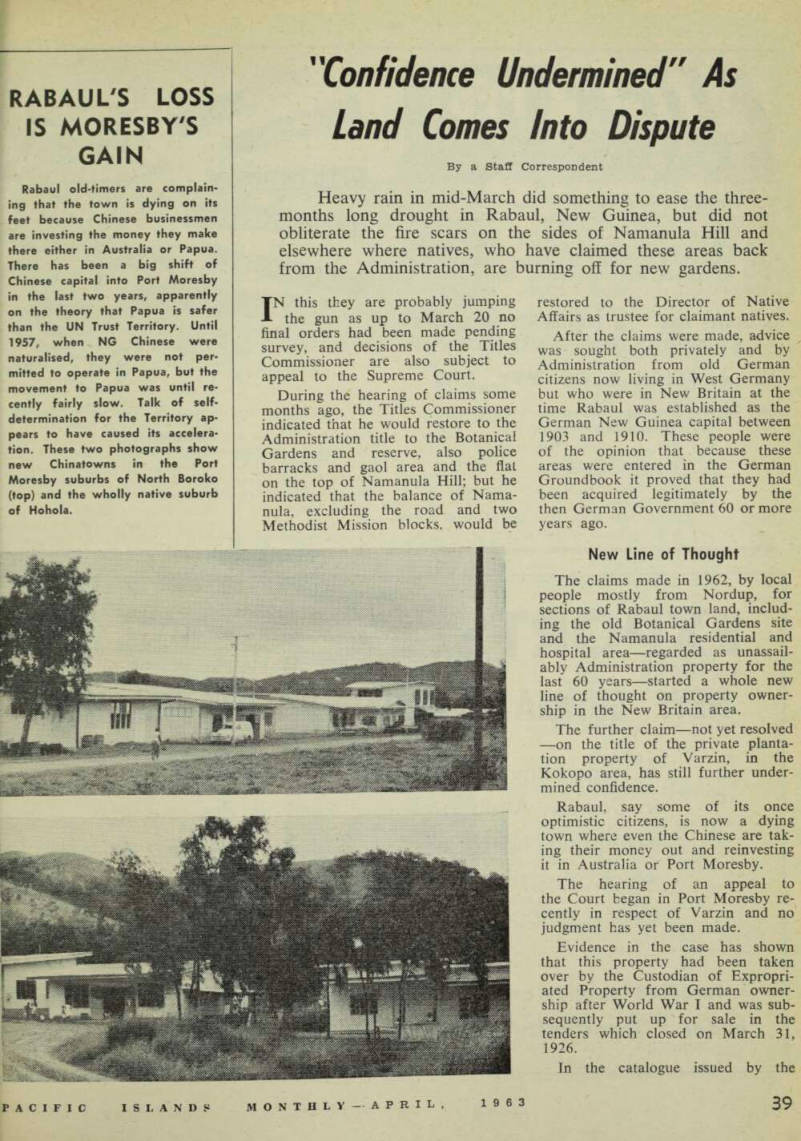
There has been a big shift of Chinese capital into Port Moresby in the last two years, apparently on the theory that Papua is safer than the UN Trust Territory. Until 1957, when NG Chinese were naturalised, they were not per mitted to operate in Papua, but the movement to Papua was until re cently fairly slow. Talk of self determination for the Territory ap pears to have caused its accelera tion. These two photographs show new Chinatowns in the Port Moresby suburbs of North Boroko (top) and the wholly native suburb of Hohola.
Pro Board at the time, the title 5 described as follows: The property is entered in the German] Groundbook and has >een surveyed. The survey is icceptable to the Administration, rhe records do not show any lative rights over the property, rhe Groundbook does not show my record of Government im jrovement conditions. The Custodian guarantees a freehold itle subject to the conditions of lales set out on pages 21-28 [of he catalogue]. fhe property was described as of f hectares, about half of it planted coconuts, and situated on the kopo-Toma Road, about 20 miles m Rabaul. It had a “substantial dwood bungalow” and the usual res, copra driers and livestock. A p issued with the old Ex-Pro ard catalogue in 1926 showed that rzin adjoined an area described as dive reserve”.
Fhe property had originally been nted up by a German called )olf but how he had acquired the )perty is not recorded in the Ger m Groundbook [the German Ad nistration’s system of recording id titles], although the fact that it s so recorded satisfies surviving ex w Guinea German nationals that acquisition had been investigated d had been considered, by the then :rman Administration, legal and iding.
It is a matter of history that while this property in the early days, oolf’s wife and child were murdered native raiders and that the small tte of Queen Emma, Caroline ismina Coe, who later grew up to come the wife of Kurt A. Schultze d the mother of the present H. L.
Schultze, was saved only when native servants hid her in an attic.
After Varzin was expropriated as enemy property and put up for tender by the Board, it was disposed of to the late Tom Garrett; it was inherited by his widow, who now is Mrs. A.
Richards. The fact that Mr. Richards is the Rabaul Delegate of the Custodian of Expropriated Property, which instrumentality guaranteed the title of Varzin in the first place, merely adds to the interesting jig saw.
The merits of the claims made by the natives and of the owners’ reply, cannot be discussed here—the case is
still before the courts, and sub judice.
But the implications of the Varzin and other cases—namely, that it is possible after all these years to chal lenge titles apparently established 50 or 60 years ago—have greatly alarmed property-owners in the Gazelle area.
If titles are subject to challenge, bank overdrafts and other financial accommodation cannot be secured, and the whole plantation system as it has been known in New Britain for 60 years, totters on its founda tions.
Rightly or wrongly, New Britain residents blame certain “young misc h i e f-making Administration officers” for the way in which this challenge to the validity of land titles has developed. They make the bullets, say the residents, and certain Tolais are only too willing to fire them.
“The Minister for Territories must have his face right out of shape by continually keeping his tongue in his cheek,” said one planter, savagely, in March.
“He comes up here and spouts rubbish about attracting new capital to this Territory, while those of us who have spent 30 years in the blasted country have this sort of thing dropped in our laps in our old age ”
As this went to press Tolai natives made claims against Ravelien and Matanatar plantations near Kokopo (now owned by Plantations Holdings); and Vu Vu on North Coast.
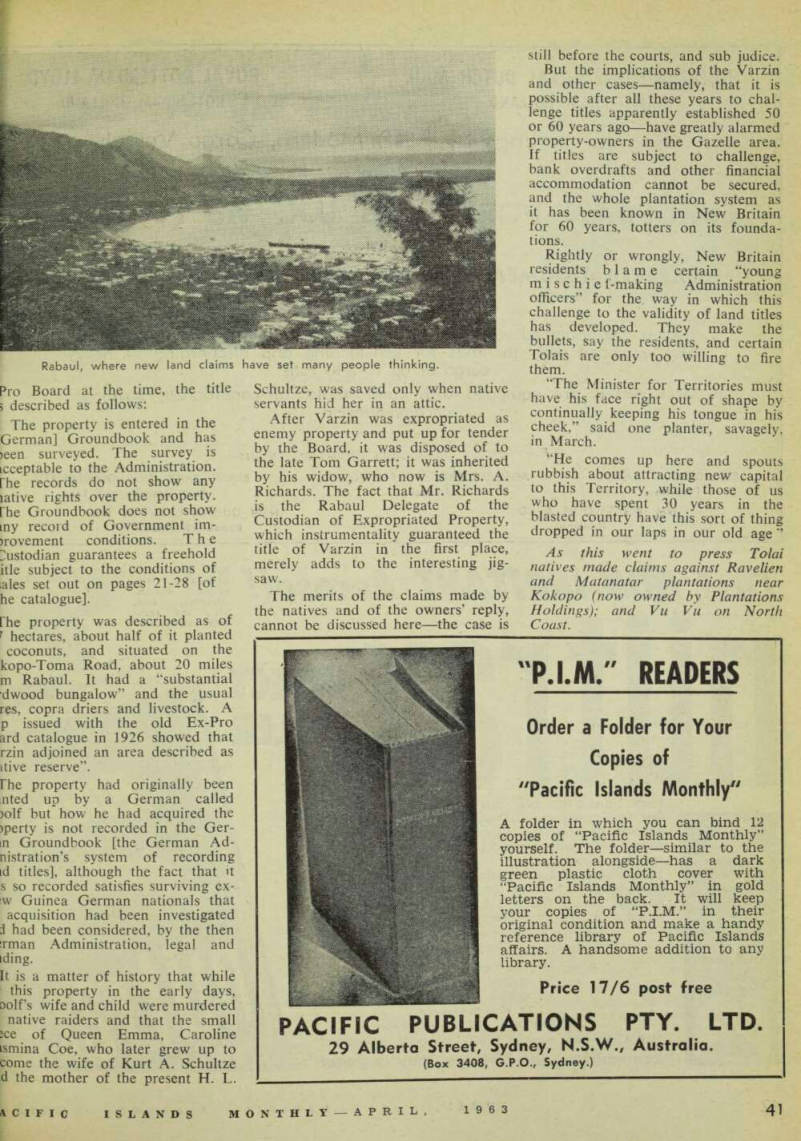
Rabaul, where new land claims have set many people thinking.