Most Famous Department
pp. 23-25 · Read in the full issue

End Of Road For Most Famous Department
From a Staff Writer in Port Moresby
Proposed new legislation aimed at severing the executive d judicial functions of Papua-New Guinea administration will obably have the most profound effect on the Territory. Among her things it will probably bring about the end of the Depart mt of Native Affairs—until recently the “glamour depart snt” of P-NG.
i pending legislation seeks to et up Local and District Courts i Territory, in place of the Native s of New Guinea and the s of Petty Sessions of Papua, previously were courts largely the jurisdiction of officers of )epartment of Native Affairs.
' legislation seeking to do these follows closely the recom ations made by Professor D. P. im, Professor of Jurisprudence : University of Melbourne, who a report to the Minister of ories in December, 1960.
' report is a privileged docu and whaf it contained has never made public— except in a state by the Minister to the Aus i Parliament in October. 1961. ! Minister, Mr. Paul Hasluck, m that occasion that Professor m considered that the basic ess of P-NG’s system of justice a the relations between the ive and judicial arms of Gov nt at all levels. He considered rith the Territory turning over a paternal form of Government aething more closely resembling stern democracy, it was neces
sary to provide a judicial system serving the law quite independently of the executive.
Mr. Hasluck went on to say that in the past it had been inevitable and advantageous that in areas of first contact with primitive people, the Native Affairs officer had undertaken all functions of Government—con ducted the census, kept the peace, settled disputes, investigated crime and, in his capacity as a magistrate of the Court of Native Affairs, dis pensed justice.
New Magistrates
In more advanced areas, changes had already been made, and full time qualified stipendiary magistrates had taken the place of Native Affairs officers. The time was now ripe, he inferred, for taking matters a step further. Amongst the essential pre requisites of self-government for Papua-New Guinea, he said, was a system of justice quite divorced from Administration.
The new proposed legislation creat ing- lower courts, and in effect bring ing all people in the Territory under
a single system of justice, stems from the Professor’s report and such points in it upon which the Minister agreed.
Opinion in the Territory differs widely as to whether it is too soon to attempt anything of the sort or not.
Some feel that, unless there is some prior attempt to get native people to settle their own domestic problems, the lower courts will be clogged with petty village troubles that now are traditionally left for Assistant District Officers to deal with.
Others believe that it would be a good thing to make the natives them selves assume the responsibilities of making decisions instead of putting their disputes over dogs and wives or gardens into the lap of the nearest ADO, and that therefore the estab lishment of lower courts is a step in the right direction.
Also stemming from the Derham report is a decision to enlarge the area of responsibility of the Royal P-NG Constabulary, so that it will take on the same role as police forces everywhere—the job of apprehend ing criminals, no matter where. The Constabulary does this in P-NG now, of course—but only in the major towns.
In primitive areas this work has always been done by patrol officers, working for the Department of Native Affairs. They have apprehended the law-breakers, dispensed justice through native courts and then acted as gaolers, too.
They have been, in fact, both judge
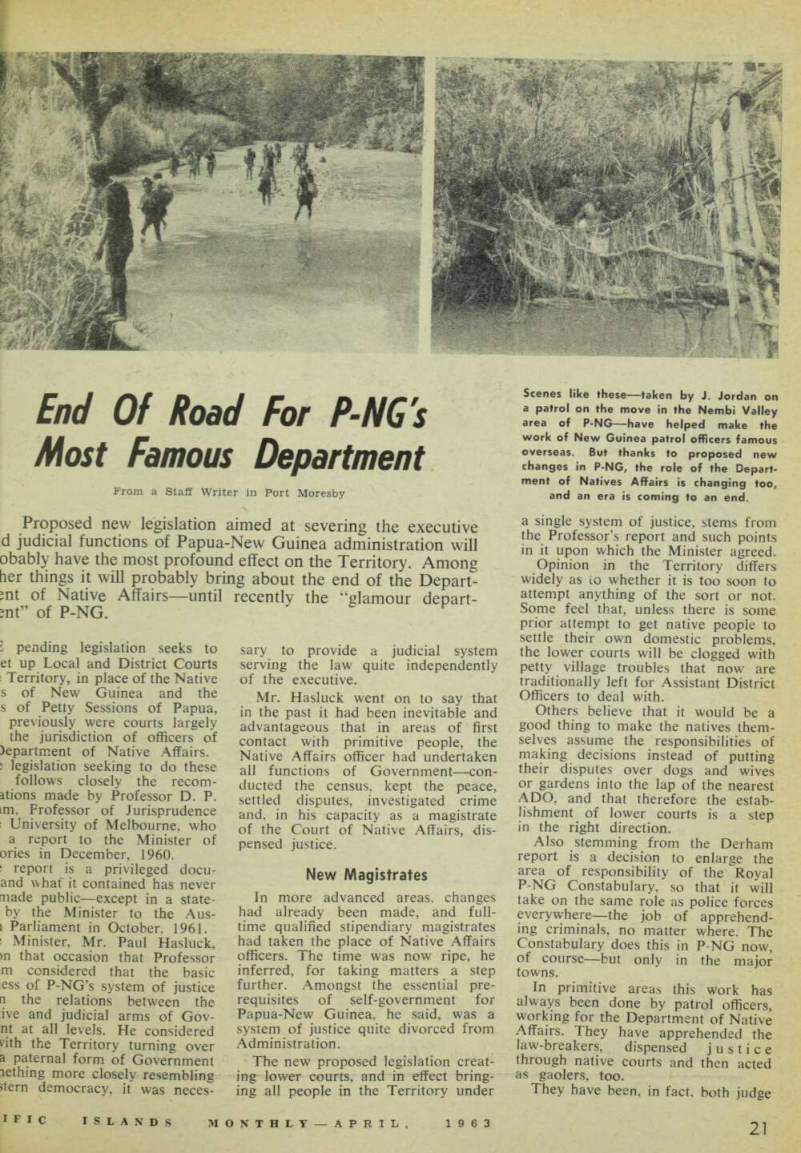
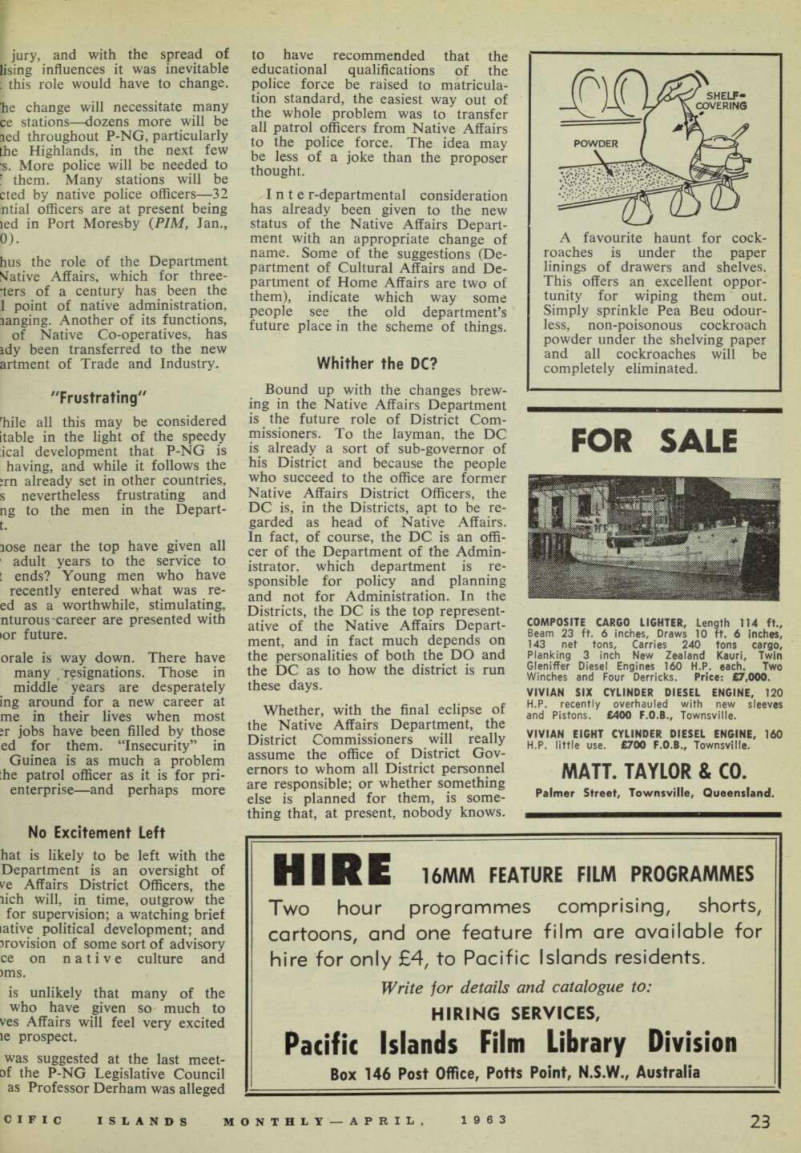
Scenes like these —taken by J. Jordan on a patrol on the move in the Nembi Valley area of P-NG—have helped make the work of New Guinea patrol officers famous overseas. But thanks to proposed new changes in P-NG, the role of the Depart ment of Natives Affairs is changing too, and an era is coming to an end.
jury, and with the spread of Using influences it was inevitable this role would have to change. he change will necessitate many ce stations—dozens more will be aed throughout P-NG, particularly the Highlands, in the next few ■s. More police will be needed to I them. Many stations will be cted by native police officers—32 ntial officers are at present being led in Port Moresby ( PIM , lan., 0). hus the role of the Department Native Affairs, which for three •ters of a century has been the 1 point of native administration, aanging. Another of its functions, of Native Co-operatives, has idy been transferred to the new artment of Trade and Industry.
"Frustrating"
r hile all this may be considered itable in the light of the speedy ical development that P-NG is having, and while it follows the ;rn already set in other countries, s nevertheless frustrating and ng to the men in the Depart t. rose near the top have given all adult years to the service to ; ends? Young men who have recently entered what was re ed as a worthwhile, stimulating, nturous career are presented with »or future. orale is way down. There have many resignations. Those in middle years are desperately ing around for a new career at me in their lives when most jr jobs have been filled by those ed for them. “Insecurity” in Guinea is as much a problem :he patrol officer as it is for pri enterprise—and perhaps more No Excitement Left hat is likely to be left with the Department is an oversight of ve Affairs District Officers, the lich will, in time, outgrow the for supervision; a watching brief lative political development; and irovision of some sort of advisory ce on native culture and >ms. is unlikely that many of the who have given so much to ves Affairs will feel very excited le prospect. was suggested at the last meet of the P-NG Legislative Council as Professor Derham was alleged
to have recommended that the educational qualifications of the police force be raised to matricula tion standard, the easiest way out of the whole problem was to transfer all patrol officers from Native Affairs to the police force. The idea may be less of a joke than the proposer thought.
In t e r-departmental consideration has already been given to the new status of the Native Affairs Depart ment with an appropriate change of name. Some of the suggestions (De partment of Cultural Affairs and De partment of Home Affairs are two of them), indicate which way some people see the old department’s future place in the scheme of things.
Whither the DC?
Bound up with the changes brew ing in the Native Affairs Department is the future role of District Com missioners. To the layman, the DC is already a sort of sub-governor of his District and because the people who succeed to the office are former Native Affairs District Officers, the DC is, in the Districts, apt to be re garded as head of Native Affairs.
In fact, of course, the DC is an offi cer of the Department of the Admin istrator, which department is re sponsible for policy and planning and not for Administration. In the Districts, the DC is the top represent ative of the Native Affairs Depart ment, and in fact much depends on the personalities of both the DO and the DC as to how the district is run these days.
Whether, with the final eclipse of the Native Affairs Department, the District Commissioners will really assume the office of District Gov ernors to whom all District personnel are responsible; or whether something else is planned for them, is some thing that, at present, nobody knows.