[?]Ssorted Journeys To Botany Bay
pp. 93-95 · Read in the full issue

The Month's New Reading
The 175th anniversary of the founding of Sydney and the ate of New South Wales has resulted in Australian presses nning hot with the output of early “journals”—including emarks on a Passage to Botany Bay, 1787-1792, by James ;ott, a Sergeant of Marines; and Journal of a Voyage to New mth Wales, by John White, Esq., Surgeon General to the ttlement.
PH authors took part in the ;ame expedition but there all resemblance stops. White was irned with the health of the ly and with the flora and fauna e new land but his journal was tally published more for its -five plates of Non descript als, Birds, Lizards, Serpents, ns cones of trees and other al productions”.
Ison stayed seven years in the ly but his journal describes only oyage out in the First Fleet and irst eight months ashore. He the journal at the request of a alist friend in London, Thomas n, who prepared it for publica and had drawings made of the nens that White sent from New Wales. The original publica was in 1790, by J. Debrett, of Tilly, and is now a collector’s valuable as well as rare.
A General Picture lite’s journal is not restricted tural history and the health of harges, however, but gives a al picture of the first faltering pt to settle what seemed to enforced colonists the most nding and inhospitable land, ittle of his own personal life jes; and it is left to a modern ipher, Rex Rienits, to produce foreword, the human-interest by describing White’s liaison a female convict which resulted son whom White later took to nd and educated, geant Scott took quite a dif ; tack to his superior scribe like any true soldier, was far interested in the rations than in ‘Non descript Animals” and ike. Small notes saying “No ie”, or “Marines Rum Stopped”, hrough it. i journal, now published for the ;ime, by the Public Library of under the William Dixson
With Judy Tudor
Foundation, reproduces exactly the style and format of the original which was written in a long, narrow note book with cardboard covers.
The original diary came into the possession of the late Sir William Dixson about the beginning of this century, he having bought it from Angus and Robertson Ltd. who had acquired it from a Miss Russell who appears to have been a grand daughter of a marine who came to NSW in the First Fleet.
How Marine Russell got Marine
ScotPs Journa l is not known and it was not until 1954, two years after it had been bequeathed to the Public Library? that it was proved that Scott was the aut hor. Previously it had been knoW n simply as “the Diary of a Sergeant of the First Fleet”, One thing is certain—no one would have been more surprised than Scott if he could have looked into the future and seen that his occasional
and jottings would one day be ished as an historical document h 25/- to the general reading :c. ott must be the most original ;r who ever put pen to paper sn in an age that was free in ■egard he must be counted some ;of an eccentric. And, except ie recording of rum and ration s or the stopping of same, and •rice of food, was usually a man iw words. : records on January 7, 1788, i the Fleet was off Tasmania, “Lady Penareen [Lady Penrhyn ] j the Signal for Land at i past the Morning which Proved to lothing but fogg”. And on ary 20 that “. . . Lay off the ing of the Bay all Night At 4 ie Morning Made Sale entred ay Bay at 8 OClock AM found Commadore & the 3 Sale that d Us at Sea Here”. i February 7, the Fleet having 1 around to Port Jackson and :onvicts and Marines then hav been landed at Sydney Cove the Governor having made a h to all (telling the convicts all their previous crimes had forgiven), according to Scott, Governer & All the Navey and ;ery officers Dinned together in Larbetery tent for that purpose ne Day the Governer Returned Marines thanks for thier Manley Soldierlike Appearance”. 3tt had taken his wife with him, d most of the married marines, his entry for September 3, 1787 e they were still on board the port Prince of Wales at Rio de ro) says: “Four female convicts one Child was changed to the ree in leu of four that Wee sent the Officers feverits & often 1 Disturbence in the Ship. Same My Wife was deleve’d. of A hter at one OClock PM After ill 27 hours”. [Other child, a son, was born to ouple in July, 1790, in Sydney, children and his wife lived to a home with him to England in the Gorgon at the end lis service—a remarkable ac lishment at a time when every d entry in these early Journals i: “Departed this life Elizabeth, of . . .” or “John, son of’, Marine So and So”—all marked Jly in with the latitude and tude and the state of the ler.
March, 1792, the Gorgon, ;ward bound, was in Capetown during some weeks there Scott
recorded; “We also Recvd. on Bd.
Capt. Ewdards of the R.Navy & two Mateshipmen Who was Cast away in His M. Ship Pandora who Was in Quest of the Bounty a pirats Ship, also ten of the pirats which Captn.
Ewdards took on Shore at Ottiety, the pirets Shipp Cutt in the Night and left them on Shore. . .
Later he records the names of the “Pirats” as Peter Heaward, Meatship man; Wm. Muspratt; Jn. Millward; Jams. Morrison; Thos. Birkett; Thos.
Ellison, and Michl. Burns.
Scott was duly discharged at Spit head in June, 1792, and until the resurrection of his Journal he and his family completely disappeared from sight.
(Remarks On A Passage To
Botany Bay; And Journal Of A
Voyage To New South Wales.
Published by the Library of New South Wales and the Royal Historical Society respectively, both in association with Angus and Robertson Ltd. 25/- and 57/6 respectively.)
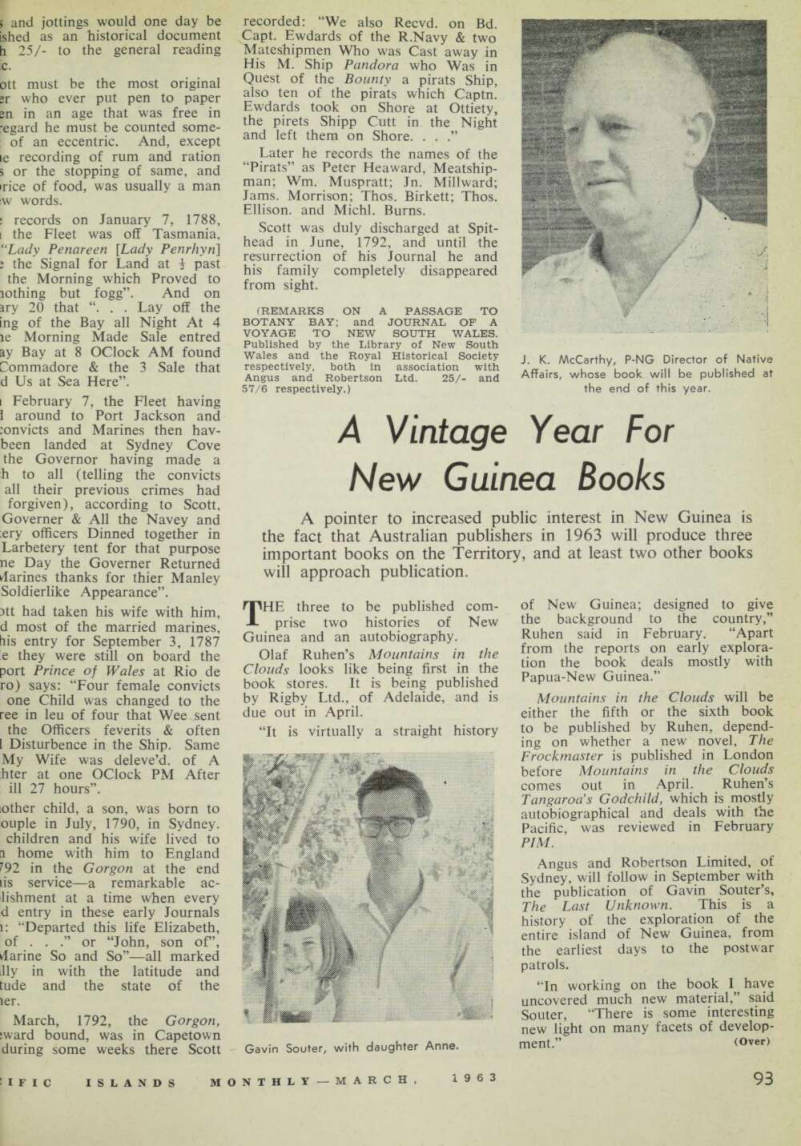
J. K. McCarthy, P-NG Director of Native Affairs, whose book will be published at the end of this year.