Austrians' Discovery
p. 91 · Read in the full issue
Solomon Islands Lived Up To Their Name After Austrians' Discovery
By R. A. Lever
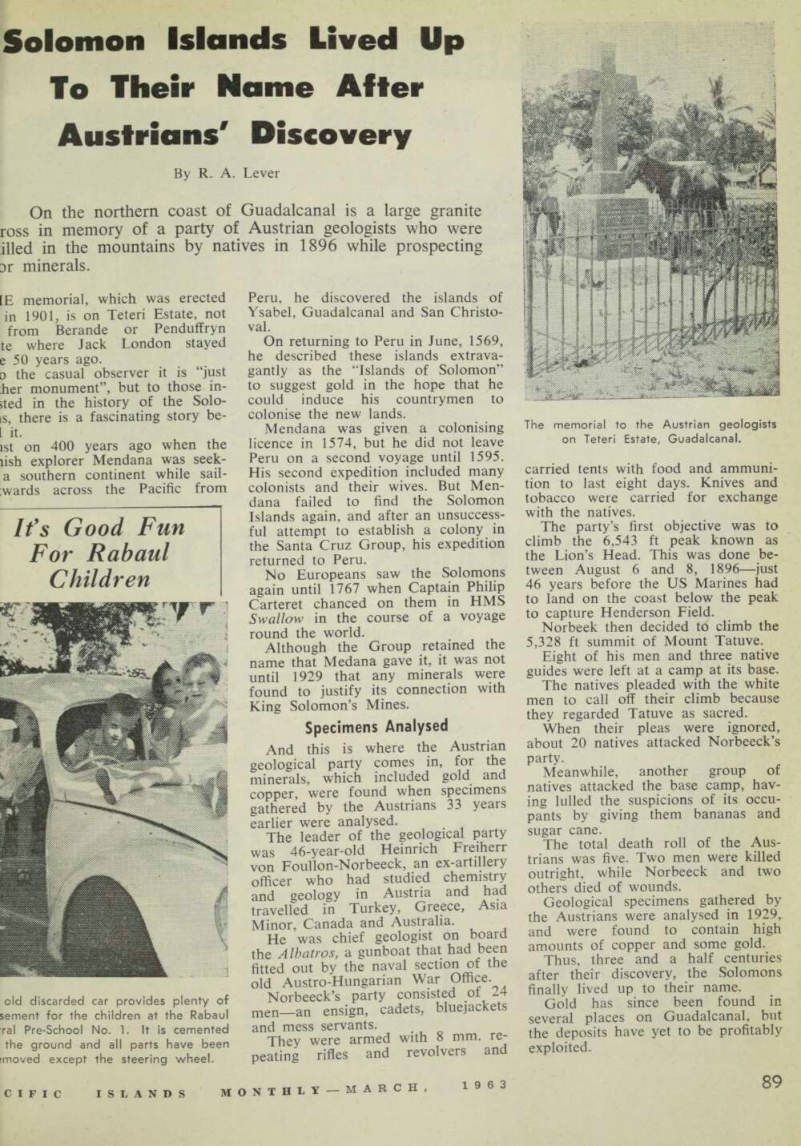
On the northern coast of Guadalcanal is a large granite ross in memory of a party of Austrian geologists who were filed in the mountains by natives in 1896 while prospecting Dr minerals.
IE memorial, which was erected in 1901, is on Teteri Estate, not from Berande or Penduffryn te where Jack London stayed e 50 years ago. o the casual observer it is “just her monument”, but to those in sted in the history of the Solo is, there is a fascinating story be [ it. ist on 400 years ago when the lish explorer Mendana was seek a southern continent while sail ;wards across the Pacific from
Peru, he discovered the islands of Ysabel, Guadalcanal and San Christo val.
On returning to Peru in June, 1569, he described these islands extrava gantly as the “Islands of Solomon” to suggest gold in the hope that he could induce his countrymen to colonise the new lands.
Mendana was given a colonising licence in 1574, but he did not leave Peru on a second voyage until 1595.
His second expedition included many colonists and their wives. But Men dana failed to find the Solomon Islands again, and after an unsuccess ful attempt to establish a colony in the Santa Cruz Group, his expedition returned to Peru.
No Europeans saw the Solomons again until 1767 when Captain Philip Carteret chanced on them in HMS Swallow in the course of a voyage round the world.
Although the Group retained the name that Medana gave it, it was not until 1929 that any minerals were found to justify its connection with King Solomon’s Mines.
Specimens Analysed
And this is where the Austrian geological party comes in, for the minerals, which included gold and copper, were found when specimens gathered by the Austrians 33 years earlier were analysed.
The leader of the geological party was 46-year-old Heinrich Freiherr von Foullon-Norbeeck, an ex-artillery officer who had studied chemistry and geology in Austria and had travelled in Turkey, Greece, Asia Minor, Canada and Australia.
He was chief geologist on board the Albatros, a gunboat that had been fitted out by the naval section of the old Austro-Hungarian War Office.
Norbeeck’s party consisted of 24 men —an ensign, cadets, bluejackets and mess servants.
They were armed with 8 mm. re peating rifles and revolvers and
carried tents with food and ammuni tion to last eight days. Knives and tobacco were carried for exchange with the natives.
The party’s first objective was to climb the 6,543 ft peak known as the Lion’s Head. This was done be tween August 6 and 8, 1896—just 46 years before the US Marines had to land on the coast below the peak to capture Henderson Field.
Norbeek then decided to climb the 5,328 ft summit of Mount Tatuve.
Eight of his men and three native guides were left at a camp at its base.
The natives pleaded with the white men to call off their climb because they regarded Tatuve as sacred.
When their pleas were ignored, about 20 natives attacked Norbeeck’s party.
Meanwhile, another group of natives attacked the base camp, hav ing lulled the suspicions of its occu pants by giving them bananas and sugar cane.
The total death roll of the Aus trians was five. Two men were killed outright, while Norbeeck and two others died of wounds.
Geological specimens gathered by the Austrians were analysed in 1929, and were found to contain high amounts of copper and some gold.
Thus, three and a half centuries after their discovery, the Solomons finally lived up to their name.
Gold has since been found in several places on Guadalcanal, but the deposits have yet to be profitably exploited.
The memorial to the Austrian geologists on Teteri Estate, Guadalcanal.