The Polynesian Past?
pp. 94-95 · Read in the full issue
Are These Rocks A Key To The Polynesian Past?
By Eugene Ressencourt
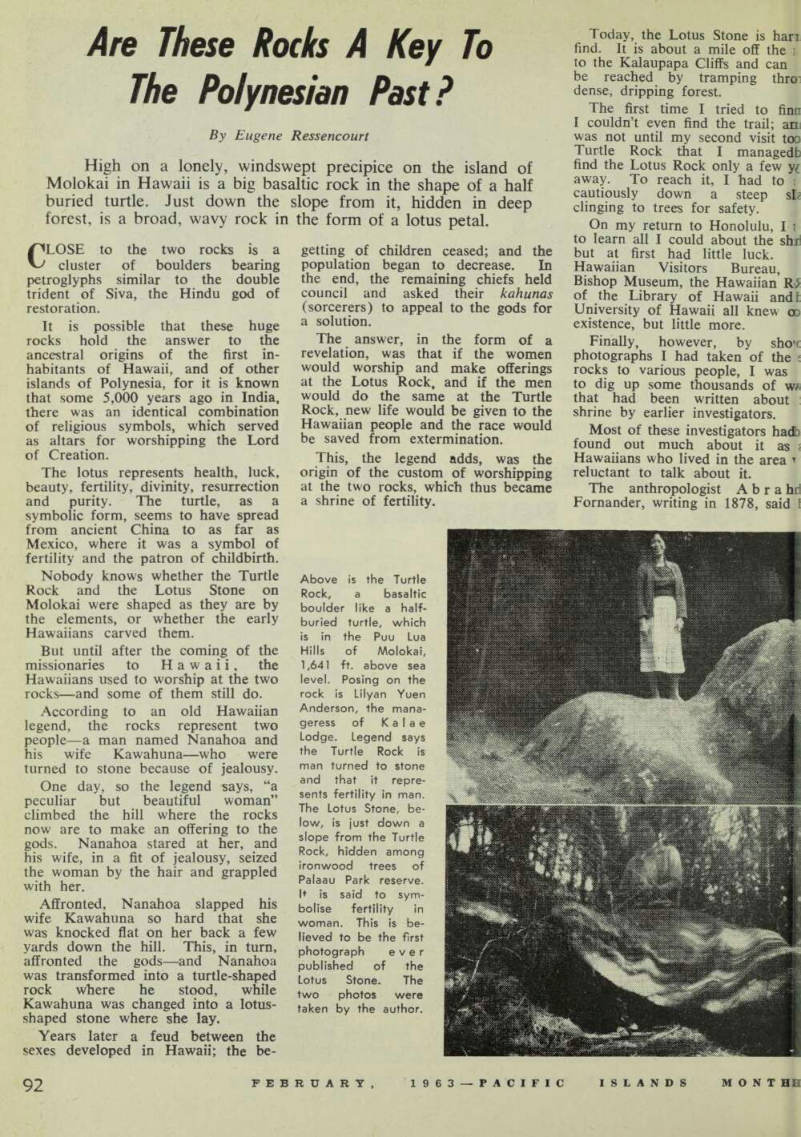
High on a lonely, windswept precipice on the island of Molokai in Hawaii is a big basaltic rock in the shape of a half buried turtle. Just down the slope from it, hidden in deep forest, is a broad, wavy rock in the form of a lotus petal.
CLOSE to the two rocks is a cluster of boulders bearing petroglyphs similar to the double trident of Siva, the Hindu god of restoration.
It is possible that these huge rocks hold the answer to the ancestral origins of the first in habitants of Hawaii, and of other islands of Polynesia, for it is known that some 5,000 years ago in India, there was an identical combination of religious symbols, which served as altars for worshipping the Lord of Creation.
The lotus represents health, luck, beauty, fertility, divinity, resurrection and purity. The turtle, as a symbolic form, seems to have spread from ancient China to as far as Mexico, where it was a symbol of fertility and the patron of childbirth.
Nobody knows whether the Turtle Rock and the Lotus Stone on Molokai were shaped as they are by the elements, or whether the early Hawaiians carved them.
But until after the coming of the missionaries to Hawaii, the Hawaiians used to worship at the two rocks—and some of them still do.
According to an old Hawaiian legend, the rocks represent two people—a man named Nanahoa and his wife Kawahuna—who were turned to stone because of jealousy.
One day, so the legend says, “a peculiar but beautiful woman” climbed the hill where the rocks now are to make an offering to the gods. Nanahoa stared at her, and his wife, in a fit of jealousy, seized the woman by the hair and grappled with her.
Affronted, Nanahoa slapped his wife Kawahuna so hard that she was knocked flat on her back a few yards down the hill. This, in turn, affronted the gods—and Nanahoa was transformed into a turtle-shaped rock where he stood, while Kawahuna was changed into a lotus shaped stone where she lay.
Years later a feud between the sexes developed in Hawaii; the be
getting of children ceased; and the population began to decrease. In the end, the remaining chiefs held council and asked their kahunas (sorcerers) to appeal to the gods for a solution.
The answer, in the form of a revelation, was that if the women would worship and make offerings at the Lotus Rock, and if the men would do the same at the Turtle Rock, new life would be given to the Hawaiian people and the race would be saved from extermination.
This, the legend adds, was the origin of the custom of worshipping at the two rocks, which thus became a shrine of fertility.
Today, the Lotus Stone is harij find. It is about a mile off the : to the Kalaupapa Cliffs and can be reached by tramping throi dense, dripping forest.
The first time I tried to fine I couldn’t even find the trail; am was not until my second visit too Turtle Rock that I managedb find the Lotus Rock only a few yt away. To reach it, I had to i cautiously down a steep site clinging to trees for safety.
On my return to Honolulu, I \ to learn all I could about the shri but at first had little luck.
Hawaiian Visitors Bureau, Bishop Museum, the Hawaiian R£ of the Library of Hawaii and fc University of Hawaii all knew oo existence, but little more.
Finally, however, by sho’C photographs I had taken of the e rocks to various people, I was to dig up some thousands of wjj that had been written about j shrine by earlier investigators.
Most of these investigators hadb found out much about it as Hawaiians who lived in the area t reluctant to talk about it.
The anthropologist Abr a hr Fornander, writing in 1878, said 1
Above is the Turtle Rock, a basaltic boulder like a half buried turtle, which is in the Puu Lua Hills of Molokai, 1,641 ft. above sea level. Posing on the rock is Lilyan Yuen Anderson, the mana geress of Kalae Lodge. Legend says the Turtle Rock is man turned to stone and that it repre sents fertility in man.
The Lotus Stone, be low, is just down a slope from the Turtle Rock, hidden among ironwood trees of Palaau Park reserve.
It is said to sym bolise fertility in woman. This is be lieved to be the first photograph ever published of the Lotus Stone. The two photos were taken by the author.
0 double tridents on a large stone ar the Turtle Rock suggested a [tural and historical bond between iwaii and India, and most other :ly anthropologists seemed to go »ng with this theory.
But when I discussed this idea th Dr. Kenneth Emory, the Bishop jseum’s eminent anthropologist, he d it might be incautious to assume it cultural memories and skills >uld live through some 5,000 years 1 be carried on in gradual migra ds through south-east Asia and ►m island to island across the cific.
However, he did suggest that the ■ly Hawaiians and other Poly- Hans could have thought up lilar ideas and skills of their own.
Whatever the truth of the matter a complex of mystery, tabu, fear, ifusion and silence surrounds the ine. Some say the site is haunted; ne that the entire island of )lokai is haunted. 3ne of my informants told me t an earlier investigator did not a natural death —that he met h an accident. \nother, when I developed an xplicable stomach ache which ted several days during my own estigations, told me an old story >ut Molakai’s Poison God.
A third, a Molokai resident, told me she feels a strange presence when she visits the site, that it frightens her, and that her mother has warned her not to go there any more.
But it is obvious that some visitors have not been deterred by such stories for they have left their names or initials scratched on the Turtle Rock.
Because of this, the Division of State Parks has prepared a notice saying: “WARNING: It is rumoured that persons who have defaced this rock have become barren. Such action also breaks Regulation I and is subject to punishment provided by law”.
Meanwhile, the Hawaii Historical Society is thinking of setting up a memorial plaque at the site, and the Division of State Parks has it on their agenda for reinvestigation and maintenance.
I have also suggested to the Hawaii Visitors Bureau that they set up a marker so that visitors to Molokai will know where to look for the shrine, for Hawaii’s burgeoning tourist industry is beginning to remember “Molokai, the Forgotten Island”, for its own fascination and charm.
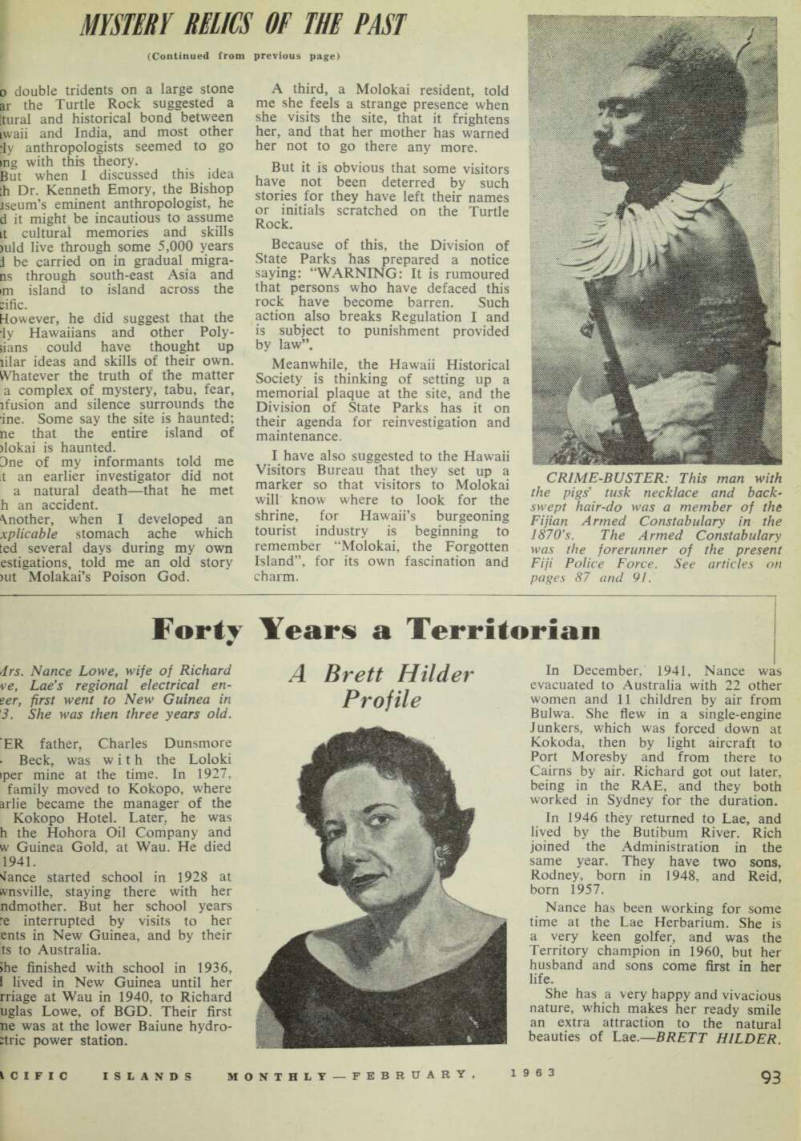
CRIME-BUSTER: This man with the pigs’ tusk necklace and back swept hair-do was a member of the Fijian Armed Constabulary in the 1870’s. The Armed Constabulary was the forerunner of the present Fiji Police Force. See articles on pages 87 and 91.