Fuzzy Haloes Are "Out"
p. 93 · Read in the full issue
For Fiji's Policemen
Photographs and text by Rob Wright.
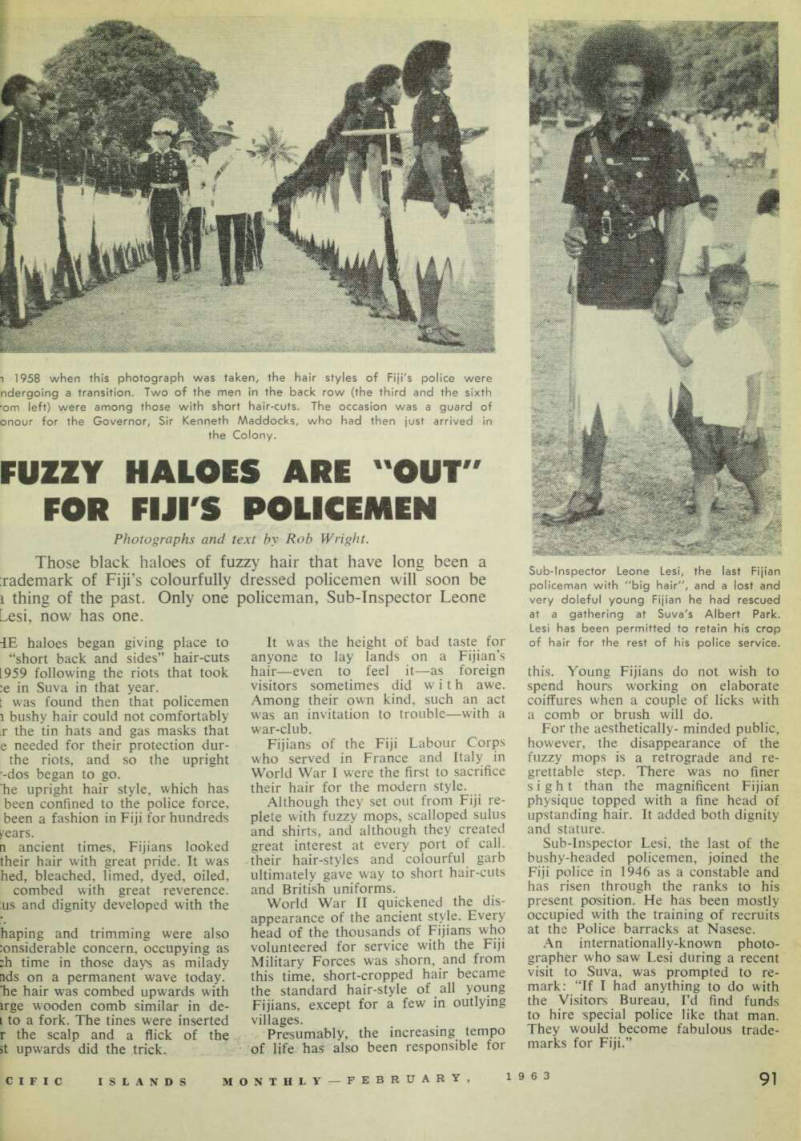
Those black haloes of fuzzy hair that have long been a ;rademark of Fiji’s colourfully dressed policemen will soon be i thing of the past. Only one policeman, Sub-Inspector Leone Lesi, now has one.
IE haloes began giving place to “short back and sides” hair-cuts [959 following the riots that took ce in Suva in that year, t was found then that policemen i bushy hair could not comfortably j the tin hats and gas masks that e needed for their protection dur the riots, and so the upright •-dos began to go.
'he upright hair style, which has been confined to the police force, been a fashion in Fiji for hundreds pears. ti ancient times, Fijians looked their hair with great pride. It was hed, bleached, limed, dyed, oiled, combed with great reverence, us and dignity developed with the haping and trimming were also considerable concern, occupying as :h time in those days as milady ads on a permanent wave today.
Tie hair was combed upwards with trge wooden comb similar in de i to a fork. The tines were inserted r the scalp and a flick of the 5t upwards did the trick.
It was the height of bad taste for anyone to lay lands on a Fijian’s hair—even to feel it—as foreign visitors sometimes did with awe.
Among their own kind, such an act was an invitation to trouble—with a war-club.
Fijians of the Fiji Labour Corps who served in France and Italy in World War I were the first to sacrifice their hair for the modern style, Although they set out from Fiji re plete with fuzzy mops, scalloped sulus and shirts, and although they created great interest at every port of call, their hair-styles and colourful garb ultimately gave way to short hair-cuts and British uniforms, World War II quickened the dis appearance of the ancient style. Every head of the thousands of Fijians who volunteered for service with the Fiji Military Forces was shorn, and from this time, short-cropped hair became the standard hair-style of all young Fijians, except for a few in outlying villages.
Presumably, the increasing tempo of life has also been responsible for
this. Young Fijians do not wish to spend hours working on elaborate coiffures when a couple of licks with a comb or brush will do.
For the aesthetically- minded public, however, the disappearance of the fuzzy mops is a retrograde and re grettable step. There was no finer sight than the magnificent Fijian physique topped with a fine head of upstanding hair. It added both dignity and stature.
Sub-Inspector Lesi, the last of the bushy-headed policemen, joined the Fiji police in 1946 as a constable and has risen through the ranks to his present position. He has been mostly occupied with the training of recruits at the Police barracks at Nasese.
An internationally-known photo grapher who saw Lesi during a recent visit to Suva, was prompted to re mark: “If I had anything to do with the Visitors Bureau, I’d find funds to hire special police like that man.
They would become fabulous trade marks for Fiji.”
[?] 1958 when this photograph was taken, the hair styles of Fiji's police were ndergoing a transition. Two of the men in the back row (the third and the sixth [?]om left) were among those with short hair-cuts. The occasion was a guard of onour for the Governor, Sir Kenneth Maddocks, who had then just arrived in the Colony.
Sub-Inspector Leone Lesi, the last Fijian policeman with "big hair", and a lost and very doleful young Fijian he had rescued at a gathering at Suva's Albert Park.
Lesi has been permitted to retain his crop of hair for the rest of his police service.