For Vanikoro
p. 67 · Read in the full issue
Five Years Left
Kauri Industry
The export of kauri from Vani koro in the Southern Solomons will cease in about five years, according to Mr. Reece Discombe, of Vila, New Hebrides, who visited the island recently.
MR. DISCOMBE says that by about 1968 the Kauri Timber Company, of Melbourne, which has the timber-cutting rights on the island, will have cut out most of the stands of kauri. However, he believes other hardwoods on the island could be exploited com mercially.
Kauri has been exported from Vanikoro since 1914 when a New Zealand company began operations there. The Melbourne company acquired the rights in 1923.
At present, about 2i million feet of kauri logs are exported each year to Australia. The straighter logs go to Brisbane as “peelers” for the making of plywood. The others go to Melbourne for use in the building industry.
The logs are shipped from Vani koro about four times a year in ships of the Swedish Australia-West Pacific Line. The last shipment, of about 610,000 ft, was exported in December. About 70,000 ft were peelers.
The Kauri Timber Company’s headquarters at Vanikoro are at Peu, on the southern side of the island, opposite a reef where La Perouse’s
ships Boussole and Astrolabe were wrecked in 1788.
The present manager is Mr. Bill Powell, an Australian, who has been working at Vanikoro for seven or eight years. His wife Nell is the only European woman on the island.
Nine or 10 other Australians and 150 to 200 Santa Cruz Group natives on two-year contracts are employed in timber-getting, which is the island’s only industry.
The native population of Vani koro has dwindled to about 100, compared with about 3,500 when Captain Peter Dillon found the first relics of La Perouse’s ships in 1827.
These natives are not commercially
employed.
The only other residents of Vani koro are a Chinaman, who runs a store, and three Solomon Islanders, who work round the clock in the weather office. Vanikoro has about 300 inches of rain a year.
Twenty-four Anglican missionaries left Australia for Papua on MV Malaita in January. Before they took up their work as clergy, teachers and tradesmen, they attended a conference at Dogura which was organised by the retiring Bishop of New Guinea, the Rt. Rev. P. N. W. Strong, who will be consecrated Archbishop of Brisbane in March.
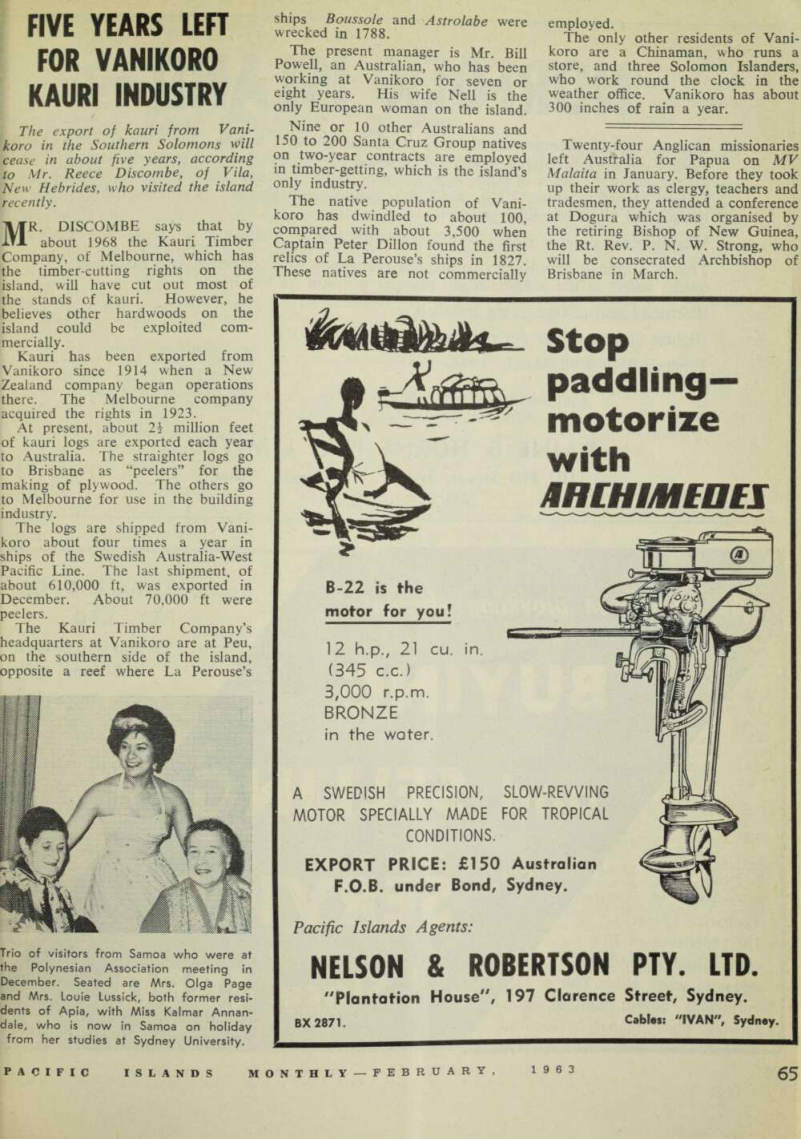
Trio of visitors from Samoa who were at the Polynesian Association meeting in December. Seated are Mrs. Olga Page and Mrs. Louie Lussick, both former resi dents of Apia, with Miss Kalmar Annan dale, who is now in Samoa on holiday from her studies at Sydney University.