Tahiti,
pp. 61-65 · Read in the full issue
Report On
1963
By Judy Tudor
The ancient sage who said that eauty was in the eye of the eholder might have had Tahiti 1 mind. No two people see the iland in exactly the same way. y'O one person, if it comes to that, tI can now ever see the island •eshly and for himself. Two hundred ;ars of fable, fact and fairy-story; avellers’ tale, poet’s praise, artist’s invas and the yearning of civilised lan for something that can never be is again, have created a complicated lystique about Tahiti that is apt to 2 a hurdle in itself.
Will you see it through Melville’s Will it be to you as it was ) Bligh—the “finest island in the odd?” Or as the means by which escape from convention, as it was >r Gauguin?
Will it, on the other hand, dis ipointingly turn out to be just lother island, with a pretty damp imate, a slight smell of drains and •me high-priced living?
The truth probably lies somewhere between. By 1963 there are no ;w discoveries to be made; only me old ones. And although the land itself is spectacular in its gged peaks and lush greenery, enery alone did not sustain the ble of Tahiti for 200 years, ssentially the charm of the place >w, as it was in Wallis’ day, is its ople.
Pure Tahitians are now almost as re as pure Hawaiians. The blood a dozen nations runs in their veins, t it is Polynesian insouciance that edominates. Life may be getting Dre real and more earnest for most ople but not for the Tahitian. At ist not yet.
Even local politics, that have had fir brief moments, come away down the list of national pastimes side dancing, singing, laughing and dding endlessly about in le truck on the 14,000 motor-scooters,
Sol ox motorised bicycles and plain bikes that the Tahitians are alleged to possess.
Their girls, in their brief cotton dresses of considerable chic or their beach-side abbreviated bikinis are a treat to the eye after the bundled up beauties of Samoa and Fiji who still take to the water in neck-toankle trimmings.
The fame of the Tahitian female is legendary and the 1963 model the end product, the direct descendant of all the fables, plus some modernday polish and sophistication, a Paris hair-style and her own grace and good-manners—has never been more attractive. , Yet an overwhelmingly large proportion of the people who visit Tahiti today are of the look-butdon t-touch variety. They come in
thousands, but usually as middle-aged to elderly couples, hung around with cameras and light-meters, determined to have full value from their excursion into the enchanted South Seas—yet foredoomed to only a vicarious sampling. To these people who, in the mass, must inevitably have a pro found effect on Tahiti, the local Tahitians, separated by language “,I.Tf 01 ?’ f t orm 3 . tantalising and colourful background, but provide C( i nta ?i s ' , , fl . Llke flocks of self-possessed butter fl ?’ acc o™P amed by • heir f and boy-friends, the girls of Tahiti t s e P 1^ 8 * 116 ? 1 ho * els eacl J night. There, for the price of a local beer, while the band keeps playing they fling themselves into rock ’n roll, le twister or Tahitian versions of South American stepping with such vim and pleasure that it leaves the
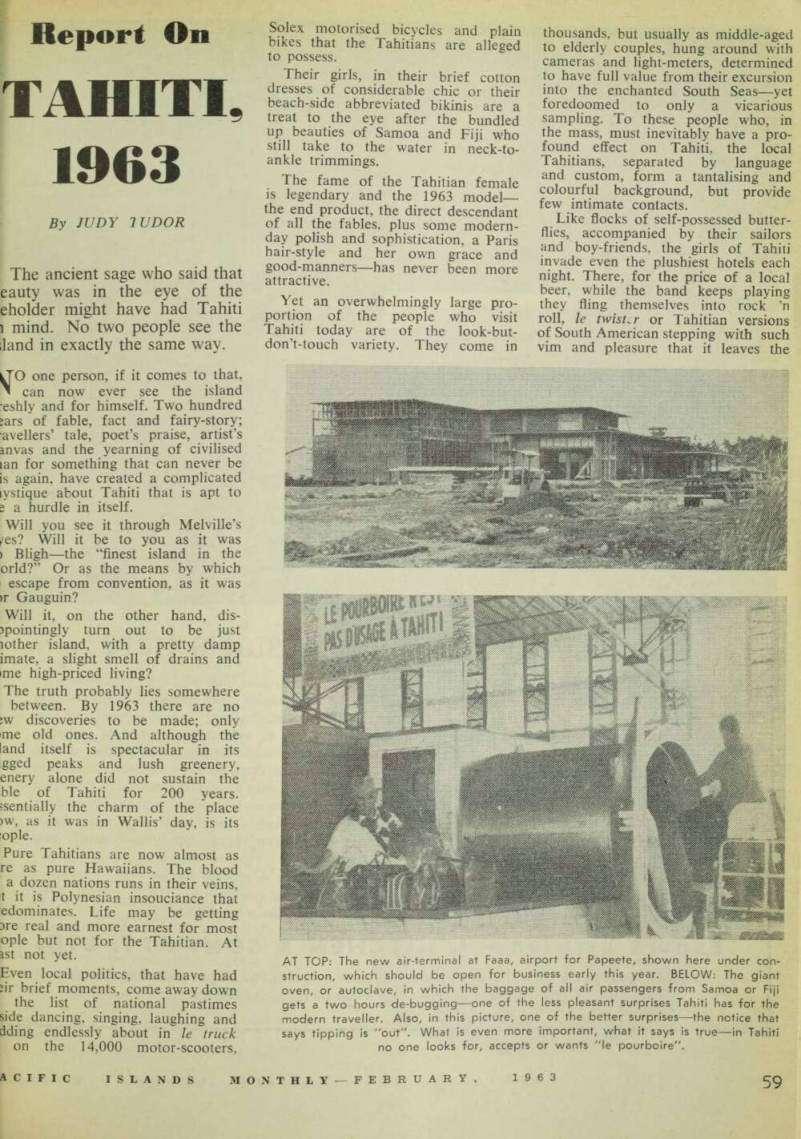
AT TOP: The new air-terminal at Faaa, airport for Papeete, shown here under con struction, which should be open for business early this year. BELOW: The giant oven, or autoclave, in which the baggage of all air passengers from Samoa or Fiji gets a two hours de-bugging —one of the less pleasant surprises Tahiti has for the modern traveller. Also, in this picture, one of the better surprises—the notice that says tipping is "out". What is even more important, what it says is true —in Tahiti no one looks for, accepts or wants "le pourboire".
average male tourist admiring but dumbfounded and his female marriage partner feeling too pale, flat-footed, over-dressed and far too old. ★ But if the majority of visitors are creating a new concept of Tahitian adventure there is still some of the old kind left. One day in December [ was standing in the queue in Papeete’s new and modern, Paris -1960 type post-office. In front of me vas one large, young American with he first-week stage of a beard on lis face, the inevitable rubber thongs, ;oloured shirt and washed-out jeans fiat looked as though he’d drawn hem on and then been inflated in dde them.
Beside him was a small version )f the same thing.
“How you doing?” asked the small American.
“Just fine, said the large one. “Just ine.” Then in a slightly lowered roice: “Been here just a week. I’m iving with two girls, at a place about 5 miles out.” ‘Two?” asked the small man. “Is t costing much?”
“It’s not costing a thing—except naybe 200 francs every couple of lays for food.”
“Man, you’ve sure got it made,” aid his admiring friend. “Will you ie staying long?”
“Long? I tell you, the police are □re going have to kick me out when ie time comes and then I’ll be com ig right back. I’m never going back p the States—boy, I tell you, that’s a ick, sick country. I’ve lived every where—London, Spain, Paris—just very where. But I’ve never been appy until this last week.”
That was December. It would be iteresting to know how this latter ay Gauguin is faring now, two lonths later. * The decision of the French Admin rtration to replace the phosphate in ustry, which is now coming to an nd, with tourism has not been with ut its local critics, who see in it the ursting of the fragile bubble of pmance that has surrounded life in ahiti for so long. Perhaps even lore than the idea of tourism itself 5 the size of the operation which he Administration planned.
About 700 tourists visited Tahiti i 1957; in 1961, the first year of ;t operations at the new airport at aaa, there were 8,000. It was calcu ated that there would be 15,000 in
1962 and 40,000 in 1965. (This ex cludes cruise-ship and transient ship passengers).
So far, the estimates have been proving wrong—through no fault of the French. There were 10,000 tourists in 1962, about a third less than expected and until there is a move in international air services in and out of Tahiti the figure can’t improve very much.
The 1962 figure was calculated on an assumption that there would be one aircraft arriving each day. This has not come about, mainly because Qantas was refused permission to route some of its Sydney-U.S. ser
vices through Tahiti; and because TEAL is still running only a weekly service, has not turned over to jet aircraft, or extended its services, as expected, to Honolulu or the North American Pacific Coast.
Nonetheless, in spite of the short fall in numbers last year, tourism has already made a tremendous im pact on life in Tahiti and the nearer outer islands of French Polynesia.
Papeete, although it still retains much of its old grubby “atmosphere” is expanding on three sides; elegant small shops, that wouldn’t disgrace the Champs Elysees are wedged in between the traditional Chinese estab
lishments of Oriental confusion, while other Chinese merchants have branched out into departmental Stores and supermarkets.
I No Pacific Islands town is so well served with restaurants or can pro duce such a variety of good food and drink. Between 1959 and 1962 the rate of hotel growth was phenomenal and at the same time inyone with spare beach side land lias cashed in on the boom by build hg thatched bungalows for rental.
Papeete airport, talked about for fears, became a reality in 1960 and et operational in 1961—a 12,000 ft ibbon of cement and bitumen along vhat was once coastal lagoon.
Two-hour De-bugging
A new terminal to match it, which pill have every facility for processing Passengers and every comfort that hey could desire, is now nearing ompletion.
The present terminal—which you each by crossing the runway—was uilt when French Polynesia had one mall flying-boat to its name and unneling incoming passengers from ;t aircraft through it is about on a ar with draining the Amazon River irough a one-inch hose pipe.
This, coupled with the compulsory imigation of the baggage of travellers 'ho have been misguided enough to rrive from Samoa or Fiji, is one f the least pleasurable facets of avel in the whole of the Pacific.
French Polynesia is free from linoceros beetle pest and very natur lly wishes to keep it out of local )conuts. Its main line of defence to fumigate the baggage of every r passenger who arrives from afuna or Nadi and this is done in huge contraption that looks a cross ;tween a hospital autoclave and an /en from Belsen.
The process takes about two hours id this after a long night flight, plus e time it takes to wind through e terminal for health. Customs and imigration checks, is guaranteed to ake the most placid tourist wish he id gone to Europe instead.
The necessity for the whole per rmance is kept a dark secret until e plane has actually landed, when e hostess breaks it to customers ho are already standing in the sles waiting for the steps to be put
in place. Before they have registered the fact that there actually is to be a two hours delay before they are let loose in Tahiti, they are already off the plane and in the ever-loving arms of Tahiti officials who are certainly hand-picked for charm and courtesy.
Ninety per cent, of passengers arriving thus have never heard of a rhinoceros beetle and see no reason for the fuss. The 10 per cent, who
have are merely left to ponder on the strange ways of officialdom.
Western Samoa, which has had rhino beetles better and longer than anyone, takes no particular precau tions; Fiji, which is trying to con fine them to present areas of infesta tion, assumes that they couldn’t get in by air but requires ships from a beetle-infested port to stand off from the wharf during hours of darkness.
Tahiti, on the other hand, allows ships that have come direct from Suva, which is beetle infested, to stand at the Papeete wharf as long as they like, concentrating their efforts on de-bugging touri s t s’ baggage.