Tonga Tourist is
pp. 63-67 · Read in the full issue

Sysneysider Goes Walkabout
Tonga Tourist is Not Amused
Tonga like most of the islands of the Pacific is attracted to the tourist dollar—but it would like to have it without the tourists, who, it is felt in high places, might “spoil the people”.
I T present the Tongan fears are * groundless. There is little to muse the tourist in Tonga and virtu ly none of the facilities that such aces as Fiji and Tahiti are now ixious to supply to visitors.
The energetic caller can see all of ongatapu’s sights in a day the *ove where the bats hang head first om the trees in rows, the blow- Dles, the haamonga, the tombs of e kings, the Queen’s palace on the •reshore and even “Captain Cook’s rtoise”.
There is no swimming pool, staurant, coffee or tea rooms and e only hotel, Beach House, is un :ensed and unpublicised.
Beach House, like just about every ing else in Tonga, is government vned, but leased by Fiji Airways hich operates the once weekly air rvice from Suva, and sub-let to Mrs. ilia Riechelmann, who runs it.
How old it is would be hard to dge but its architecture is distinctly id-Victorian, South Seas Colonial ith verandahs and dark interior oms, push-out shutters held up by Mens, and many additions that have curred from time to time especially
in the way of bathrooms and the usual offices. It has eight bedrooms none of them singles and sharing is the general procedure, like it or not.
With thin matchlining for partitions, Beach House gets a two-sleeping pill rating in my private hotel grading list—zero being my bed, in my own room, in my own house, in Sydney.
During the once-fortnightly period when Fiji Airways remains in Nukua lofa from Thursday noon till Saturday, Beach House seethes as much as an eight bedroom establishment can ever seethe, and few of the nocturnal habits of guests can remain secret from the other guests for very long.
On these nights there seems only a breath space between the late-comers who stamp in in size 10 field boots, full of cheer and Yacht Club beer at 2 a.m., and the early risers who tune in to the BBC on their private tran sistor radios at 6 a.m.
In recent months Nukualofa has had an influx of Americans observing the effect of their various atomic blasts in the Pacific. All but a handful have now departed, the remaining clutch being scientists of the Lockheed Cor poration who have found some
radiation band established somewhere in space above Tonga peculiarly in teresting.
Mrs. Riechelmann runs Beach House as a civic duty and not be cause she wants to. She has been try ing unsuccessfully to interest some one else in the venture so she can retire with honour, but so far there are no takers.
Now that Tonga’s so-called tourist hotel venture has fallen through, it looks as though she will be stuck with it for some time yet. Local residents point out the large area on the sea-front, with its heaps of build ing sand, as the place where the tourist hotel was going to be, but now isn’t. It was to be a joint enterprise between the Tongan Government and an American who married a local girl and who is alleged to be a millionaire.
What caused the rift in the lute is unknown, although local opinion is that the Government imposed so many restrictions that not even a millionaire would have it on.
So, for the time being, the hotel joins the tuna industry, decimal coin age and numerous other enterprises that are on the pad but not yet ready for launching. * * *
Public Image
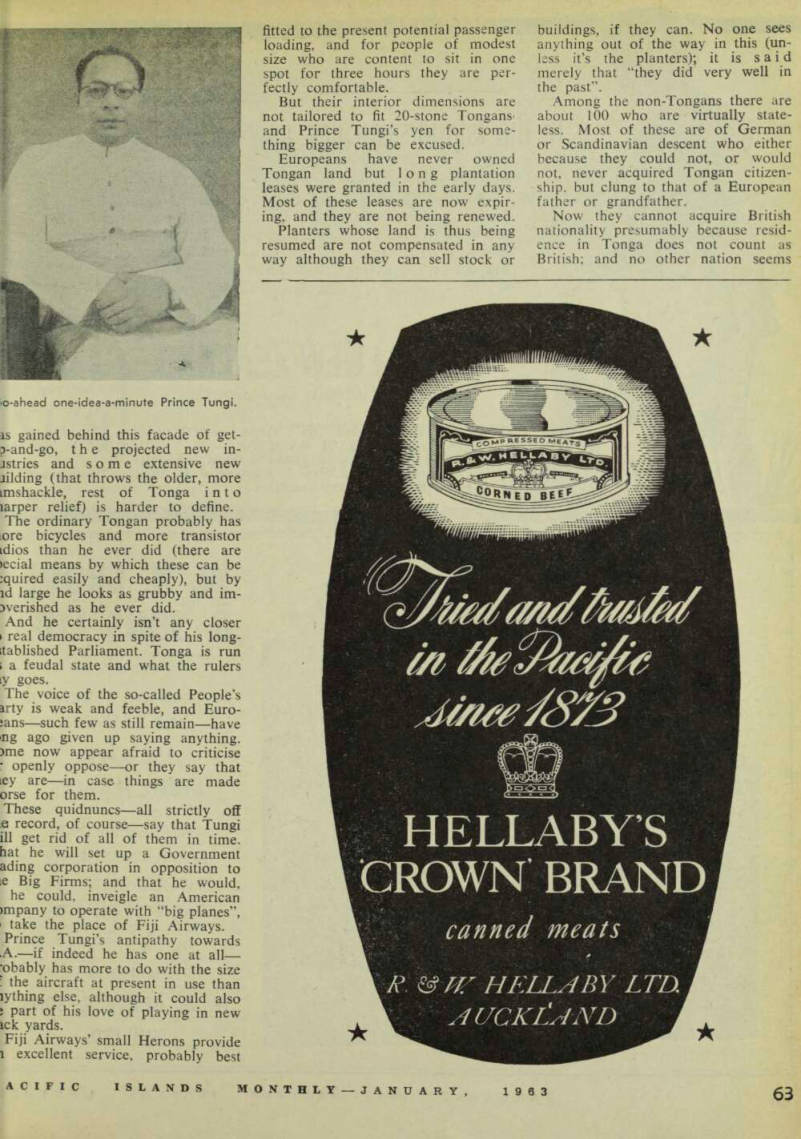
Tonga is often presented to the world through the public image of go-ahead one-idea-a-minute, Prince Tungi—who is Premier, Minister of Foreign Affairs, Minister of Agri culture, Minister for Education, Min isterial head of the Broadcasting, Telegraph and Telephone Department, Chairman of the Copra Board and Produce Board, etc.
How much the ordinary Tongan
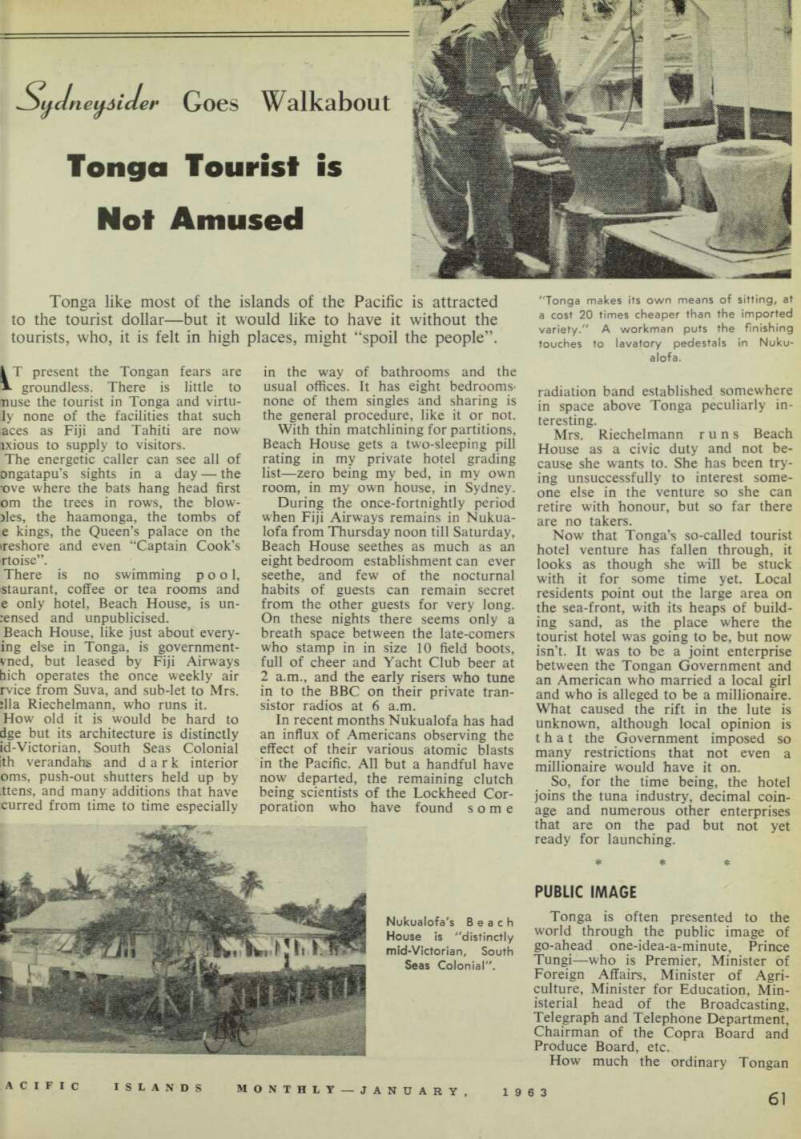
"Tonga makes its own means of sitting, at a cost 20 times cheaper than the imported variety." A workman puts the finishing touches to lavatory pedestals in Nuku alofa.
Nukualofa's Beach House is "distinctly mid-Victorian, South Seas Colonial".
is gained behind this facade of get p-and-go, the projected new in istries and some extensive new .hiding (that throws the older, more imshackle, rest of Tonga into larper relief) is harder to define.
The ordinary Tongan probably has ure bicycles and more transistor idios than he ever did (there are >ecial means by which these can be :quired easily and cheaply), but by id large he looks as grubby and im jverished as he ever did.
And he certainly isn’t any closer » real democracy in spite of his long itablished Parliament. Tonga is run i a feudal state and what the rulers ly goes.
The voice of the so-called People’s arty is weak and feeble, and Euro ;ans—such few as still remain—have mg ago given up saying anything. )me now appear afraid to criticise * openly oppose—or they say that iey are—in case things are made orse for them.
These quidnuncs—all strictly off e record, of course —say that Tungi ill get rid of all of them in time, hat he will set up a Government ading corporation in opposition to ie Big Firms; and that he would, he could, inveigle an American unpany to operate with “big planes”, i take the place of Fiji Airways.
Prince Tungi’s antipathy towards A.—if indeed he has one at all— •obably has more to do with the size I the aircraft at present in use than lything else, although it could also 5 part of his love of playing in new ick yards.
Fiji Airways’ small Herons provide i excellent service, probably best
fitted to the present potential passenger loading, and for people of modest size who are content to sit in one spot for three hours they are perfectly comfortable.
But their interior dimensions are not tailored to fit 20-stone Tongansand Prince Tungi’s yen for something bigger can be excused.
Europeans have never owned Tongan land but long plantation leases were granted in the early days.
Most of these leases are now expiring, and they are not being renewed.
Planters whose land is thus being resumed are not compensated in any way although they can sell stock or
buildings, if they can. No one sees anything out of the way in this (un less it’s the planters); it is sa i d merely that “they did very well in the past”.
Among the non-Tongans there are about 100 who are virtually state less. Most of these are of German or Scandinavian descent who either because they could not, or would not, never acquired Tongan citizen ship, but clung to that of a European father or grandfather, Now they cannot acquire British nationality presumably because resid ence in Tonga does not count as British; and no other nation seems
o-ahead one-idea-a-minute Prince Tungi.
icen to extend protection to them.
During the first war, those of 3erman parentage were prevented Tom carrying on business, but this lid not incline Germany towards idopting them when petitioned by he German-Tongans some years ater.
The Stateless 100 now are the concern of the British Consul in tonga who provides them with certificates of identification, instead )f passports, when they must travel nit of the Kingdom. * * *
Wild Your Own
A WHO environmental sanitation earn under the direction of a Filipino engineer, a Mr. Adan, is currently doing something about fongatapu’s water supplies.
They have got a pilot reticulated icheme going at Houma, on the vestern end of the south coast, and expect to complete the project with t 8 more village and school schemes jefore the end of 1963.
Flat Tongatapu has no streams, md depends for water on roof catch nent and, when this fails, from veils. Because of these patchy water conservation methods. Tongatapu lanitation is of the deep-pit latrine ype. Deep-pit latrines and deep veils add up to such endemic liseases as dysentery and typhoid and i former Medical Director was inally able to interest WHO in the )roblem in 1958.
Mr. Adan, a small man who looks even smaller amongst the mammoth fongans, but who has a great sense )f fun and twinkling bright eyes, eckons that if he can get a suf iciently reliable water supply to sub titute flushing toilets for the deep fit latrines, Tonga’s enteric-type liseases will be close to cured.
The cheapest and easiest means to his end would be the so-called lavatory—the hole in the loor with foot rests.
Nukualofa from the air, as seen from the seat of a Fiji Airways' Heron.
“But,” says Mr Adan, his brown eyes creased in laughter wrinkles, “the Tongans just don’t like to squat —they like to sit.”
His big problem at the moment is to give them the means of sitting at a cost 20 times cheaper than the imported lavatory pedestal and cistern, which is sold in Tonga at about £2B.
He has a team casting the pedestals in cement; the Works De partment provides the wooden seats, and the whole job works out at about 30 shillings. * ♦ ♦ Death in Tonga has almost as important a place as life. Tongans, like the Spaniards, are almost in a constant state of visible mourning for some family connection; remote or close, and consequently half of the population is clothed in black, a colour that does nothing for the Tongan complexion.
When Sisilia, wife of High Chief Kalaniuvalu, one-time Chairman of Parliament, died in the evening of November 29, the obsequies began at midnight. From then until 7 a.m., the massed vows of grieving friends and relatives rang out across Nukua lofa, powerful enough to penetrate into most dwellings and disturb all slumbers.
Tongan versions of Shall We Gather at the River, Onward Christian Soldiers, Home Sweet Home and innumerable unrecognis able hymns thundered across the landscape almost without pause, ris ing and swelling on the fitful breeze like some great mechanical organ.
If few Tongans slept that night, there were even fewer foreigners.
The funeral rites the following day all but denuded Government offices of their higher-ups; none could be got-at, or seen, even though the monthly Tofua was in for the day, with its usual quota of visiting businessmen.
The bereaved family is important and highly connected; one son is Ngaul Mo Tutulu, aide-de-camp to Queen Salote.