Territories TALK-TALK
pp. 55-61 · Read in the full issue
Whilst thumbing through some reference books the other day in an attempt to answer queries about the discovery of New Guinea, by whom and when, and the origin of some of the place-names, 1 came across a few interesting statements, which could have been facts, dealing with the island’s early history.
THF enquiries came from overseas.
They invariably do; because it seems that we as Aussies—as a gen eral run—couldn’t care less who dis covered New Guinea or whence the derivation of the various names.
We aren’t particularly concerned whether it was the Portuguese navi gator, Antonio d’Abreu, in 1512 or the Spanish governor of the Moluccas, Jorge de Menezes, in 1526 who made the discovery, or for that matter it could have been Billy Hughes in 1929, Eddie Ward in 1943 or Paul Hasluck a decade later. The majority of us are more concerned with the changing present or the problematical future.
However our culture being what it is, history does form a part. We don’t want to delay in gathering the
With Tolala
data and recording them. And we must make the facts available to the general public in such a manner that they are accessible so nobody has to delve into contradictory records in remote government departments.
There are “contradictory records” in the confusion as to the first dis coverer of New Guinea. Was it the Portuguese, d’Abreu in 1512, or the Spanish Governor of the Moluccas, who is described as Portuguese?
Was there any funny business in those days between Portugal and Spain as a result of the Treaty of Tordesillas, signed in 1494 between the two countries when they agreed to partition all newly-discovered land east and west, respectively, of the imaginary line drawn by Pope Alex ander VI, one hundred leagues west of the Azores?
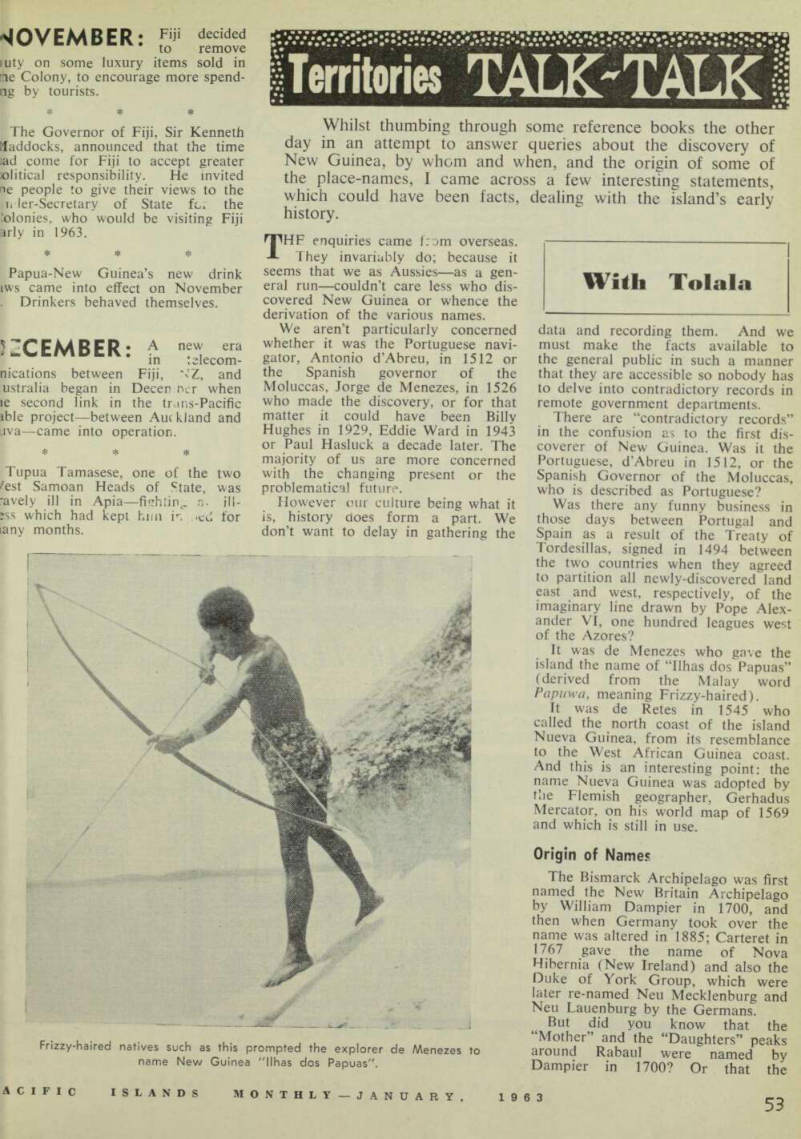
It was de Menezes who gave the island the name of “llhas dos Papuas” (derived from the Malay word Papuwa, meaning Frizzy-haired).
It was de Retes in 1545 who called the north coast of the island Nueva Guinea, from its resemblance to the West African Guinea coast.
And this is an interesting point: the name Nueva Guinea was adopted by the Flemish geographer, Gerhadus Mercator, on his world map of 1569 and which is still in use.
Origin of Names The Bismarck Archipelago was first named the New Britain Archipelago by William Dampier in 1700, and then when Germany took over the name was altered in 1885; Carteret in 1767 gave the name of Nova Hibernia (New Ireland) and also the Ouke of York Group, which were later re-named Neu Mecklenburg and Neu Lauenburg by the Germans.
But did you know that the “Mother” and the “Daughters” peaks around Rabaul were named by Dampier in 1700? Or that the
Frizzy-haired natives such as this prompted the explorer de Menezes to name New Guinea "llhas dos Papuas".
\bgarris, or Fead Island Group, was lamed after the whaler Abgarris in 822?
And that Tabar, Lihir, Tanga and 7 eni islands were discovered by Tas nan in 1643?
The Admiralty Group (Manus) is aid to have been discovered by Gri alva in 1537. He was afterwards nurdered by his mutinous crew. But vhence comes “Admiralty”? I do lot know.
Le Maire and Schouten in 1606 ighted them and called them a part if the “Twenty-Five Islands”. The lame could have been given by Car eret in 1767; he it was who named )jaul Sandwich Island after the First .ord of the Admiralty at that time. >jaul is the native name.
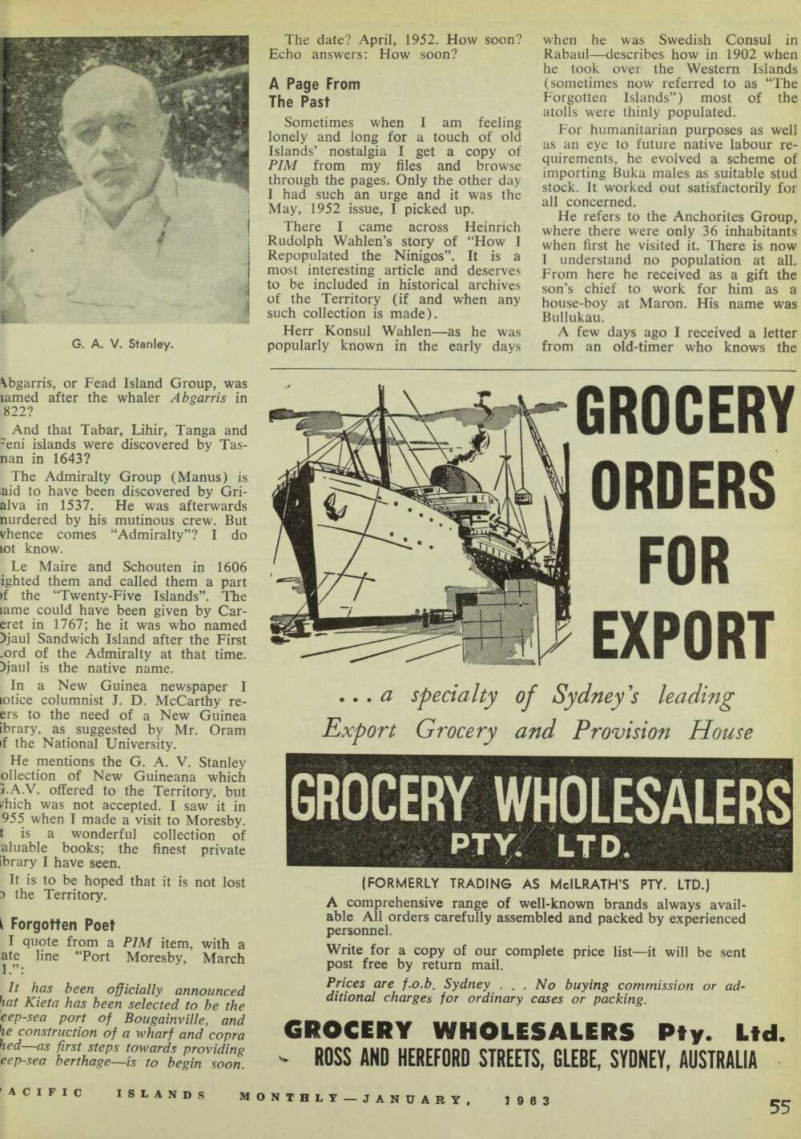
In a New Guinea newspaper I lotice columnist J. D. McCarthy re ers to the need of a New Guinea ibrary, as suggested by Mr. Oram •f the National University, He mentions the G. A. V. Stanley ollection of New Guineana which j.A.V. offered to the Territory, but /hich was not accepted. I saw it in 955 when I made a visit to Moresby, t is a wonderful collection of aluable books; the finest private ibrary I have seen.
It is to be hoped that it is not lost 3 the Territory.
i Forgotten Poet
I quote from a PIM item, with a ate line “Port Moresby, March 1”: It has been officially announced hat Kieta has been selected to be the eep-sea port of Bougainville, and he construction of a wharf and copra hed —as first steps towards providing eep-sea berthage—is to begin soon.
The date? April, 1952. How soon?
Echo answers: How soon?
A Page From The Past Sometimes when I am feeling lonely and long for a touch of old Islands’ nostalgia I get a copy of PIM from my files and browse through the pages. Only the other day I had such an urge and it was the May, 1952 issue, I picked up.
There I came across Heinrich Rudolph Wahlen’s story of “How I Repopulated the Ninigos”. It is a most interesting article and deserves to be included in historical archives of the Territory (if and when any such collection is made).
Herr Konsul Wahlen—as he was popularly known in the early days
when he was Swedish Consul in Rabaul—describes how in 1902 when he took over the Western Islands (sometimes now referred to as “The Forgotten Islands”) most of the atolls were thinly populated.
For humanitarian purposes as well as an eye to future native labour re quirements, he evolved a scheme of importing Buka males as suitable stud stock. It worked out satisfactorily for all concerned.
He refers to the Anchorites Group, where there were only 36 inhabitants when first he visited it. There is now I understand no population at all.
From here he received as a gift the son’s chief to work for him as a house-boy at Maron, His name was Bullukau.
A few days ago I received a letter from an old-timer who knows the
G. A. V. Stanley.
astern Islands well. He said that ahlen had written to him enquiring □ut this old retainer, and asking Ithere was anything he wanted.
Bullukau, with his wife Poni, are II on Maty Island (part of the Wes in Islands) so my scribe said, and was the last of the Anchorites.
Surely that is something worthy of :e. (Wasn’t it Fenimore Cooper 10 wrote a book about the Last of ' Mohicans?) My correspondent continued that lllukau’s eye-sight had been failing : he (the writer) had been able make arrangements with George aittaker for suitable eye-glasses to made and now Bullukau and his : e “have a new lease of life”. He is: “Bullukau must have been serv : whites for well over 50 years— ite a record, I’d think.”
And a propos of the “Forgotten ands” this correspondent adds that PHD spraying team has again ited Maty Island and sprayed the ive village houses a second time the course of the anti-malarial npaign.
Let’s hope now they become the les of Remembrance” instead of ! “Forgotten Isles”. le Bob Moody Having finished the book review ?es with Judy Tudor ( PIM , c., p. 93) I picked up my Satur n’s Sydney Morning Herald and, usual, turned to the back page 1 there saw the name “Shaw >ody, Robert”, amongst the deaths.
Phis rugged old pioneer, whose lures had gazed up at me from ' December PIM page and whom I 1 known so well in the B 4 days, 1 passed to his rest on November at Hall’s Creek, aged 75. lest peacefully, Bob. It is well de ved and there are many old New inea friends who will mourn your ising.
ose Peregrinating
is t was with a considerable degree interest I read the story from a . Hagen correspondent concern- N.G. Highlanders’ reaction to the id” Press {PIM, Dec., p. 9) from ich P-NG has been suffering. The •ritory has been suffering for too ny years at the hands of itinerant ters, especially from the Australian vspapers when New Guinea be nes world news. It is unnecessary me to say, “I told you so.” Most ders will recall that for some years v I have been emphasising this le danger which so many of these
sensational. “objective”, highlycoloured stories from the pens of itinerant special correspondents are to the Territory as a whole. lt’s welcome to learn that an appreciation of this danger and a proper evaluation of the articles have been recognised by a coterie of practical and progressive organisations centred in the Highlands, Undoubtedly they are a community capable of getting things done.
There are some wise heads amongst them—not the least of them Tom Ellis whose remarks hit the
target as efficiently as did his bombs in the last war.
My one regret is that this awaken ing did not take place years ago, be fore the bad impression had been made on the somewhat limited men tality of the Australian reader in re gard to NG affairs, and prior to the Afro-Asian bloc assuming such an influential force in UN.
However, better late than never, and here’s wishing them all success in their counter-propaganda campaign to put P-NG in its proper place in the sun and demonstrate some aspects
loyalty, not only to themselves, ut to the country which bred them.
Mightier Than
ne Sword"
I don’t want to be-labour the issue ut this matter of the Fourth Estate id the pen being mightier than the vord is naturally a topic very near my heart, having been connected ith the Press for nearly 60 years, hat is a long time in anybody’s life •an.
It was about two centuries ago lat the noted British statesman, Ed lund Burke, made his famous ref icnce to the Fourth Estate that here were Three Estates in Parlia ent” (the Lords Spiritual, the 3rds Temporal and the Commons) *ut in the Reporters’ Gallery yonder, ere sat a Fourth Estate more im irtant far than they all.”
That power has not diminished; in ct it has grown to unprecedented ©portions, as everyone knows.
In more recent years its sub liaries such as advertising agencies, iblic relations bureaux, radio, TV, ive become mammoth enterprises, ■ntrolling information, and catering r public requirements (which are often non-essential).
As a result the John Citizens, too any of whom have lost their indivi lal initiative owing to Welfare State nditions, and other people thinking r them, are more than ever suscep >le to high-pressure sales talk, lether it is buying things they don’t ally want, or believing fantastic )ries of racial discrimination in ;w Guinea, and of native unco erativeness.
A point, I think, which the High id folk (and all other P-NG folk 10 think along the same lines) ould realise is that the danger lies t so much with the individual re rter (usually easily identified by his y-line”) as with the executive who ids him out to get the story.
I have yet to find a top-level news per executive who permits the pub ation of a story which is contrary the paper’s policy, A good journalist writes what he is d to write. He is quite capable of lorting the same circumstances >m an entirely different angle: tried highlights here and there; a ange of nuance now and then; ig ring some events; emphasising iers.
So the counter-attack by the High iders will have to be directed ainst the top-level strata—the Es dishment—and not those working the lower level.
And when you bump the Upper
Strata . . . Oh, boy! You have a problem. It would even be difficult for a “Letter To The Editor” to be published about a truly controversial matter, which might be an embarrassment to the Establishment.
All this may sound unencouraging to these people who quite rightly want to rectify a wrong. And there is no doubt but a wrong has been done to them over the past years.
What I do want them to realise, however, are the problems with which they are faced.
Actually the problems should never have arisen, as the folk in P-NG know too well. We have done a good
job up there—officials, private enter prise and missions, Although at times there have been some differences of opinion, nothing particularly basic has been wrong, During the past decade there has been sniping from international on lookers, as a result of global anta gonism towards “colonialism”, and the Australian Press has undoubtedly supplied pegs upon which to hang Afro-Asian propaganda, It would not worry us too much except for the fact that that very word “propaganda” is one of the modern world’s greatest curses when it is not based on fundamental truths.