Castaways’ Letters
pp. 103-113 · Read in the full issue
Turn Up at Kadavu
Seven letters written by sur vivors of the Tongan yacht ‘I,aJ cepau’, which n vi\c d on South Minerva Reef in July, turned up in Fiji in November and were sent on to Tonga. Fijian women, fishing at Kadavu, found the letters and handed them to an employee of the Kadavu Timber Company, who in turn passed them over to the Commissioner, Eastern, Ratu K. K. T. Mara.
All the letters were written in uencil and were addressed to relatives and friends in Tonga.
Each bore the address, “Minerva Reef, 285 W of Ata Island".
The letters were written on September 9 and 10, about five weeks before the men were rescued by an RNZAF Sunderland Hying-boat.
When found, the letters were hound together with string. It was thought in Suva that they had been tied to a piece of wood or something else which would float. • See “Emotional Welcome Home for Tongan Castaways", p. 47.
jse nobody could get into trouble icking flowers in somebody else’s ;n. ; is seldom that a ship’s crew on ng a port looked so sad as the of the Cap Domingo when we Rarotonga disappear over the on.”
Runic Salvage: The 300-
schooner Gerard returned to ey early in November with its load of scrap from the British iter Runic. The 13,8 57-ton c ran aground on Middleton 440 miles north-east of Sydney ;bruary, 1961.
Frigate On Reef Hunt:
Royal Australian Navy frigate lS Gascoyne sailed from Sydney 2 end of October to inspect some efs, islands and island groups off lorth-east coast of Australia, e Minister for the Navy, Senator 3n, said the frigate would steam al of 6,500 miles on a reconnais : survey in the Coral Sea and the > of Papua and Carpentaria, r drographic work it would do in d the investigation of several fe reefs, which the Navy was not need should be on navigational s. The Gascoyne’s task would be e if they actually existed. The would also chart mountains be i the sea off the north-east coast astralia. ider the command of Lieutenant mander R. J. Rust, the Gascoyne
was due to return to Sydney on December 3.
• Mission Ship Aground:
The Melanesian Mission ship, Southern Cross, ran aground on the Alite Reef, between Malaita and Gela in the BSIP, on October 24. Accord ing to a mission spokesman at Auck land the captain reported there was no structural damage, and although salvage might take some time, it was expected to be successful.
The BSIP Government ships Coral Queen and Coral Princess and the mission ship Baddeley stood by in case the Southern Cross required help.
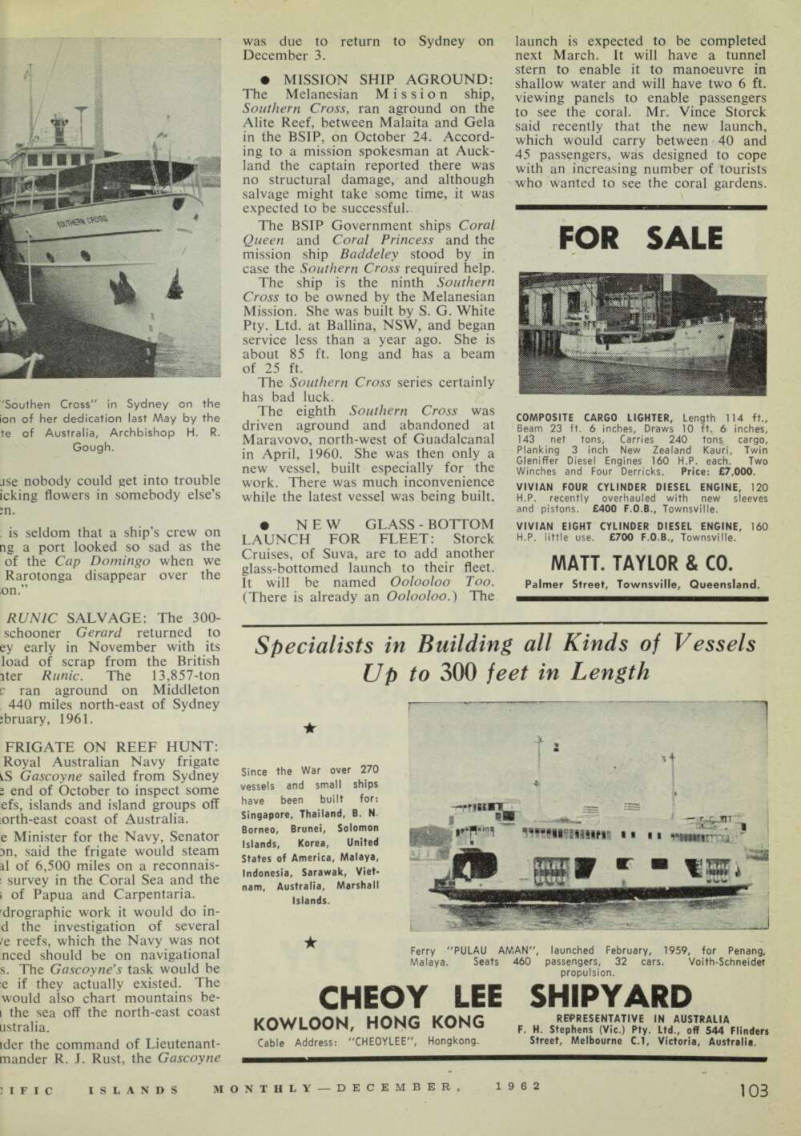
The ship is the ninth Southern Cross to be owned by the Melanesian Mission. She was built by S. G. White Pty. Ltd. at Ballina, NSW, and began service less than a year ago. She is about 85 ft. long and has a beam of 25 ft.
The Southern Cross series certainly has bad luck.
The eighth Southern Cross was driven aground and abandoned at Maravovo, north-west of Guadalcanal in April, 1960. She was then only a new vessel, built especially for the work. There was much inconvenience while the latest vessel was being built.
• New Glass - Bottom
Launch For Fleet: Storck
Cruises, of Suva, are to add another glass-bottomed launch to their fleet.
It will be named 00100100 Too. (There is already an Oolooloo.) The
launch is expected to be completed next March. It will have a tunnel stern to enable it to manoeuvre in shallow water and will have two 6 ft. viewing panels to enable passengers to see the coral. Mr. Vince Storck said recently that the new launch, which would carry between 40 and 45 passengers, was designed to cope with an increasing number of tourists who wanted to see the coral gardens.
[?]'Southern Cross" in Sydney on the [?]ion of her dedication last May by the [?]te of Australia, Archbishop H. R.
Gough.
New Japanese Fisher:
of the newest additions to the nese South Pacific fishing fleet ed in Suva in late October on her visit. She is the mother ship 0 Mam which was launched in and has a gross tonnage of 4.
BACK AGAIN: The French y’s “floating officers’ college” ne d’Arc will visit the Pacific n soon. The ship, escorted by the ette Victor Schoelcher, was due eave France in early November, two ships will call at the West es, Balboa, Callao (Peru), Tahiti, Wallis Islands, Noumea, Guam, gkong, Saigon, Bangkok, and mese ports. They were in Noumea er this year.
Kavieng Trader In
EST: An inquest began in Rabaul November 13 into the deaths of men who died from injuries >wing three explosions in the 70fuel tanker Kavieng Trader off coast of New Ireland in Septem he two men were the ship’s en ;er, Willy Lee, and.. Paul Moso, a iser. The Rabaul Coroner, Mr.
D’Connell, SM, conducted the in -st.
Tie skipper of the Kavieng Trader, »tain Frederick Charles Matthies, Rabaul, told the Coroner that the losion occurred while the ship was hored off the New Ireland coast. : crew was degassing and cleaning tanks after discharging a cargo of :01.
'aptain Matthies, whose face and ids are fire-scarred, said Willy Lee 1 handling a water hose which ick an electric light bulb on a lead pended above the main deck.
Three explosions and a fire fol lowed.
The ship’s owner, William Francis Carruthers, of Rabaul, said the clean ing and degassing procedures met the requirements of the Rabaul port authorities.
Other witnesses told how Captain Matthies, burned and half-blinded after the explosions, dived from the burning ship to rescue Lance Atkin son, a passenger, who was badly burned and fell into the sea.
9 Record Sounding: Thn
Royal Navy survey ship HMS Cook reported in November that she had measured the world’s greatest known ocean depth. In an undersea ravine
off the Philippine Islands, the ship re corded a depth of 6,297 fathoms, or nearly seven miles.
The new sounding is 263 fathoms deeper than the previous greatest known depth—in the Marianas Trench, north of Guam. The Cook’s discovery has been named the Cook Trench.
The survey ship will return to Fiji about December 17 to continue her survey of the islands.
• First Since The War:
The first passenger liner to visit Norfolk Island since the end of
For Research
WORK: The Tongan ocean - going tug "Hifofua", which has been hired by a US research team on radio-active fall-out, beside Vanua Wharf, Nukualofa, recently just before she left for duty. The plat form, which has been newly erected, will be used to send up balloons for checking weather in formation. —Photo: Tulua Bros.
Id War II dropped anchor in ade Bay on October 17. She the Wanganella, veteran of the i-Tasman. She was making a i-day cruise from Sydney to : olk Island and return, her heavy rain, Norfolk sparkled farm sunshine and most of the passengers landed at Cascade to make the most of a 12-hour le enterprising shopkeeper pro ! free transport to the shopping where tourists fell like locusts Norfolk’s ample supplies of >s, cameras, etc. long the Burnt Pine shopping ■e, cash registers clattered as the visitors snapped up hundreds ounds worth of imported items h — so they said—were consider cheaper than those provided by ganella’s duty-free shop. the afternoon, many passengers id the island’s community hall e the Administrator, Major ;ral Wordsworth, opened the lal Agricultural and Horticultural v. le quality of exhibits was very and the tourists were impressed he wide variety of produce on ay. anganella left for Sydney at it and the captain later radioed Administrator expressing his eciation “for the excellent igements for my passengers’ con nce and reception, and the out ling effort of Norfolk’s boatmen”,
Search For New Ocean
IFT: Matson Lines has joined the glas Aircraft Company in efforts reduce a new trans-ocean craft bining features of aircraft and Matson Press release says the are known by several names— cushion vehicle, surface effect :le or ground effect machine— -1 for short. Several craft using 5 principles have been built and d in the United States and other tries.
Sydney recently, Matson’s vice dent in the South Pacific, Mr. iam F. Meeske, said Douglas been engaged for about 20 ths in a research programme to lop an efficient and practical ice effect vehicle for primary over water. 5 said: “Since the commercial of such a craft would depend ts ability to fit into the pattern xisting sea commerce, which it d supplement, Douglas engineers Long Beach, California, have
broadened their studies to include collaboration with the steamship experts at Matson.
“As currently envisaged, the
vehicle would be supported on water by a hull and would rise a short distance above the surface as it attains speed. The distance above the surface is governed by the size of the machine.
“One design under investigation
calls for a vehicle about 200 ft long and 130 ft wide. It would accommodate 300 passengers or 25 tons of cargo and would glide 15 ft above the surface at about 100 knots.”
• Grant For Work At
TULAGI: A supplementary grant of £A2,000 from the BSIP allocation of
Colonial Development and Welfare funds has been approved for the completion of the Government slip way and cradle at Tulagi, including provision for a small mooring dolphin and a catwalk between the dolphin and the shore, which were not included in the original scheme, The slipway is expected to be ready soon, the total cost being about £A3 5,000.
A Colonial Development and Welfare Scheme approved this year provided £A 1,800 as grants to local councils for the construction of wharves, up to a maximum grant of £A2OO or one-third of the cost of the wharf.
The issue of grants will be authorised by the Commissioner of
s if he is satisfied that the con s justifying a grant have been ed. The assessed cost will in the actual cost as shown in the :il’s accounts, plus the estimated of materials or labour contri free in the course of the con ion of the wharf, exact specifications have been down, but a wharf which ies for a grant should be capable king the RCS Coral Queen or Princess alongside and should a minimum depth of 13 ft at ide. RCS Coral Queen is 110 g and Coral Princess is 87 ft.
Pelope Shoal Lowered;
of Pelope Shoal, in the harbour oniara, near Point Cruz, was ed by underwater blasting tly. ope Shoal covers an area of 210 square feet. Its height has been a hindrance and danger to ing and to safe anchorage near lore. th a view to removing part of loal to give at least 26 ft clear and possibly 30 ft, the BSIP rnment obtained the services of u’n T. Hardy, RE, who arrived oniara on October 22. ptain Hardy is in command of tachment of Royal Engineers ing in the Gilbert and Ellice Is Colony to improve reef pass to several islands.
Wearing aqualungs, Mr. L. M.
Davies, chairman of the Ports Authority, and Captain Hardy went down in a wire cage to examine Pelope Shoal. They found it nearly all flat apart from a few craters.
After this inspection. Captain Hardy decided to use a 400 lb charge as a test. Later, 800 lb charges were used, and for three days Honiara shook under the blasting.
The MV Iris dragged a steel bar on 30 ft ropes over the whole area on the third day and it was free in all places. When lowered a further six inches it touched at one point.
This was located and a charge laid.
The charge did not go off as the cable connecting the detonater with the TNT worked loose. So Captain Hardy dived and reset it (all in a day’s work!), and this time the cable broke.
Diving again, he put more gelignite with a new line of cable and wedged it in place, then surfaced and set a four-minute fuse which detonated the charge. It took t\o and a half tons of TNT to complete the work.
There has been some discussion over the years about the real value of the shoal. Some masters insist it has an important bearing on harbour currents.
AND DRY: The motor vessel [?]a", which has been bought by a [?]n syndicate, was still high and dry [?]asova, Levuka, Fiji, recently when grapher Stan Whippy took this snap.
> Japanese Ship Re
LATED: For the first time since went aground on the reef near itoka in February, the Asahi Maru 8 was afloat early in November, alvage work on the vessel, a anese fish catcher, has been ied out by Mr. Barry Philp, of otogo, and Mr. G. Dewes, of toka, who bought the vessel from owners in May. /ork has progressed continuously e June when it was decided to mpt to refloat the ship in a lagoon :h is inside the main reef. . 1,000-yard channel was blasted bulldozed in the reef leading to lagoon and at each high-tide the age workers using winches and ship’s anchors slowly eased the along. . series of high tides in mid- Dber saw the vessel moved over yards from her original position re she first went aground and 11 gains were made up to the nd week-end in November. high tide on November 9 en d further progress in the winching •ations and she was moved over yards towards the lagoon along channel, reaching a point where channel makes an awkward right J turn into deeper water, nother good tide next day aided team in moving the Asahi Maru 8 a further 70 yards and safely md the bend, was at this point that the vessel ;ed clear of the reef for the first : since she ran on the reef in ruary. was then thought that two more ; of favourable tides could see Asahi Maru No. 8 permanently it.