Pacific Shipping And Cruising Yachts
pp. 101-103 · Read in the full issue
Cruising Yachts
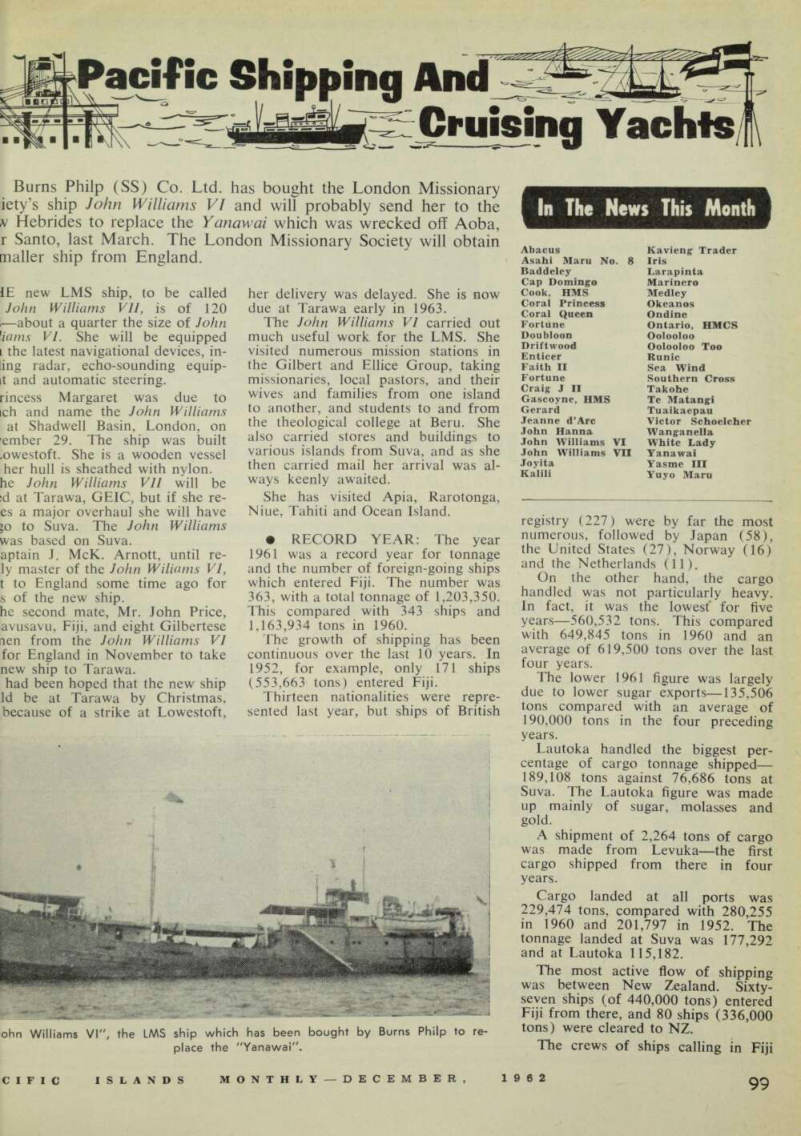
Burns Philp (SS) Co. Ltd. has bought the London Missionary iety’s ship John Williams VI and will probably send her to the n Hebrides to replace the Yanawai which was wrecked off Aoba, r Santo, last March. The London Missionary Society will obtain mailer ship from England.
IE new LMS ship, to be called John Williams VII, is of 120 ;—about a quarter the size of John Hams VI. She will be equipped i the latest navigational devices, in ling radar, echo-sounding equip it and automatic steering, rincess Margaret was due to ich and name the John Williams at Shadwell Basin, London, on ember 29. The ship was built xiwestoft. She is a wooden vessel her hull is sheathed with nylon, he John Williams VII will be :d at Tarawa, GEIC, but if she re es a major overhaul she will have 50 to Suva. The John Williams was based on Suva, aptain J. McK. Arnott, until re ly master of the John Wiliams VI, t to England some time ago for s of the new ship, he second mate, Mr. John Price, avusavu, Fiji, and eight Gilbertese nen from the John Williams VI for England in November to take new ship to Tarawa, had been hoped that the new ship Id be at Tarawa by Christmas, because of a strike at Lowestoft,
her delivery was delayed. She is now due at Tarawa early in 1963.
The John Williams VI carried out much useful work for the LMS. She visited numerous mission stations in the Gilbert and Ellice Group, taking missionaries, local pastors, and their wives and families from one island to another, and students to and from the theological college at Beru. She also carried stores and buildings to various islands from Suva, and as she then carried mail her arrival was al ways keenly awaited.
She has visited Apia, Rarotonga, Niue, Tahiti and Ocean Island. • RECORD YEAR: The year 1961 was a record year for tonnage and the number of foreign-going ships which entered Fiji. The number was 363, with a total tonnage of 1,203,350.
This compared with 343 ships and 1,163,934 tons in 1960.
The growth of shipping has been continuous over the last 10 years. In 1952, for example, only 171 ships (553,663 tons) entered Fiji.
Thirteen nationalities were repre sented last year, but ships of British
registry (227) were by far the most numerous, followed by Japan (58), the United States (27), Norway (16) and the Netherlands (11).
On the other hand, the cargo handled was not particularly heavy.
In fact, it was the lowest' for five years—s6o,s32 tons. This compared with 649,845 tons in 1960 and an average of 619,500 tons over the last four years.
The lower 1961 figure was largely due to lower sugar exports—l3s,so6 tons compared with an average of 190,000 tons in the four preceding years.
Lautoka handled the biggest per centage of cargo tonnage shipped— -189,108 tons against 76,686 tons at Suva. The Lautoka figure was made up mainly of sugar, molasses and gold.
A shipment of 2,264 tons of cargo was made from Levuka—the first cargo shipped from there in four years.
Cargo landed at all ports was 229,474 tons, compared with 280,255 in 1960 and 201,797 in 1952. The tonnage landed at Suva was 177,292 and at Lautoka 115,182.
The most active flow of shipping was between New Zealand. Sixty seven ships (of 440,000 tons) entered Fiji from there, and 80 ships (336,000 tons) were cleared to NZ.
The crews of ships calling in Fiji
ohn Williams VI", the IMS ship which has been bought by Burns Philp to re place the "Yanawai".
imbered 36,237. Although they are >t recorded as tourists, the money ey spend has the same effect as that aich a tourist spends. They leave ihind them in Fiji ports considerable ms of money.
• Training Course: A Three
onth course of advanced training r Papuan and New Guinea seamen 11 start at the Napa Napa Ad inistration Nautical Training School, )rt Moresby, early next year.
Announcing this in November, the NG Director of Trade and In istry, Mr. G. D. Cannon, said 12 perienced seamen would be chosen r the course, which would train perienced seamen for Certificates of Dmpetency or Local Master’s cence examinations.
Mr. Cannon said plans were also ing made to admit up to 30 ad tionai trainee seamen to Napa Napa xt year. They would do a two ar course to qualify as Grade One amen.
The first 12, enrolled when the hool opened in May, would com ete tneir training next April.
They were now building a 10 ft.
scale model of the MV Kalili to be used for instruction on navigation, cargo stowing and operation of derricks.
• German Captain Likes
RAROTONGA: A keen fan of the island of Rarotonga is Captain Klemm, master of the ship Cap Domingo, which called there last year.
In an article, “Visit to a South Seas Paradise”, written for a German publication, he said Rarotonga was “the most beautiful place I have had the pleasure of visiting during my seafaring career.
“The climate is excellent and a
pleasant sea breeze maintains reason able temperature in the houses.”
He described Rarotongan hospi tality as “gracious and charming”.
“In tne afternoon sport was on the programme, and at night hula danc ing and singing,” Captain Klemm said. “The unavoidable flower neck laces were put around the necks of my officers and seamen by the beauties of the island.
“The women wore flowers in their hair; the young girls had a flower behind an ear. On the right side it meant: T am still free’. Worn on the left side it meant: ‘Sorry, already be spoken’.
“This habit we found very practical