Magazine Section
pp. 85-87 · Read in the full issue
Pacific Islands Monthly
Fortune In Coins May Await A Finder At Vanikoro
By Robert Langdon
After the famous French navigator La Perouse sailed out of Botany Bay in his ships Astrolabe and Boussole early in March, 1788, no white man ever saw him again and nearly 40 years passed before relics of his ships were found at Vanikoro in the southern Solomons, thus solving one of the greatest maritime mysteries of the age.
INCE those first relics were dis covered, many others have been ind from time to time—some by mbers of the Vanikoro Timber mpany, and some by expeditions rching specifically for remains of Perouse’s ships.
However, none of the people who ve searched for remains of the La rouse expedition recently seems to ve been aware that there may be substantial treasure at Vanikoro iting for a finder.
Fhe treasure, in the shape of two llion livres worth of coins, is not sntioned in the official account of Perouse’s voyage. But it is briefly scribed in a letter which an nerican naval officer, John Paul
Jones, wrote to Thomas Jefferson, the French Minister in Paris, in 1785.
Jefferson, who later became Presi dent of the United States, sent Jones to the French port of Brest in August, 1785, to “enquire into the circum stances relative to” La Perouse’s expedition.
La Perouse had already left Brest on his voyage of exploration to the Pacific by the time Jones arrived there, but Jones’ discreet enquiries enabled him to get an accurate idea of what La Perouse intended to do.
When he reported on his enquiries to Jefferson on October 5, 1785, he said among other things: “Each ship had on board a large shallop in frames and a million of French livres in the coins of different nations”.
Coins Found A few such coins, including those of Spain and Russia, are among the La Perouse relics that have been found at Vanikoro over the years, and it could well be that they formed part of the treasure that Jones described.
But whether the main body of treasure is still on the seabed where the Astrolabe and Boussole sank, whether it is buried on shore, or whether it existed at all may remain a mystery for all time as no one from the two ships lived to tell the tale — although there were two men who were narrowly prevented by Fate from doing so.
These two men, who lived on Vanikoro for 30-odd years after the Astrolabe and Boussole were wrecked, missed being rescued by passing ships on at least three occasions.
Their story is one of the many tragic facets of the drama of La
Perouse, which is, itself, one of the great epics of the sea.
After leaving Brest on his voyage of exploration, La Perouse rounded the Horn, visited Easter Island, Hawaii, Alaska, California, Macao, the Philippines, the Sea of Japan, and the Siberian port of Petro pavlovsk.
At Petropavlovsk, La Perouse put ashore the only Russian-speaking member of his crew to carry his journals to Paris. This man, 22-year old Jean-Baptiste Barthelmy de Lesseps (uncle of the builder of the Suez Canal), made the hazardous journey across Siberia, Russia and Europe in 11 months and thus be came the only member of the ex pedition to return to civilisation.
Meanwhile, La Perouse sailed for the island of Tutuila in what is now American Samoa. At Tutuila, 11 of his men, including his second-in command, Viscount de Langle, were killed in an affray with natives dur ing a watering expedition.
A long boat was also lost in this affray, and it was with the object of building another to replace it that La Perouse sailed for Botany Bay.
After the long boat was completed, La Perouse sent an officer to Governor Phillip at Port Jackson with dispatches, which Phillip undertook to send to France.
Among these was one in which La Perouse outlined his future course.
He said that after leaving Botany Bay, he intended to visit Tonga, New Caledonia, the Solomon Islands, and the Louisiade Archipelago of New Guinea, pass through Torres Strait and continue on home via Mauritius.
He said he expected to reach France within 18 months.
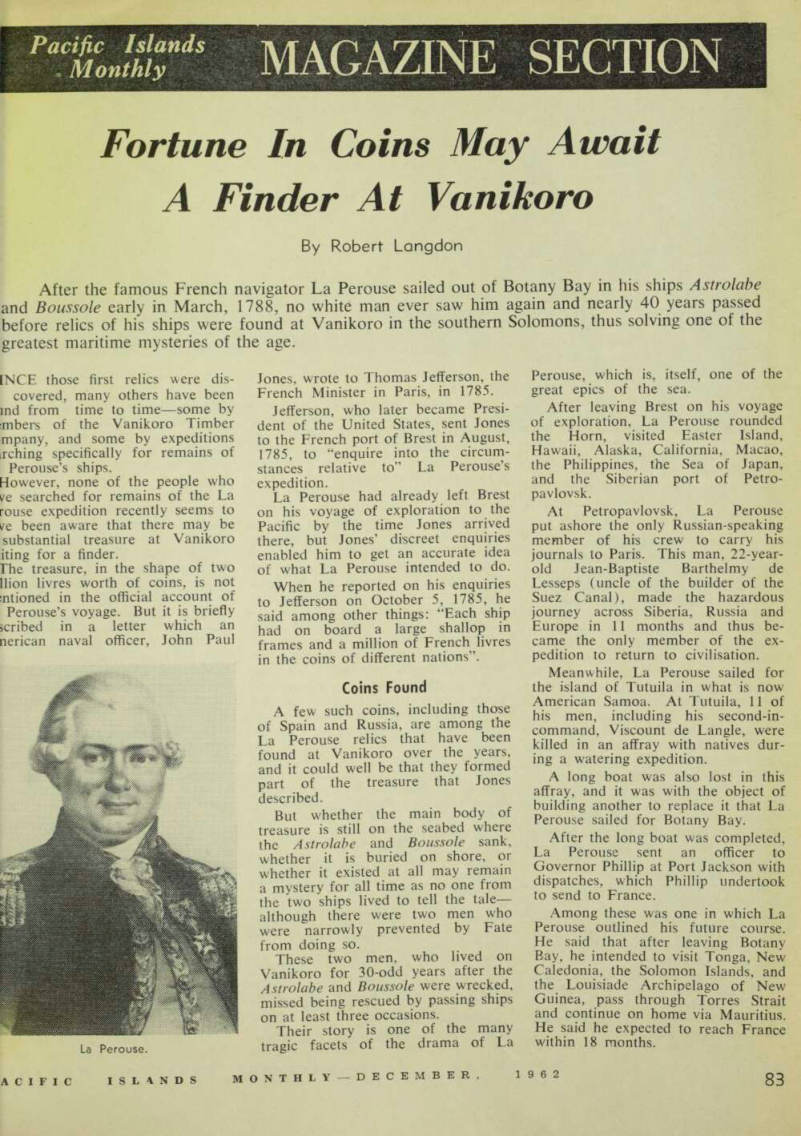
La Perouse.
When nothing had been heard of him by mid-1790, a young French man, Aristide Du Petit-Thouars, or ganised a private expedition to go in search of him. The result was disastrous.
Soon after leaving France in September, 1790, in the brig Diligent, many of Du Petit-Thouars’ crew fell sick, and on reaching the island of Fernando de Noronha, off the Brazilian coast, they were all im prisoned by the Portuguese Governor.
The Governor later sent them to Lisbon where they remained in prison until December, 1793.
Meanwhile, the French Govern ment had sent out an official ex pedition under Admiral Brunei D’Entrecasteaux. This expedition, in the ships Recherche and Esperance, left France on September 28, 1791, D’Entrecasteaux’s orders were to follow the route La Perouse had out lined in his dispatch from Botany Bay. However, when he reached Cape Town, he learned that two French merchant captains had brought news to Mauritius that natives of the Admiralty Islands, north of New Guinea, had been seen wearing red and blue French naval uniforms. The uniforms were pre sumed to have belonged to La Perouse’s men.
Instructions Ignored
Although D’Entrecasteaux doubted the accuracy of these reports, he felt he could not afford to neglect any clue that might lead to the discovery of La Perouse’s fate. So he decided to ignore his instructions and sail at once for the Admiralty Islands by the shortest course—across the Indian Ocean.
However, contrary winds compelled him to sail via Tasmania and up (but well clear of) the east coast of Aus tralia. When, at last, he reached the Admiralty Islands six months later, he was soon convinced that La Perouse had not been near them.
He then decided to follow his original instructions, but as the pre vailing winds prevented him from turning back to the Pacific, he was forced to almost circumnavigate Aus tralia before his search for La Perouse could begin.
By the time he reached Tonga, the first place mentioned in La Perouse’s dispatch, D’Entrecasteaux had been at sea for nearly two years and many of his men were down with scurvy and other complaints.
No trace of La Perouse was found on S a > nor New Caledonia, the Solomons and the Louisiade Archipelago which D’Entrecasteaux
subsequently visited.
In New Caledonia, D’Entre casteaux’s second-in-command died of consumption, and he, himself, died of scurvy off the Hermit Islands a few weeks later. The officers who succeeded to the command of the two ships then made for the Dutch port of Amboina as quickly as possible.
And there the expedition ended in confusion because of war between Holland and France.
It was probably because of D'Entrecasteaux’s illness that his ships failed to stop at an island in the Solomons which he named Recherche.
It was a tragic omission, for this island was Vanikoro, where some of La Perouse’s men, and possibly La Perouse himself, were still living.
A similar tragedy happened two years earlier when Captain Edward Edwards, of HMAS Pandora, passed Vanikoro while searching for Fletcher Christian and other mutineers of the Bounty. Although Edwards “saw smoke very plainly” (probably from signal fires lit by La Perouse’s men), he could not see any houses or people, and he therefore decided that the island was uninhabited and not worth investigating.
There was another similar omission in 1817 when the French navigator Captain Louis de Freycinet, who had been ordered, among other things, to seek traces of La Perouse, passed close to Vanikoro but did not think it worth a visit.
Nine more years passed before an Irish seaman, Captain Peter Dillon, chanced to discover the first clues to the mystery of La Perouse’s fate.
While crossing the Pacific from Valparaiso to Bengal in his ship St.
Patrick in 1826, Dillon was prompt by curiosity to call at the island Tikopia to find out what h happened to two men whom he h landed on that island at their requ< in 1813.
The two men were a Prussi; called Martin Buschart and a Lasc named Joe, both of whom car aboard his ship soon after the anch was dropped. While Dillon was tal ing to Buschart, the Lascar sold silver sword guard to one of the Patrick’s officers for a few fish hool When Dillon asked Buschart whe the sword guard had come froi Buschart told him that the Tikopia; had brought it from the island i Mallicollo (Vanikoro), about tv days’ canoe voyage to the westwar along with other articles of Europes origin.
On examining the sword guai minutely, Dillon saw, or thought II saw, the initials of La Perou; stamped on it. This made hi question Buschart, the Lascar ar some of the Tikopians more closell He then learned that, according j the Vanikorans, two large ships ha arrived at their island many yeaj previously and that both had bee wrecked in a storm soon afterward Some of the survivors were kills by the Vanikorans when they lande+ others, who escaped the massacr eventually built another boat and le: the island. Two of the Frenchmer however, had remained on the islam and, according to the Lascar, the had still been alive when he visits Vanikoro two years before Dillonr visit.
On hearing this, Dillon decided ft
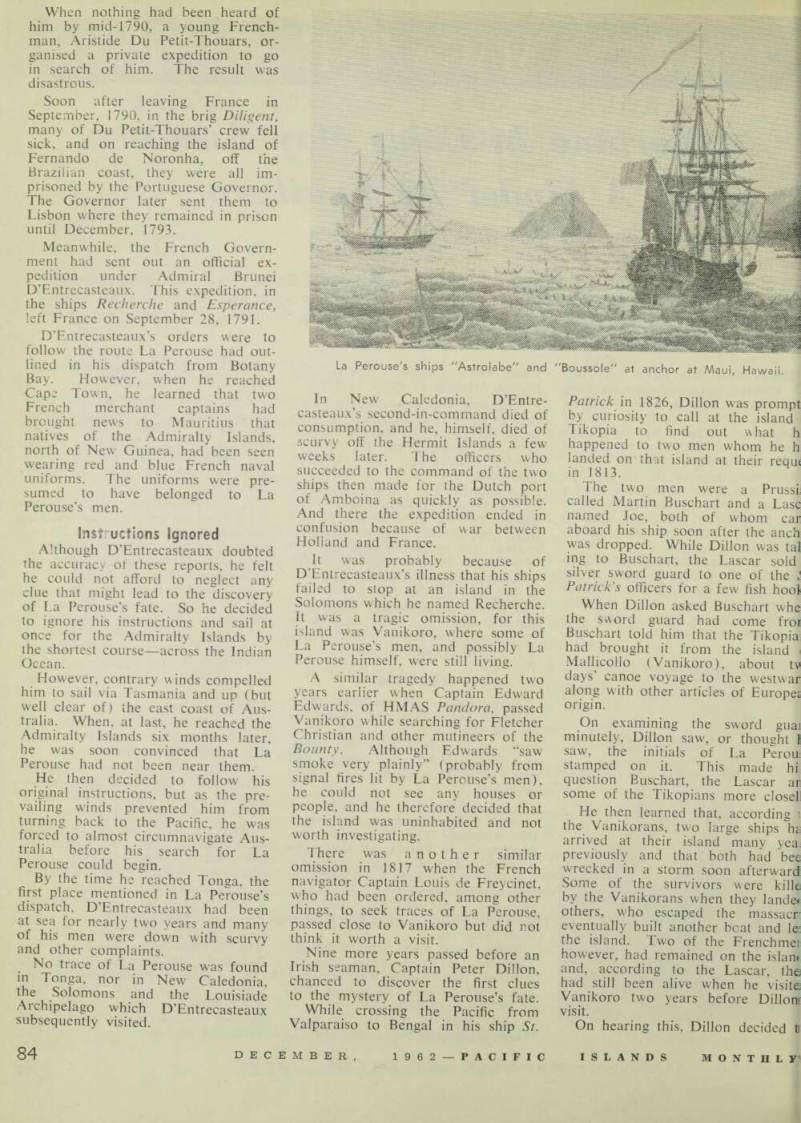
La Perouse's ships “Astrolabe" and “Boussole" at anchor at Maui, Hawaii,
for Vanikoro at once in the hope escuing the two Frenchmen. But ral days of calms, a shortage of fisions and a leaky ship compelled to abandon this plan and make Bengal. n reaching Bengal, Dillon uaded the East India Company trovide him with a ship to go to ikoro to rescue the two French ; and ascertain beyond doubt that Perouse had been wrecked there. illon sailed from Calcutta in the Research in January, 1827. All ned set for a reasonably quick age. But on the way to Tasmania, on fell out with his medical :er, Dr. Tytler, and arrested him. (fiien the Research reached >art, Dr. Tytler sued Dillon for ult. The case came before the reme Court, and Dillon was enced to two month’s imprison it. However, Dillon was released r only a few days, after several iing residents had petitioned the 'ernment, urging the humanitarian ire of his voyage. >n reaching Vanikoro, after calling Fikopia and picking up Buschart a native interpreter, Dillon found was too late to rescue the two ihe had come for. One was d, and the other was said to have to another island. )illon remained at Vanikoro for
six weeks. During this time, he acquired numerous articles that the natives had obtained from one of the wrecks or had been washed up on shore.
Dillon’s inquiries on what had happened to the crews after the two ships were wrecked brought many contradictory replies, but, in general, the information he gathered was similar to what he had learned at Tikopia the previous year.
Search for Frenchmen On leaving Vanikoro, Dillon made unsuccessful inquiries at two neigh bouring islands for the Frenchman who was said to have fled from Vanikoro. He then abandoned the search because many of his crew were sicK.
After returning to Calcutta by way of Sydney, Dillon took the articles he had recovered to Paris. There, besides being presented to the King, lionised, made a Chevalier of the Legion of Honor and granted a pension of 4,000 francs a year for life, Dillon met the sole survivor of the La Perouse expedition, de Lesseps.
De Lesseps confirmed tbal the articles Dillon had brought back had belonged to La Perouse’s ships.
Meanwhile, another seaman, the French navigator Dumont D’Uiville,
had gathered further relics of La Perouse at Vanikoro.
D’Urville, who was in the Pacific on an exploring voyage, had called at Hobart seven months after Dillon and had there learned of Dillon’s expedition.
As he had been specifically instructed to search for traces of La Perouse, he was extremely jealous of what Dillon had learned at Tikopia the previous year, and in the hope of beating Dillon to the positive discovery of La Perouse’s fate, he sailed northwards immedi ately.
D’Urville, however, was too late to do anything more than gather some relics that Dillon had missed, erect a monument to his famous countryman’s memory, and gather further native stories on what had happened to La Perouse’s men.
One thing about D’Urville’s visit that seems significant in the light of John Paul Jones’ statement is that D’Urville made a point of showing European coins to the natives and asking them if they had ever seen such objects.
Unless he had been officially in formed that the Astrolabe and Boussole had been carrying a large number of coins it is hard to imagine why he would have troubled about inquiring after such small objects.