Raft Experiment Could Lead
p. 80 · Read in the full issue
To Bonanza For Fishermen
An unusual experiment, carried out recently off the coast of Hawaii to observe the behaviour of fish, could provide a new and useful technique for estimating the abundance and composition of fish resources in the Pacific and elsewhere.
THE experiment, made with a 12 ft by 12 ft raft called Nenue, was the first attempt in Hawaiian waters to make direct observations of the communities of fish and other sea creatures which congregate under objects floating in the ocean.
The raft, which had an observa tion capsule underneath, drifted off the Kona coast of Hawaii for two weeks. Four scientists from the Honolulu biological laboratory of the US Bureau of Commercial Fisheries spent more than 100 hours in the capsule. They are John Magnuson, Reginald Gooding, Walter Matsu moto and Joseph Harada.
The scientists were enthusiastic about the opportunities which the raft afforded for sustained study of the behaviour and interactions of a variety of species.
But they admitted that more than 100 hours in the cramped capsule, concentrating on circling fish while the Nenue bobbed on the swells, had been a severe test of their stomachs’ devotion to science.
The research vesse/ Charles H.
Gilbert, skippered by Captain Wil liam Tanaka, launched the Nenue about 10 miles off Kealakekua Bay, on September 27 and stood by with in sight and walkie-talkie range of the raft for the next two weeks.
Nenue drifted north along the Kona coast unexpectedly fast, some times at four miles an hour, with the result that the Charles H. Gilbert had to pick the raft up four times to keep it from drifting ashore or out into rough channel waters.
Fish behaviourist Magnuson re ported that each time the Nenue was placed in the sea, small fish began to seek it out within five or 10 minutes.
The first arrivals were generally rudderfish, similar to the nenue for which the raft was named, and at times there were as many as 60 of this species under and around the raft.
Small triggerfish (close relatives of Hawaii’s famililiar humuhumunuku
nukuapuaa) were also numerous and regular members of the Nenue’s fol lowing.
Dolphins were often about the raft, sometimes as many as 30 at a time.
These colourful, fast-swimming mam mals would come in under the Nenue and rub their sides against its oil drum floats, then range out to the far periphery of the drifting com munity where, the scientists thought, they might have been picking off stragglers or intercepting new recruits attracted by the raft.
The dolphin mingled harmoniously with the triggerfish, but they vora ciously harried a stray jack, keeping it a prisoner under the raft for several hours. The jack finally escaped by joining the pilotfish escort of a passing whitetip shark.
From the windows of their obser vation capsule the biologists also saw porpoises, marlin, manta rays, barra cuda, opelu, wahoo and skipjack tuna. With the exception of the wahoo, these fish gave no indication that their behaviour was affected by the presence of the raft and remained in its vicinity only briefly.
When the Nenue was moored to the anchored Charles H. Gilbert, with a strong current running by, it failed
to attract even the rudderfish and triggerfish which were its almost con stant companions when it was drifting free.
Although the Nenue’s scientists knew that rafts were regularly used in the dolphin fishery in Japan, they did not expect so many dolphin to gather so quickly around their raft, particularly as it has commonly been thought that drift logs and othei flotsam do not attract large fish until they have been drifting long enough to accumulate a growth of seaweeds and a population of small inverte brate animals.
The unexpectedly wide variety ol fish species and large numbers ol individuals seen from the Nenue convinced the scientists that floating observation posts could provide a new and useful technique for esti mating the abundance and composi tion of the fish resources of an area The scientists noticed that there were definite changes in the make-up of the raft’s following as it drifted into different locations at varying distances from shore.
If further observations show these changes to be regular, they should give new insights into the relations between some commercially impor tant fish and their environment.
Many of the raftsmen’s observa tions were recorded in still and mov ing pictures, and numerous specimens were collected for identification anc for examination of their stomact contents.
Detailed analysis of these data and of similar observations made frorr the underwater viewing chambers ol the Charles H. Gilbert at various dis tances from the raft will furnish s basis for more sharply focused ex perimental work on future voyage; of an improved Nenue.
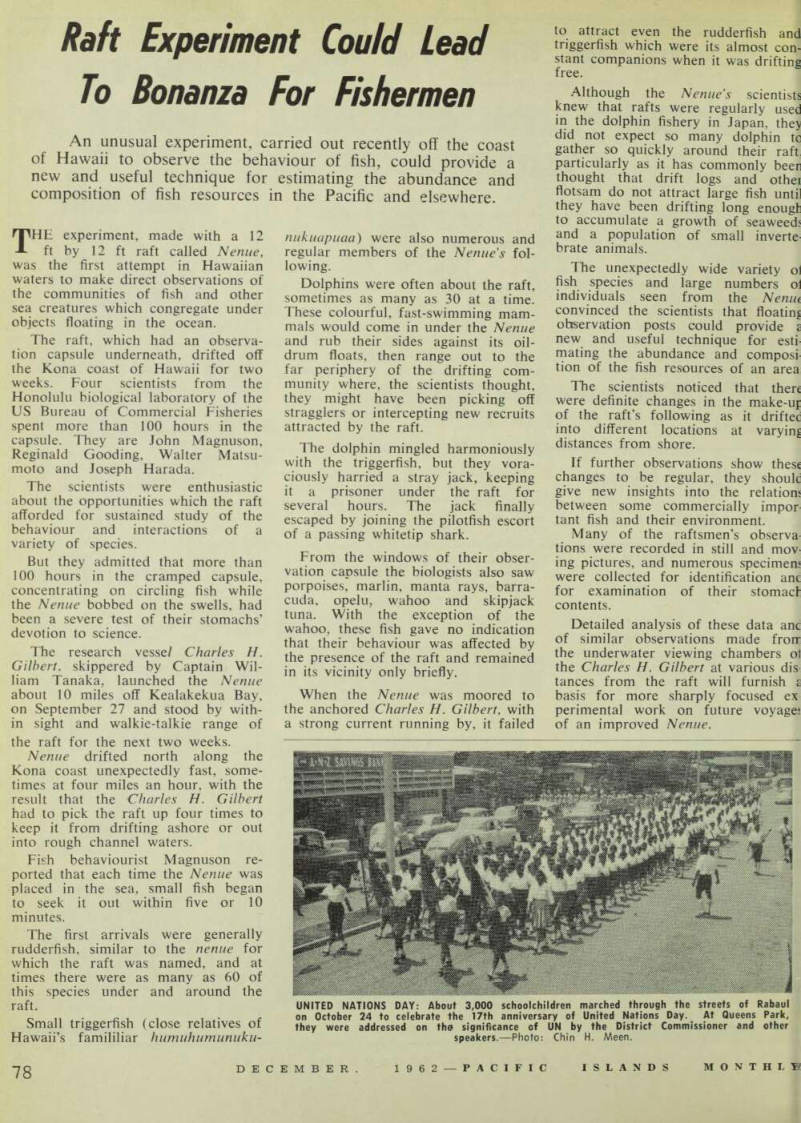
UNITED NATIONS DAY: About 3,000 schoolchildren marched through the streets of Rabaul on October 24 to celebrate the 17th anniversary of United Nations Day. At Queens Park, they were addressed on the significance of UN by the District Commissioner and other speakers. —Photo: Chin H. Meen.