Sparks Fly Over Those Old
pp. 40-41 · Read in the full issue
Polynesian Voyages
By a Staff Writer
One of the most fascinating pastimes in the field of an thropology is to try to figure how Polynesians and Micro nesians managed to populate their vastly scattered islands in the North and South Pacific.
SOME theorists hold the view that the islands were populated de liberately. They picture the Islanders as people with great courage, in curable curiosity and a wonderful knowledge of offshore seamanship, weather, etc.
These theorists maintain that the Polynesians and Micronesians set out to seek new islands when their own islands became over-populated, when they were driven from them through defeat in war, or when am bition urged them to look for pastures new.
Other theorists believe that the Pacific islands were populated by accident when storms, winds and con trary currents drove canoe-loads of people from one island to another.
The most noted protagonist of the accidental voyages theory in recent years is New Zealander Andrew Sharp, whose book, Ancient Voyagers
in the Pacific, first published in 1956, has won him many followers.
However, a movement now appears to be on foot to restore the deliberate voyages theory to favour and to take the wind out of Sharp’s sails.
In the latest (September) issue of the Journal of the Polynesian Society, the first part of a symposium has been published on Sharp’s accidental voy ages thesis.
The idea of the symposium was conceived about two years ago by Jack Golson, then editor of the Poly nesian Society’s journal.
In a foreword to the symposium, he says that when Sharp’s book was published few reviewers could be found who were competent enough to assess Sharp’s arguments, so it was decided to get a panel of reviewers to do the job.
The Polynesian Society’s panel oi reviewers comprises: • Mr. G. S. Parsonson, senioi lecturer in the Department ol History at Otago University, whc has been working on a history ol the New Hebrides since 1949. • Mr. G .M. Dening, a recent graduate with first-class honours of Melbourne University. • Dr. C. O. Bechtol, a University of California professor, with j lifelong interest in sailing boats • Captain G. H. Heyen, genera manager of the Australia] National Line, Melbourne, win has had long sea experience ii the Western Pacific. • Captain Brett Hilder, master o the Burns Philp ship Malaitc who is well known to PIA readers for his profiles of Pacifi personalities and other articles.
Only papers by Mr. Parsonso: and Captain Heyen have so far bee: published, but Mr. Golson says tha Captain Hilder is the only contribute who fully accepts Sharp’s accident voyages theory. (Captain Hilder put lished an article on these lines in th August issue of PIM, p. 67, and ther was a reply to it by Gordon Russe in the issue for November, p. 95.) Mr. Parsonson’s contribution to th symposium is a 53-page onslaught o Andrew Sharp’s theory. He sa> Sharp’s case for accidental voyage “omits and misinterprets materu evidence, selects whatever suits th
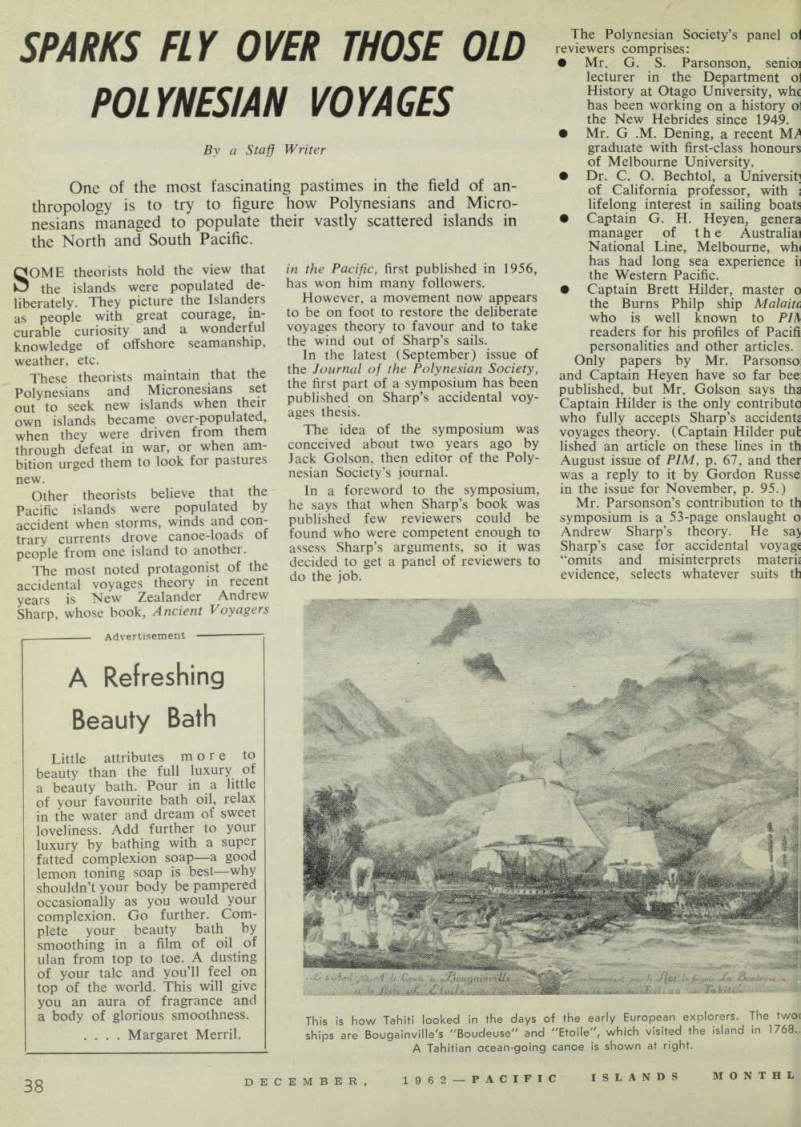
This is how Tahiti looked in the days of the early European explorers. The two[?] ships are Bougainville's "Boudeuse" and "Etoile", which visited the island in 1768.[?] A Tahitian ocean-going canoe is shown at right.
argument and leaves out or explains away what does not”.
“It quite inexcusably denies,” Mr.
Parsonson says, “no doubt in the in terests of uniformity, the most irre fragable testimony concerning long distance voyages in other seas in medieval times.”
He says: “Its basic assumptions are iften quite untenable, if not wholly llogical. The Atlantic islands, it flaims, though many of them were iesirable and near at hand, were all minhabited before being discovered ay accident or by systematic explora ion in and after the 15th century, md this presumably because early European seamen blown off course :ould always find their way back to heir extended coast.
“Why the ancestors of the Poly lesians did not also seek safety in luch circumstances in the land from vhere they had originally come, is, lowever, far from clear . . .
“Further (Sharp’s) book is quite mreliable on nautical matters: a veakness which reflects its preoccupa ion with theory rather than with fact, md overmuch reliance on secondary ources.
“It thus constantly exaggerates the lifficulties involved in oceanic sailing . . It becomes hard in the end to >elieve that the Polynesians could lave negotiated even the limited dis ances allotted to them.”
Mr. Parsonson says that the acci lental voyages theory owes its sur ival to such factors as: the incom ictence of the early explorers as ob ervers of native life; the sudden and Imost complete destruction of the ncient Oceanic culture in the great pidemics and civil wars of the 19th entury; and the comparative infancy if Pacific studies, notably of archae logy, which might eventually lead to tie solution of the problem.
Captain Heyen says in his paper: Andrew Sharp has made an excel mt study of the Polynesian problem, nd his argument in favour of acci ental voyages appears logical.
“But his logic does not explain the olonisation of all the islands, nor oes it disprove deliberate explora on.”
After discussing such matters as terms, winds, currents, waves and well, Captain Heyen says: “Surely in Oceania, early man had le same urge for adventure and ddening of knowledge that inspired arly exploration by other maritime copies.
“The men of Oceania today are ardy, brave and intelligent, and are ood weather-wise seamen. Con eivably, their forbears had the same
qualities, possibly to a greater degree.
Whether they were capable of ex ploratory voyages over long distances depended on various factors—know ledge of navigation, seamanship and weather-lore, and the sea-keeping quality of their canoes.”
Captain Heyen considers in detail the possibility of voyages by primitive navigators between Nukuhiva and Hawaii; Tahiti and Hawaii; Tahiti and New Zealand; Tongatapu and New Zealand; Kadavu and New Zealand; and Savaii and Hawaii— distances varying from 977 miles to 2,242 miles.
He concludes that voyages between all those points would have been
possible either from north to south or from south to north, or both ways.
“Undoubtedly many canoes would have been lost, but it is possible that some canoe captains did discover new lands and return to tell of their wanderings.” he says.
“How, otherwise, would tales still be told of Gilbertese journeys to Samoa, and Polynesian voyages to New Zealand? Sea traditions stem from hard fact, not fancy.”
Judging from the first instalment, readers interested in the settlement of Oceania can look forward to some further lively reading on the subject in the next two or three issues of the Journal of the Polynesian Society.