Fijian's Plea For A South
pp. 36-37 · Read in the full issue
Seas Colombo Plan
By Ratu Joni Vuiyasawa
One has only to look at the more developed countries of the South Pacific—Western Samoa, Tonga, New Caledonia, Fiji —to find that one of the greatest barriers to their independence is economic under-development.
FIJI, for example, has wide potentials in the field of agriculture; but unless it has trained men and women capable of putting into practice scientific methods of agriculture the country will be soon struggling to feed its fast-growing population. At this moment it is of prime importance that Fiji produces enough to cut down as much as possible on its imports of foodstuffs.
In many of the Pacific Islands almost the only possible sources of income are copra and bananas.
But in Fiii and in Paoua-New Guinea there 3 are wider mAshould noAleft in the hands
Ah e nT
J“ D J'„ ! ‘A
of the Islands as a place of cheap lanour.
There is only one way to prepare for indigenous leadership in the scientific field and that is through tertiary education At present this is deplorably slow, nor can there be much change in the foreseeable future unless some such scheme as that advocated by the South Pacific Commission is implemented.
One of the serious problems confronting Fiji is racial, arising out of the presence of 200,000 Indians.
They are there because the Colonial Sugar Refining Company
wanted cheap and efficient labour, These indentured labourers were promised repatriation, but the neces sary provision was not made. In the meantime they were settled comfort ably in our country and, without any thought for the future, the CSR, as sisted by the Colonial Office, left this problem of two distinct races right in the lap of the Fijian people, The Indians have nothing in com mon with the Fijians. Ours is a chiefly society and, for the last 100 years, most of our people have been Christian. The Indian are chiefly Hm dus’ Wlth a P ercenta S e of Muslims. ‘“A iS entirely different We have to confess that they are far more thrift y than the Fijians, have a , re / dy cap t ure d a good deal of the local trade and there is h evidence that in this respect the Fijians have t take a se £ ondary j' ce in th ' eir own country .
So far, we have been able to avoid serious clashes between the two les is due chiefly> j belfeve , to the h and contente d tempera men( of the Eijians Not thought has been given to the problem of their living to gether. Like Topsy, the problem has “just growed”. So far, the Indians and Fijians have not even found a way of worshipping together.
Recent articles in "Pacific Islands Monthly" and "Fiji Times", describ ing the concern of the South Pacific Commission regarding future gov ernment in the South Pacific Terri tories, the need to train the in digenous people for self-govern ment, and the special problem presented by multi-racial Fiji, have been read with interest by Ratu Joni Vuiyasawa.
Ratu Joni is a young Fijian
student at Wesley College, Sydney.
He is a member of the well-known Sukuna family—his father is Ratu Charley, a brother of the late Sir Lala Sukuna.
Invited to write his opinions for "Pacific Islands Monthly", Ratu Joni gave us an article that is both forthright and notable for con structive thinking. Many will find it controversial.
No thinking has been done by th Government on this matter. It seem that, like most governments handlin undeveloped peoples, the onl method they know of preservim racial harmony is that of bayonet and tear gas. In 1943, and again I 1959, the Government resorted t these measures in clashes betwee; Fiji’s two peoples.
The services of trained Fijians an essential, if the two groups are tl live together in harmony. Foreig leadership is no answer to the prob lem. Leadership means training at th tertiary level.
One of the most unhealthy situ? tions in Fiji is the lack of an edu cated and independent Fijian voic* Most Fijians who have graduate either from Australia or from Ne T Zealand are civil servants. All thr
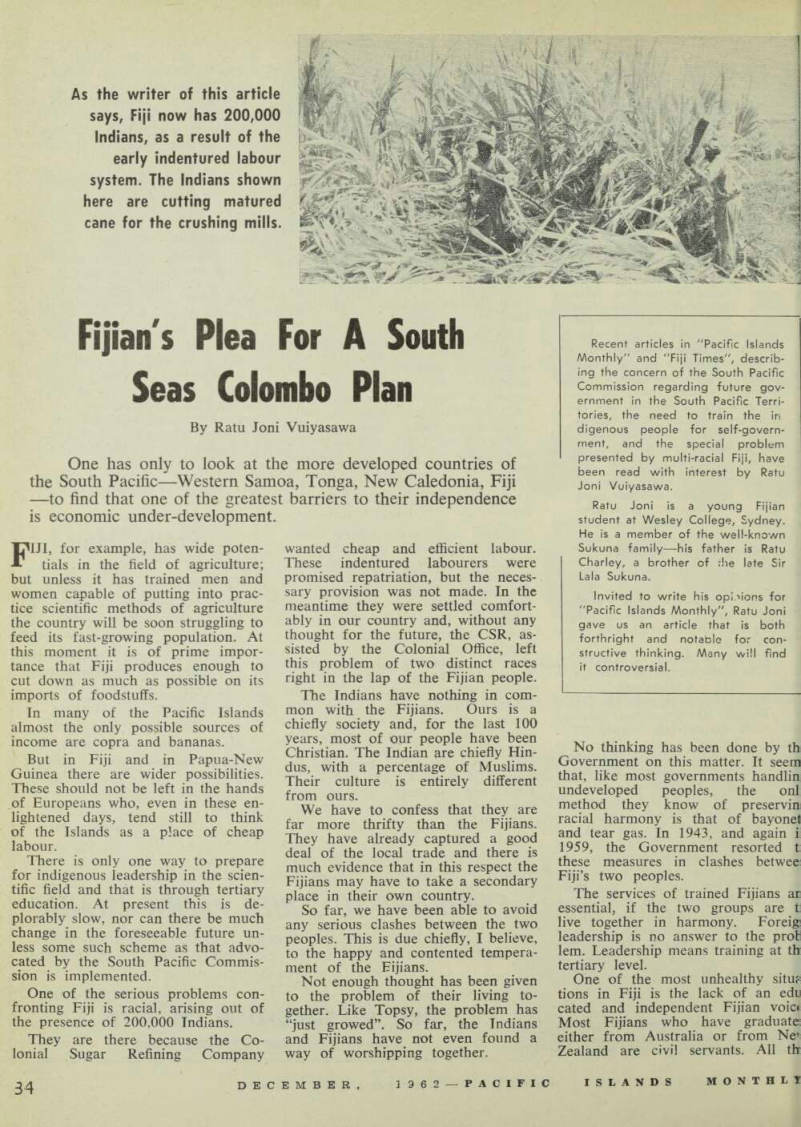
As the writer of this article says, Fiji now has 200,000 Indians, as a result of the early indentured labour system. The Indians shown here are cutting matured cane for the crushing mills.
7 ijian members of the Legislative Council today are civil servants. This, believe, is entirely unsatisfactory. do not have to come all the way rom Fiji to tell you what happens o Government people who “speak •ut of turn”. We need more people /ho are free to speak their mind.
At next year’s election, when the fijians, for the first time, will elect heir representatives to the Legislative Council, they will be able only to lect civil servants because there is ast no reliable independent Fijian oice outside the civil service.
The Indian people, however, have o such problem, because their raduates, without any exaggeration, utnumber the Fijians by almost 10 0 1.
A "Colombo Plan"
Do not for a moment think that tie Fijian is incapable of taking srtiary education. He is capable /hen given the opportunity. Our len and women have proved that hey can take their places with other aces. The opportunity can only come 1 New Zealand and Australia will be lore generous and establish a Co imbo Plan for the Pacific territories.
It is pointless to talk about giving tie peoples of the South Pacific more esponsibility in the work of the 'ommission, if you have not got le qualified men to do the highly jchnical work that would be re uired of them.
Each year the number of Fijian oys and girls who pass the equiva ;nt of your Leaving Certificate out umber those of any other race. Yet hen you look at the number of eople who come overseas from Fiji is usually the other way around.
This is because the Indian is :onomically stronger and is capable f sending his children overseas with ut seeking support. The Fijian, on le other hand, has always relied on le limited number. of Government holarships. This creates an im alance at home, and is continually jading to misunderstanding and mis ust and suspicion—an altogether un ealthy and unhappy state of affairs.
The fact that Fijians are mostly hristian does not, in itself, go far i the solution of the inter-racial roblem. “Thou shalt love thy neigh our as thyself”, has to be spelled in ;rms of social ethics—equal oppor mities in education and equal sc anty for family life.
In every country in the world to ay trained men and women are in estigating these matters for their
own peoples and governments. This should have commenced years ago in the Pacific Islands. But it must be postponed until more and more people can be given a university edu cation.
It is true that more and more post-graduate people from the Aus tralian universities are using our islands of the Pacific as happy hun ting-grounds for material for their doctorial theses; but little or no bene fits have accrued for our people out of these excursions.
Fiji's Debt to Neighbours
One further point, the Pacific Islands are linked to Australia and New Zealand in a very much closer way than are the countries of Asia.
Most of our trade has been with Aus tralia and, for our part, we have
much for which to thank Australia and New Zealand.
It has been largely due to your missionary effort that our people have been awakened to seek some better form of social life. We shall always be grateful for what you have done. But we do not want to go on through the years looking to you and depending on you for social progress or for the determination of our destiny as a people.
Therefore, having done much for us, do this one thing more: Make possible amongst us that training by which our people may be led to nationhood, independent and free and able to take our place in the wide family of nations. Into that family of nations, we believe, we have our tribute to bring; and one day we shall bring it with gratitude to you, and to God.