The Solomons
pp. 27-29 · Read in the full issue

The Air Road to The Solomons
Henderson said that matters are t likely to improve, as the airlines : unlikely to change their schedules, ich have been arranged for the ivenience of passengers arriving at Iney or Honolulu.
But he added that Nadi will always nain a convenient junction between ckland, Sydney, Noumea, Hono -11 and Tahiti.
Meanwhile, official figures tell an story. Air travel in the :ific, and through Nadi Airport in ticular, has grown spectacularly in last few years. For example, the nber of aircraft which entered Fiji reased from 1,763 in 1957 to 04 in 1961.
Vhile the number might not be remarkable, it is the tonnage of :raft which shows what is hap ling. In 1957 the tonnage was 700 and in 1961 it had risen as h. as 179,895, which showed that average size of aircraft had risen siderably. Nadi has been getting re and bigger aircraft. * as . t ;.y ear 68,287 passengers arrived Fiji, 19,275 to disembark and £92 in transit. Nadi accounted for bulk of the number, 67,594. isori Airport, 14 miles from Suva, :red for the remainder who ved by Fiji Airways from the P, Tonga and Western Samoa, by RNZAF and other planes. )f the aircraft which arrived in the ony 1,304 were British-owned, 900 were foreign. Most flight ar 1s were from the United States 4), New Zealand (566), and Aus ia (563). But the tonnage of air f from New Zealand was much Her—27,763, against 62,347 from United States and 61,129 from tralia. here was a considerable amount traffic from neighbouring island ips—l4l from Canton Island, 97 n Tahiti, 72 from American 10a, 42 from Tonga, 22 from the
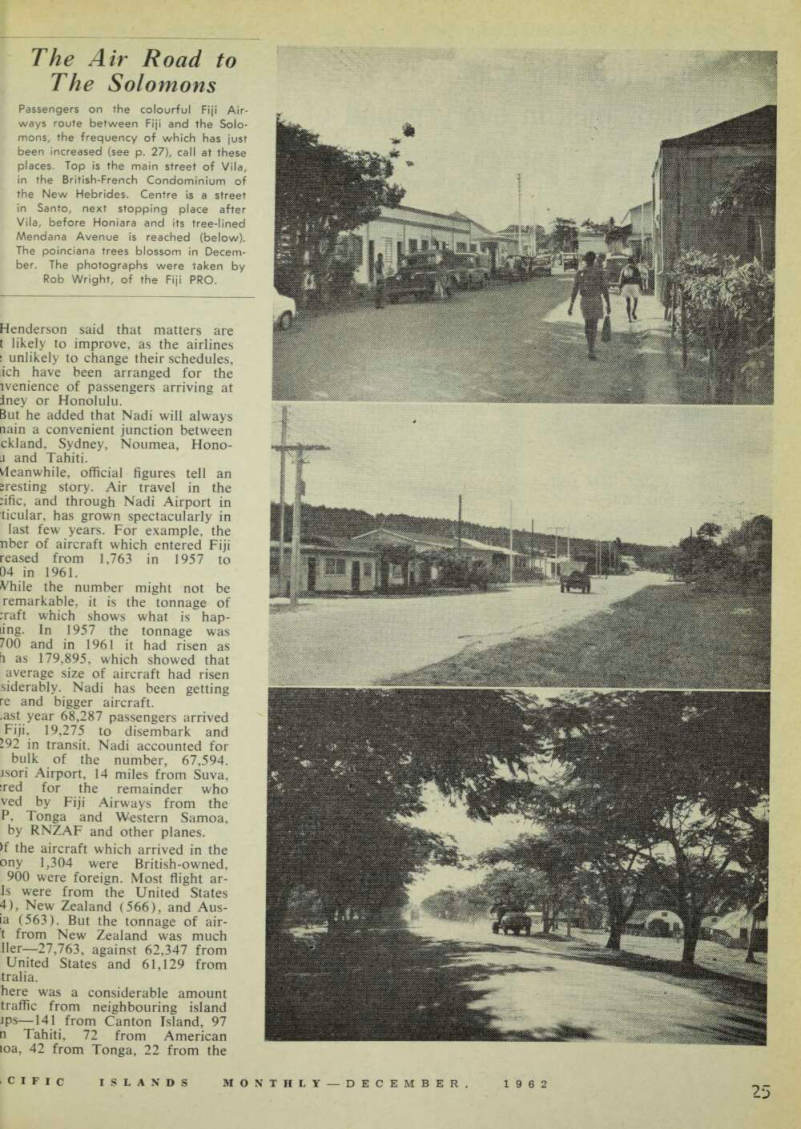
Passengers on the colourful Fiji Air ways route between Fiji and the Solo mons, the frequency of which has just been increased (see p. 27), call at these places. Top is the main street of Vila, in the British-French Condominium of the New Hebrides. Centre is a street in Santo, next stopping place after Vila, before Honiara and its tree-lined Mendana Avenue is reached (below).
The poinciana trees blossom in Decem ber. The photographs were taken by Rob Wright, of the Fiji PRO.
Gilbert and Ellice Islands (mainl RNZAF) and 19 from Wester Samoa.
New Hebrides Moves In the New Hebrides, work is gc ing on to improve Bauer Field, Vila airstrip, and new airstrips have bee completed at Tangoa and Aneityum.
First job to be done at Baue which is a grass strip, is to impro\ the drainage. The field is still usiri drains put down by the Americai during the war.
Tongoa’s new airstrip is 670 yc long. The New Hebrides Airway Drover made the initial landing.
The Aneityum airstrip is 280 yarc and was built by the Condominiui Government—the first to be built s a joint effort. With its opening a southern New Hebrides islands no have strips.
During the construction of the aii field a number of relics and remaii of the old whaling station whic existed on Aneityum in the middl decades of the nineteenth centui were uncovered. They included tl graves of three Europeans, a mai woman and child, now re-interre: harpoons, pottery, the foundations ■ buildings and the pots in which tl whale blubber was rendered dow It is hoped some of these artifac will be put on show in the Vila Cu tural Centre.
The first permanent settlement t Aneityum was made by the notorioi Paddon of Sydney who established! station for the collection of sandr wood there in the late 1840’s, usi:i his ex-opium brig, the Brigand. B built up a small colony of about six people. The sandalwood was shippt direct from Aneityum to China.
A few years later, however, sa dalwood supplies dwindled as a resn of excessive exploitation and tl small colony of permanent settle turned their hand to whaling.
This area is being cleared for an airstri[?] on Malaita, BSIP. It is hoped a sma[?] internal air service will be developed[?] improve communications between the[?] island and the capital, Honiara. Preser communication and transport is by sma boat. —Photo: Rob Wright.
Since the 1880’s the number of vhales in New Hebridean waters is aid to have diminished. However, >aul Burton, of New Hebrides Air vays, has recently reported seeing rom the air whales in fairly large lumbers around the southern islands.
Easter Island Plans The prospects for construction of jet airport at Easter Island, some ,100 miles east of Pitcairn Island ,nd 2,200 miles west of Chile, were evived in mid-October when two big Jnited States Air Force Hercules jet irop transports flew to the island rom Chile.
One of the Hercules landed, the JS State Department said, and the ther returned to Chile. The reason or the second plane’s immediate re urn flight was not given.
Easter Island has a 4,000 ft air trip, unsealed, but US engineers have aid they can build a 9,000 ft strip lere. Easter Island would be an im ortant link in a new air route to outh America. This route was sur eyed by Sir Gordon Taylor in 1951.
Australia is taking close interest i negotiations for an airstrip at 'aster Island, which belongs to Chile, [owever the growth of trade between mstralia and South America “will be significant factor in deciding diether an air service from Aus •alia to South America will be insti lled, ’’ says the 1961-62 Australian )epartment of Civil Aviation report, fleased in November.
Qantas representatives travelled dth an Australian trade mission hich visited South America earlier lis year.
The report says that any routing to outh America “will almost certainly ivolve the solving of new and in vesting operational problems, and :tive consideration is being given to lese at present”.
NG Developments
Work continues in Papua-New iuinea on new airstrips and improve lents on old ones.
Two officers of the Department of ivil Aviation in November were irveying potential airstrip sites near le island of Samarai, headquarters F the Milne Bay district. The sites re on the mainland—one adjacent > Loani plantation, about 20 minutes tunch trip from Samarai, and an ther about the same distance away om Samarai, six miles distant, near le old plantation of Konabirubiru.
If an airstrip is built at either site, le four-to-five hour launch trip from amarai to Gurney airfield, at the far id of Milne Bay, would be iminated.
Milne Bay people have had poor
air services over the years, mainly due to the lack of suitable landing strips.
A Catalina flying-boat service was suspended some months ago when the aircraft crashed at Daru, at the op posite end of Papua, but a new ser vice has recently been resumed. The new airstrip sites should be capable of taking DC3 standard aircraft.
Mendi, in New Guinea’s Southern Highlands, in November greeted its first DC3. Its arrival created great excitement among the local natives.
The DC3 brought in a stone crusher which is being used to de velop Mendi from its present Cate
gory B (light aircraft) to Category