New Competition For South
pp. 25-26 · Read in the full issue

Seas Air Routes
From PIM Correspondents in Suva and Auckland There will be new pressures in South Pacific aviation next April when the BOAC flag flies in the South Seas for the first time.
BOAC Comet 4’s will cross the Tasman from Sydney to Auck land twice a week as an extension of the present London-Sydney Comet service. BOAC will thus compete with Qantas, TEAL and Canadian Pacific on Tasman services. Until last year the Tasman was a TEAL monopoly. PAA and TAI have yet to come in, but this is only a matter 3f time.
The BOAC decision means the first leg home in the British effort to get sack into the South Seas—an area hey left when BCPA was absorbed md when they dropped out of TEAL several years ago.
British airline chiefs have conceded n the last 12 months that Britain nade a mistake in getting out of the South Seas. The area now has one )f the quickest-growing tourist poten ials in the world, and Britain until low has had no aviation interest in t —except for Fiji Airways in a ninor way.
The new BOAC service will termi late at Auckland and follow the same oute home, via Australia. But there s no doubt that BOAC’s next bid vill be to bridge the gap between NZ md Honolulu, and thus get a round he-world service via the South Seas, ts present service between London md Honolulu, using Boeing 707’s, ►oes on to Tokyo and then round the vorld.
BOAC may run its own service icross the gap or else come to some find of charter arrangement with PEAL. The second scheme is the nost probable—TEAL will do the lying.
The key to it—as with all future
services through NZ—is completion of the big new jet airport at Mangere, serving Auckland. The £ 10-million scheme is expected to be finished in 1965.
BOAC will eventually replace the Comet with the Vickers VC 10, and BOAC has offered TEAL the charter of these aircraft. BOAC no doubt would like to see TEAL buy the VC 10 to replace the present TEAL Electras, but no public announce ments have been made by TEAL on its re-equipment programme.
PAA Plans Other important news in November was the announcement that PAA from early December would operate one of its three trans-Pacific jet ser vices a week through Pago Pago.
The aircraft, a 707, will fly Sydney- Pago-Honolulu, over-flying Nadi.
No announcement was made as to the reason for this, but PIM reported in September (p. 141) that PAA was planning to route its Pacific trunk services through Pago because land ing charges at Pago were lower and because the US Government wanted to encourage use of the big new jet airport, which was opened in July for day landings and which only re cently has ben operational at night.
PAA would eventually operate feeder services to Nadi.
With the advent of the new trunk service once a week, PAA will cease to operate the Honolulu-Pago leg of its weekly DC7c service between Honolulu and Auckland, The DC7c will in future be based at Auckland instead of Honolulu.
Pago airport, like Nadi airport, is
nothing but an airport, and through passengers will still have to take a ride to see any local colour.
However, at Nadi through passengers have no chance at all of seeing the Fiji capital of Suva, which is on the other side of the island, but Pago passengers may get the opportunity of a fast ride into town to see the capital, Pago, on its famous harbour. Earlier this year the Ad ministration put through a first-class sealed road between the airport and Pago, a distance of about 10 miles.
Pago’s new jet airport is very much like the new one at Faa’a, in Tahiti, in that it is built on coral on the coast.
Nadi's Future New Pacific air developments such as these have recently brought into prominence the future of Nadi as an international airport.
Millions have been spent on bring
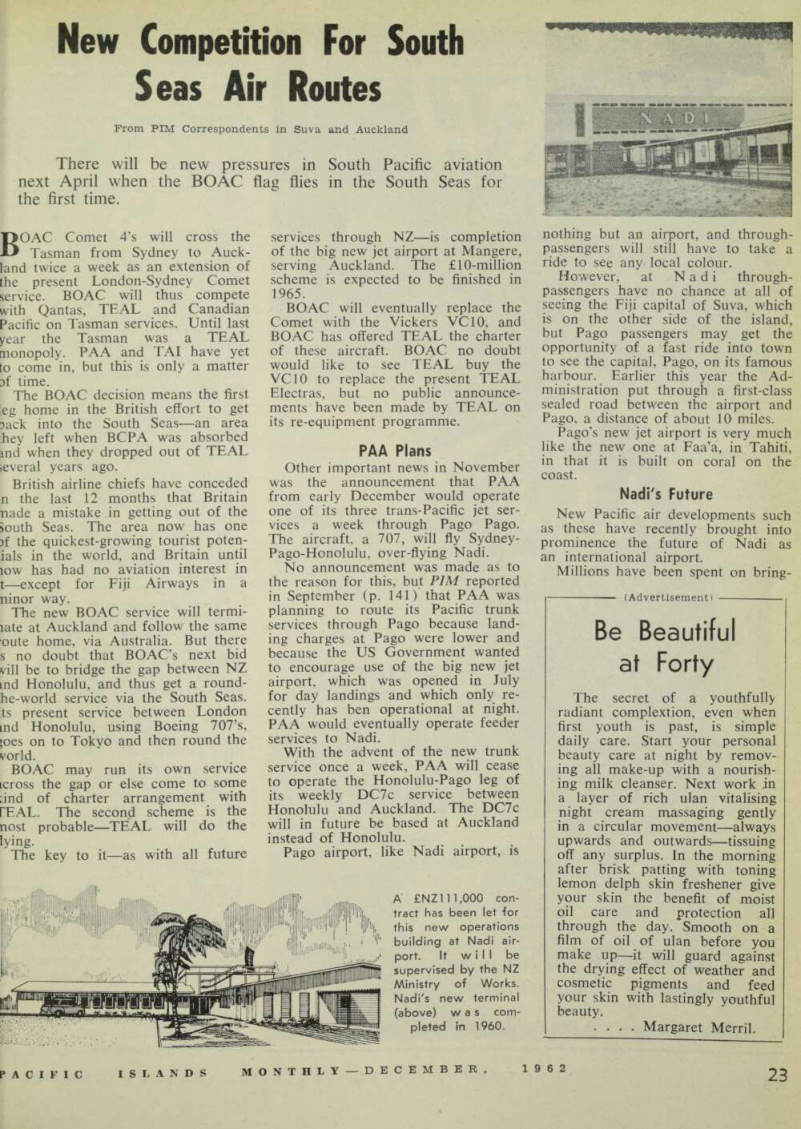
A £NZ111,000 con tract has been let for this new operations building at Nadi air port. It will be
supervised by the NZ
Ministry of Works.
Nadi's new terminal (above) was com pleted in 1960.
mg the airport to its present state (and more money is planned) and some people have been asking whether it has been worth the expen diture. The answer should certainly be yes. Nadi will always be an in ternational airport of importance, de spite the bids for additional trunk services, at Nadi’s expense, being made by Faa’a (in Tahiti) and Pago, American Samoa.
With bigger and faster jets coming into service Nadi can be overflown, just as PAA plans to do. But Nadi is Fiji, and Fiji can’t be ignored.
As Governor H. Rex Lee, of American Samoa, said earlier this year ( PIM, Sept. p. 31), “Pago Pago Airport won’t be taking anything from anybody. We will be giving things. Air services need to work to gether and if people go through the South Pacific one way they will want to go back another,”
Those who want to see Fiji will still have transport to get them there —whether direct or as a feeder ser vice it probably doesn’t matter.
Direct trunk services go through Nadi so fast these days that nobody bene fits much anyhow, except the Gov ernment with its landing fees (which is just one of the reasons why PAA has decided to shift a service to Pago).
This fact was underlined by New Zealand Herald aviation correspon dent Dan Henderson in November, in an article he wrote for his paper after a fortnight’s visit to Fiji.
He drew attention to the £300,000 Nadi terminal building which was virtually deserted during daylight hours, and the fact that the terminal building shops were closing. He asked whether there was danger of Nadi airport becoming a white elephant.
Henderson pointed out that the major international airlines, Qantas and PAA, plus Canadian Pacific Air lines on their weekly flight, use Nadi only as a fuelling stop, lasting a maximum of one hour. Arrival and departure times are between 10 p.m and 2 a.m. northbound and 5 a.m and 8.30 a.m. southbound.
The feeder services provided by TEAL and Qantas (through New Zealand to Sydney or Melbourne) have to fit in with these schedules* Thus through-passengers rarely have more than an hour to fill in during refuelling. As disembarking passem gers usually go to one of the nearby hotels there is not much business of fering for the shops in the terminal building.
Some shops in the terminal build! ing are feeling the pinch, and some have closed. The banks have shui their airport agencies.