Sea Mystery
p. 13 · Read in the full issue
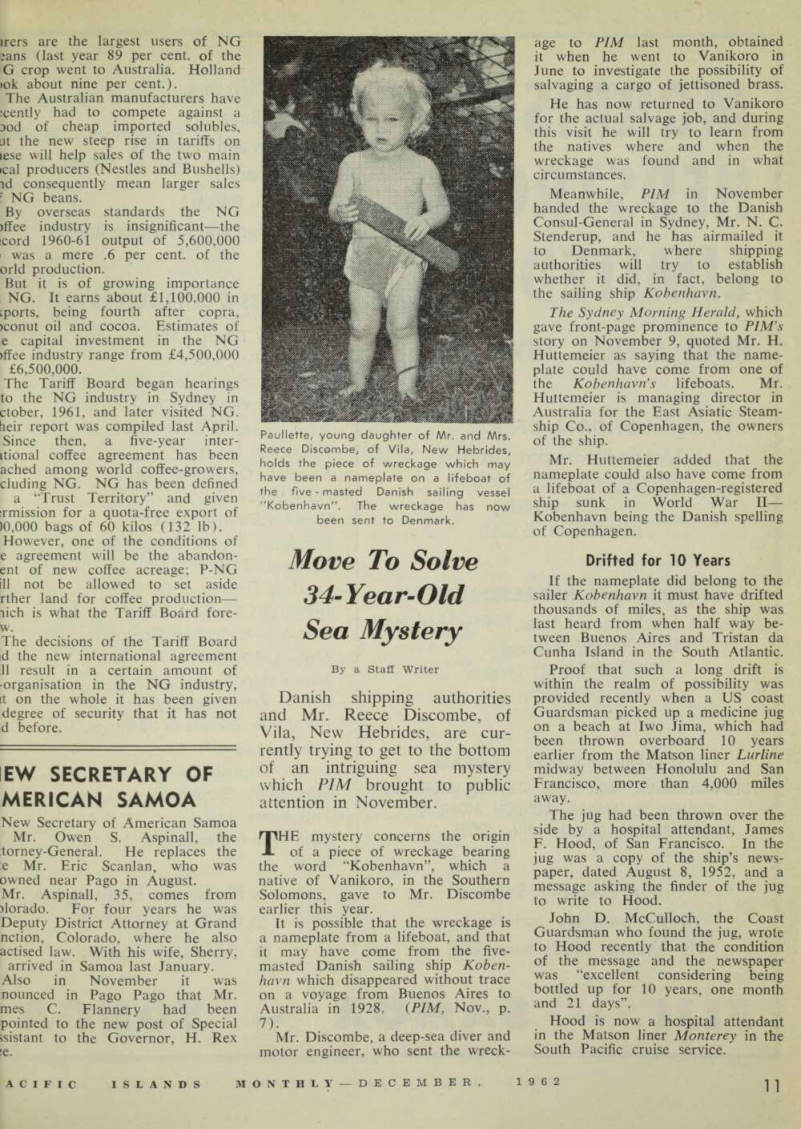
Move To Solve 34-Year-Old Sea Mystery
By a Staff Writer
Danish shipping authorities and Mr. Reece Discombe, of Vila, New Hebrides, are cur rently trying to get to the bottom of an intriguing sea mystery which PIM brought to public attention in November.
THE mystery concerns the origin of a piece of wreckage bearing the word “Kobenhavn”, which a native of Vanikoro, in the Southern Solomons, gave to Mr. Discombe earlier this year.
It is possible that the wreckage is a nameplate from a lifeboat, and that it may have come from the five masted Danish sailing ship Koben havn which disappeared without trace on a voyage from Buenos Aires to Australia in 1928. (PIM, Nov., p. 7).
Mr. Discombe, a deep-sea diver and motor engineer, who sent the wreck
age to PIM last month, obtained it when he went to Vanikoro in June to investigate the possibility of salvaging a cargo of jettisoned brass.
He has now returned to Vanikoro for the actual salvage job, and during this visit he will try to learn from the natives where and when the wreckage was found and in what circumstances.
Meanwhile, PIM in November handed the wreckage to the Danish Consul-General in Sydney, Mr. N. C.
Stenderup, and he has airmailed it to Denmark, where shipping authorities will try to establish whether it did, in fact, belong to the sailing ship Kobenhavn.
The Sydney Morning Herald, which gave front-page prominence to PlM’s story on November 9, quoted Mr. H, Huttemeier as saying that the name plate could have come from one of the Kobenhavn’s lifeboats. Mr.
Huttemeier is managing director in Australia for the East Asiatic Steam ship Co., of Copenhagen, the owners of the ship.
Mr. Huttemeier added that the nameplate could also have come from a lifeboat of a Copenhagen-registered ship sunk in World War II Kobenhavn being the Danish spelling of Copenhagen.
Drifted for 10 Years If the nameplate did belong to the sailer Kobenhavn it must have drifted thousands of miles, as the ship was last heard from when half way be tween Buenos Aires and Tristan da Cunha Island in the South Atlantic.
Proof that such a long drift is within the realm of possibility was provided recently when a US coast Guardsman picked up a medicine jug on a beach at Iwo Jima, which had been thrown overboard 10 years earlier from the Matson liner Lurline midway between Honolulu and San Francisco, more than 4,000 miles away.
The jug had been thrown over the side by a hospital attendant, James F. Hood, of San Francisco. In the jug was a copy of the ship’s news paper, dated August 8, 1952, and a message asking the finder of the jug to write to Hood.
John D. McCulloch, the Coast Guardsman who found the jug, wrote to Hood recently that the condition of the message and the newspaper was “excellent considering being bottled up for 10 years, one month and 21 days”.
Hood is now a hospital attendant in the Matson liner Monterey in the South Pacific cruise service.