Polynesian Voyages
pp. 97-99 · Read in the full issue

There's Still Room For Unbelievers On Those Polynesian Voyages
• GORDON RUSSELL, formerly of Rarotonga and now a resident of Wellington, New Zealand, was spurred to write the following article after reading Captain Brett Hilder’s article on ancient Polynesian voyages in August PIM, p. 67. Captain Hilder said in his article that New Zealander Andrew Sharp had “proved convincingly ” in his book, Ancient Voyagers in the Pacific, that all voyages over 300 miles were accidental drifts. Gordon Russell does not accept this. He says Sharp may have argued convincingly, but has proved nothing. Here he tells why he thinks so.
By Gordon Russell
Like many others who have studied the problem of how the early Polynesians made their long Pacific voyages, I deplore the cold logic of Andrew Sharp which is being accepted as the final answer to this question.
WHEN Sharp’s Ancient Voyagers in the Pacific appeared in 1958, in sisting that early voyages were acci dental rather than deliberate, it cut a nasty gash across the picture that the traditionalists had patiently pieced to gether some 50 years earlier.
The surprising thing is that no one had attempted to do this earlier, for it was easy for anyone unfamiliar or unimpressed by Polynesian traditions to believe, with Captain Cook, that the dispersal of a primitive people over such a vast expanse of ocean was accidental.
However, I believe that although any race not possessing skills is inclined to be classed as “primi tive,” those early Polynesian “primi tives” were in tune with the universe to a degree that is beyond our com prehension today.
Part of our trouble is that we view this world through little squares of latitude and longitude and have be come enmeshed in them.
The stars have been on their present courses for long enough and one thing that Captain Brett Hilder failed to mention in his article in PIM in August (p. 67) is that the compass we rate so highly was evolved by “primitive” mariners from the points of rising and setting of those stars on those courses.
The Polynesian of old was com pletely identified with nature and his conception of creation was surely conceived by ancient mariners for the edification of initiates.
In the beginning there was the Sky Father and the Earth Mother and a great darkness prevailed until Tane and other offspring forced their parents apart and brought light into the world.
With further assistance Tane fashioned the sun, the moon and the stars and to supplement the light of the moon he gathered the stars in a basket and attached them individually and in clusters to the breast of Atea, the Sky Father.
In such manner was the Hanging Sky of the Polynesians brought into being. Below, upon the breast of the Earth Mother, were the abodes of man.
His fortunes were decided by his knowledge of, and his harmony with, the firmament.
I believe the essence of the Poly nesians’ maritime skills died with the navigators who made their objectives centuries ago.
Anything that came through to post-European times passed on with the priests who lost their standing with the new religion and died before we awoke to the potentialities of what remained of the oral traditions of this race.
Hence the inadequacy of sailing directions such as were quoted by Captain Hilder, derived from descend ants remote from the navigational knowledge of their forbears.
Even so, gleanings of what re mained when the first Westerners ap
peared raised many an eyebrow at the time.
How impressed were Captain Cook and his officers when the Tahitian chief Tupaea drew a rough chart showing the Society, Austral, Tua motu, Marquesas, Samoa, Cook and Fiji groups as we know them today!
How intrigued was Cook’s friend Banks with the Tahitian mariners of his day!
“In their longer voyages,” he wrote, “they steer in the day by the sun, and in the night by the stars.
“Of these they know a very large number by name, and the cleverest among them will tell in what part of the heavens they are to be seen in any month when they are above the horizon.
“They also know the time of their annual appearance to a great nicety, far greater than would easily be be lieved by a European astronomer.”
Ellis, an early and erudite mis sionary, recorded that “when setting out on a voyage some particular star or constellation was selected as their guide in the night. This they called their aveia and by this name they now designate the compass, because it answers the same purpose.”
By the phase of the moon the Polynesian marked the passage of the nights, planted his crops and ordered his activities. By the stars he read ;he time and defined his seasons.
Compass Card
His compass card was the Hanging sky of Tane and where the bearing nf a distant landfall was known, he narked its line through his land so hat it could be related to the stars ivailable at the time of departure.
By such means the pioneer mis sionary John Williams was given the :ourse to Rarotonga from the island )f Atiu in the Cook Group.
Beechey, an early visitor to the Marquesas, wrote of the meticulous decision with which such departures vere actioned.
No voyage so initiated could be :lassed as accidental. But how vould they establish and maintain a :ourse, say, to New Zealand from Rarotonga, not having been there be bre?
Sketch in the main flyways of the nigrant birds on a map of the Pacific md it becomes apparent that they unbrace every major movement that ve attribute to the Polynesian voy igers of old.
Heaviest traffic is upon the flyway hat moves southward from Siberia lown the China coast through Indo lesia and then swings in a great arc icross island chains and eastward to he far corners of tropical Polynesia.
From Indonesia onwards this broad flyway parallels what most authorities claim as the oceanic highway of the forebears of this race.
What of the two major movements credited to these mariners outward from the heart of Polynesia, to Hawaii in the north, to New Zealand in the south-west?
The particular flyway of the golden plover and the bristle-thighed curlew is from Alaska straight to the heart of Polynesia via the Hawaiian islands.
The particular flyway of the long tailed cuckoo is from the South Seas to New Zealand and return.
Some two dozen species of shore birds make the same summer flight to New Zealand, an extension in many cases of the long journey from the north.
Birds have been used as navi gational aids since Pliny was a boy.
The Norsemen carried land homing birds on their Atlantic voyages.
When Christopher Columbus set out in 1492 he was well aware that the Portuguese had already dis covered the Azores by noting the directional flight of migratory birds.
Let us concede that the Polynesians had the brains to do the same and that they could adjust to changes in the pattern of their Hanging Sky with changes in latitude.
We would be doing these venture some voyagers an injustice to suggest that they were incapable of exploit ing the aerial trail blazers that cen tury after century winged their way from roosting place to roosting place within, through and beyond the bounds of their oceanic territory.
The importance of the bird in Oceanic art is recognised. One example is the manaia, the mysteri ous bird-headed figure that is a com mon motif in the striking and vigor ous beauty of the wood-carving of the New Zealand Maori.
A bird-like figure appears in the baffling script of the Easter Islanders.
Another avian motif, the garuda, a mythical figure, half-man, half-bird, that is the regal symbol of Thailand was recently in the news during King Phumiphon’s visit to New Zealand.
King Phumiphon evinced a keen in terest in Maori artifacts and customs.
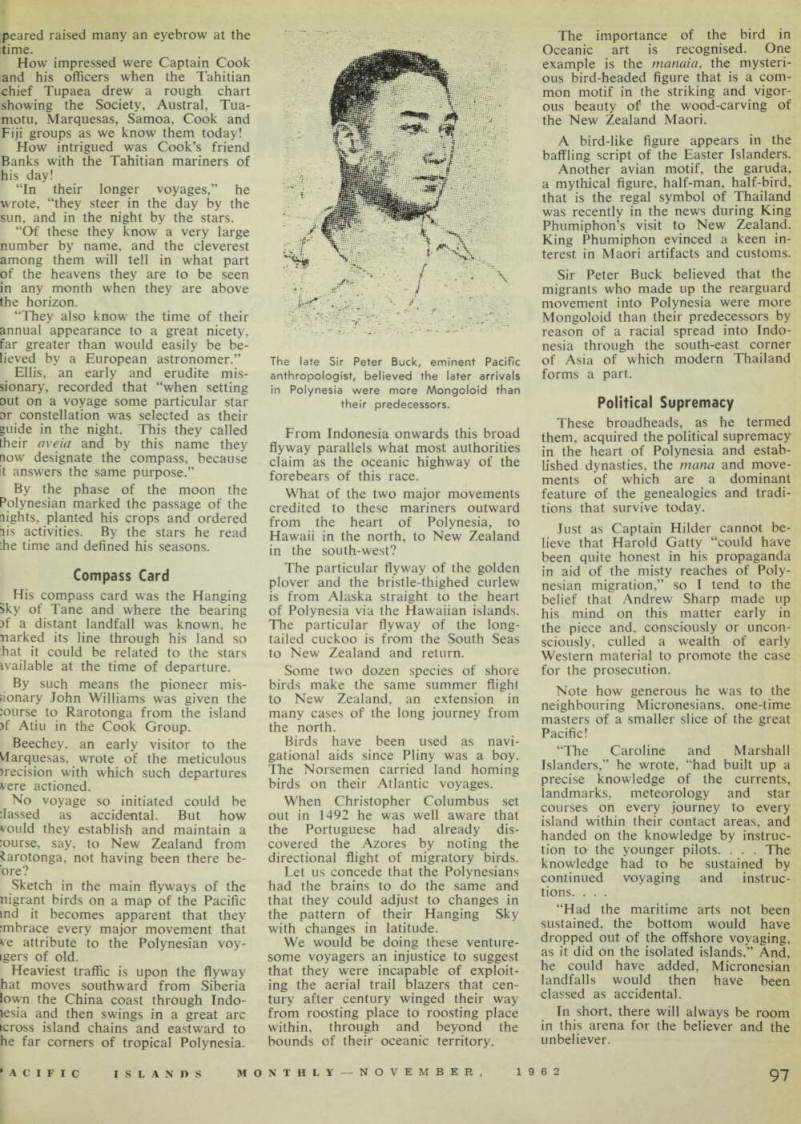
Sir Peter Buck believed that the migrants who made up the rearguard movement into Polynesia were more Mongoloid than their predecessors by reason of a racial spread into Indo nesia through the south-east corner of Asia of which modern Thailand forms a part.
Political Supremacy
These broadheads, as he termed them, acquired the political supremacy in the heart of Polynesia and estab lished dynasties, the mana and move ments of which are a dominant feature of the genealogies and tradi tions that survive today.
Just as Captain Hilder cannot be lieve that Harold Gatty “could have been quite honest in his propaganda in aid of the misty reaches of Poly nesian migration,” so I tend to the belief that Andrew Sharp made up his mind on this matter early in the piece and, consciously or uncon sciously, culled a wealth of early Western material to promote the case for the prosecution.
Note how generous he was to the neighbouring Micronesians, one-time masters of a smaller slice of the great Pacific!
“The Caroline and Marshall Islanders,” he wrote, “had built up a precise knowledge of the currents, landmarks, meteorology and star courses on every journey to every island within their contact areas, and handed on the knowledge by instruc tion to the younger pilots. . . . The knowledge had to be sustained by continued voyaging and instruc tions. . . .
“Had the maritime arts not been sustained, the bottom would have dropped out of the offshore voyaging, as it did on the isolated islands.” And, he could have added, Micronesian landfalls would then have been classed as accidental.
In short, there will always be room in this arena for the believer and the unbeliever.
The late Sir Peter Buck, eminent Pacific anthropologist, believed the later arrivals in Polynesia were more Mongoloid than their predecessors.