There's Beauty And History In
pp. 91-95 · Read in the full issue
The Neglected Duke Of Yorks
By Lew Priday
Nowadays, few of Rabaul’s Europeans ever visit the Duke of York Group, even to picnic. They tell you the Group is an uninteresting backwater.
Yet the Group is an altogether de ightful place, memorable for its luthentic low-island beauty, besides jeing the most interesting land, listorically, in the whole Bismarck \rchipelago. The Duke of Yorks, in : act, were the cradle of European ►ettlement in the archipelago.
My interest in the Duke of Yorks >oes back to the 1920’s when, returni ng to Europe after a long spell in Mew Zealand, I went to Berlin and Dade friends with a German who was steeped in the lore of the New Cuinea islands.
He was Professor Eichhorn, a Lutheran ex-missionary, who was :hen curator of the Berlin Ethno ogical Museum.
It was from him that I first heard Df the Bismarck Archipelago, of places he called Neu Pommern, Neu Mecklenburg and Neu Lauenberg; of an explorer named Finsch; and of an administrator named Buluminski.
Today we again know Neu Pom mern as New Britain, the name Dampier gave it in 1700; Neu Meck lenburg has reverted to New Ireland, Carteret’s christening during his wonderful voyage 67 years later; while Neu Lauenburg is once more the Duke of York Group, as the first whalers, traders and missionaries knew it, and as the Germans them selves printed it on their first maps.
The tiny Duke of York islands lie athwart St. George’s Channel half way between Blanche Bay on which Rabaul lies, and southern New Ireland.
When you stand on the Duke of Yorks looking eastward, you see a striking row of volcanoes, the North Daughter, Mother and South Daughter, looking still much as
Captain Hunter of the Sirius saw them in 1791.
From the other side of the group, across another 20 miles of sea to the west, you see the long high coastline of New Ireland, rising to 6,000 feet.
The charm of the Duke of Yorks is that they are in complete contrast to both of these immense, dark, high silhouettes.
Whereas New Britain and New Ireland were formed by subterranean convulsions of a magnitude impossible to conceive, the Duke of Yorks, only 22 square miles in all, have been pushed up through the ages by the gentle and incessant growth of coral.
Today they are only just high enough to save them from being swamped by tidal waves from their great vol canic neighbours. They are insig nificant looking, and you have to gaze low over the ocean to pick them up, but once there you are charmed by their almost Polynesian grace and fruitfulness, in the midst of so much Melanesian sternness.
Though their inhabitants used to be famous canoe builders and warlike raiders, their numbers were limited,
so the Duke of Yorks appealed to the first Europeans for their relative safety, as well as for their protected anchorages.
Whalers from Sydney came there; then the first trader, an Australian, whose station was burnt down. Then, in the late 1870’s, came “Queen Emma” Forsayth and the New Zea lander Tom Farrell, who had kept a waterfront bloodhouse at Apia.
These two played a notable part in rescuing some of the unhappy French and Italian colonists dumped on New Ireland by the Marquis de Rays; and it must have been for them that Louis Becke ran a trading post. Becke wrote afterwards: “To the aid of the despairing French and Italian colonists came Tom Far rell, the trader of the Duke of York Islands. He gave them provisions, advanced them money, and treated them well, taking care to get pos session of their steamer Genii and their barque the Marquis de Rays.
“The Genii he sent to Australia under command of an English cap tain. Rabardy, the French captain, was dead by then. His dying words to me, as he grasped my hand, were: ‘I have tried, but failed. I had not one competent officer with me to maintain my authority, or shoot some of the ruffians who have ruined the expedition’.”
Besides Rabardy and other French colonists buried at Mioko, Becke says that six more Frenchmen were eaten by cannibals of the islands there abouts, and a score of others who remained probably went down under
Australian writer Louis Becke spoke to Captain Rabardy during his last hours.
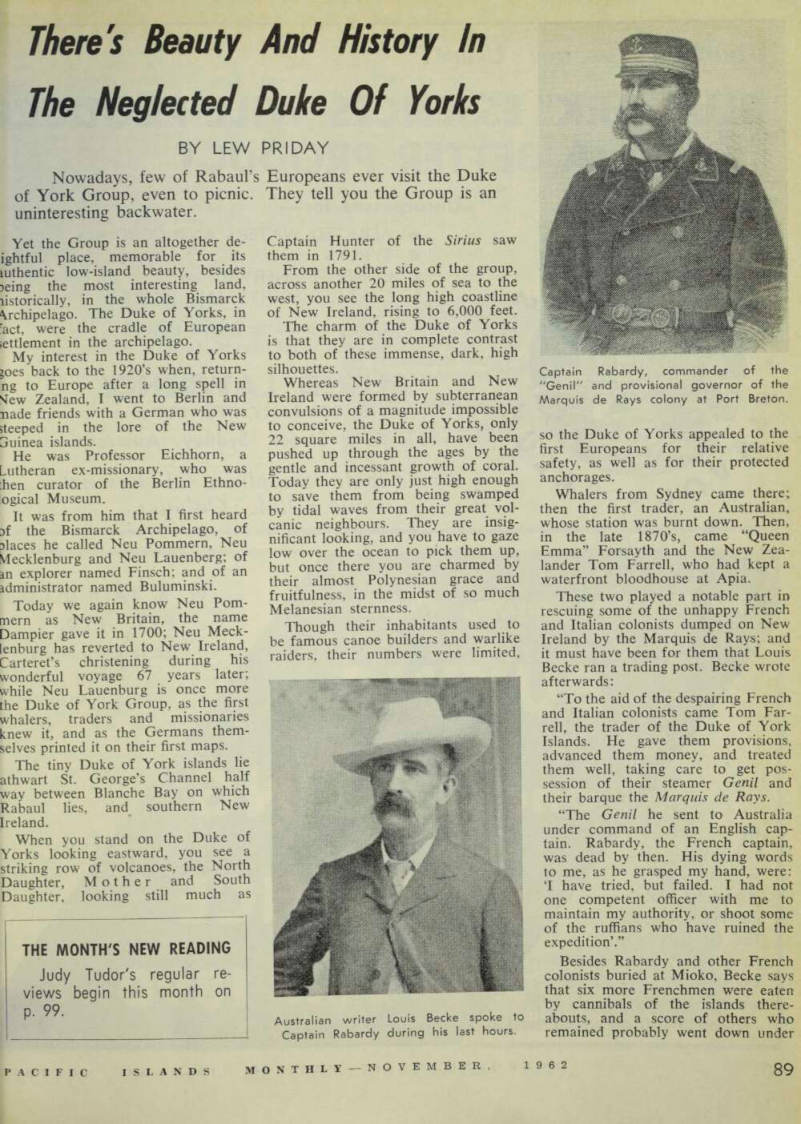
Captain Rabardy, commander of the "Genii" and provisional governor of the Marquis de Rays colony at Port Breton.
ic spears and clubs of the wild eople of the archipelago.
Only one, named Mouton, suc seded; he became owner of a large lantation adjoining one of “Queen mma’s” on New Britain.
Another of the colonists who did ;main was Father Lannuzel. After visit to Sydney, he returned to be ome the first Catholic missionary in lew Britain, where he died.
The Methodist missionaries Brown nd Danks, who were on the Duke of r orks some years before him, were le first to bring Christianity to the lew Guinea Islands. They gave the darquis de Rays colonists as much id as Tom Farrell, but did not make he same profit out of them.
Although I had been interested in he Duke of Yorks for many years, it /as not until recently that I visited hese historic islands.
Fine Groves of Coconut Chugging across St. George’s Channel from Rabaul’s Blanche Bay n a fishing launch, we turned into he lagoon which separates Duke of fork, the largest island, 8 miles long »y 4 miles wide, from the pleasant sland of Ulu. Here are fine groves >f coconuts planted long ago, and 'reen slopes and gardens leading up o a former Methodist training chool.
All the first Germans in New juinea were more or less closely connected with the Duke of York Troup. It was here, for instance, hat the powerful Hamburg-Samoan irm of Goddefroy and Son had its beginnings in the New Guinea area.
The Germans put a stop to the :annibal practices of the natives and ;o their traffic in bodies which had some connection with their rites, and ;oday the natives are no more frightening than children’s ghost stories.
Ahead of us was Mioko, where Farrell and other traders, with the help of the Frenchman Rabardy and the guns of the Genii, beat off an attack by the troublesome natives of nearby Utuan, This was in 1881.
The natives had murdered the Ger man botanist Kleinschmidt, who was collecting for the Berlin Museum. To my mind it was the German’s fault, for though he claimed to have bought the island, he tried to prevent the natives from walking over it, a pro hibition they could not understand, as he might well have known.
The Germans sent a warship to in quire into Kleinschmidt’s death, a move which led to Germany pro claiming sovereignty over the area.
The British also sent an official in Hugh Hastings Romilly, acting gover
nor of Papua, who found that Farrell had acted in self-defence.
South of Mioko (where I visited the grave of Rabardy and other French colonists) is Kerewara, another small island. This was the first seat of government in the Bismarck Archipelago after Germany laid claim to part of New Guinea in 1884.
Kabakon, a small southerly outlier of the group, was the home of the “simple-lifer” Englehardt until World War I. He is said to have lived exclusively on a coconut diet.
He argued that a man could live on 10/- a year—the produce of five
coconut trees. He had 200 acres of them, but spent the money earned from what he didn’t eat, on German and English books.
A philosopher, he had no time for the sword-rattling Germany of his day. Neither had the ardent naturalist Herr Bradke, who shared his island for a while. Englehardt wore clothes only to receive visitors, and it was said that he slept in or on the sand according to temperature.
At Ulu jetty a young Australian missionary joined us to pilot our fish ing launch round Duke of York Is land.
rhrough Makada lagoon we passed he northern Makada Island, where he first great German trader Hern >heim—a bitter enemy of Parkinson, 3ueen Emma’s friend and asso ciate—had his main station.
Rounding a tiny flower-basket sort af coral island into full view of New Ireland, we came to Mioko or Port Hunter. Ashore we met Mr. and Mrs. Poole, the Methodist missionary and his wife, who was in charge of what had begun as the first Christian settlement in the whole of New Guinea.
Mrs. Poole’s first husband, Mr.
Mannering, was the missionary there when World War II reached Rabaul.
The Japanese took him to Kavieng and beheaded him.
The two missionaries showed me where the Rev. George Brown’s first mission house once stood—on a cliff at the northern entrance to the bay.
Today both the mission and the church are down on the flat, along which stretch the huts of Mioko village. Brown was New Britain’s first permanent resident.
On each side of this deep, peace ful, and historic little stretch of water the land rises, covered with tall bush, vines and creepers, with orchids growing on the branches of the trees.
We took some of them back with us to see if they would grow in Rabaul.
A fine dugout canoe on the beach, resembling one illustrated in Captain Hunter’s account of his voyage, re minded us that the Duke of York islanders were not far below the Solomon islanders as craftsmen.
Hanging on a line were a number of small fish traps. They were unique
in my experience. They had a cone like framework of native thorns, the thorn side turned inwards so that a fish pushing its head in to get at the bait, could not pull it out again.
The trap is attached by a length of native rope to a float of balsa wood.
We spent a couple of hours picnicking on the beach, boiling the billy and enjoying the steaks we had brought with us from Rabaul. It was not exactly secluded as most of the villagers came along to see us per form.
On the way over from Rabaul it had been calm; we saw a couple of whales spouting and the owner of our fishing launch had a few pot shots at sharks with his rifle.
The sea on our return was not so calm. In fact, it was too rough for fishing, so we pulled in our lines and sought shelter from the spray.
I had already learned from masters of small ships on Rabaul’s waterfront that St. George’s Channel is notorious for its currents in the monsoon season.
We had no trouble with these, but I could not help remembering the story of the German barque Etienne, which, in the days of sail, spent the best part of three months beating up a distance of 20 miles.
In the morning she would make a good start and almost reach her ob jective, only to drift back by sunset, sometimes even further than she had come in a day.
In these conditions, the Duke of Yorks were a haven of refuge. They still are a haven today for anyone seeking beauty and the sites of many an historical incident.
Duke of York Islanders by the cairn over the graves of Captain Rabardy and other Frenchmen from the ill-fated Marquis de Rays colony at Port Breton, Duke of York Island.