The Big Industry
pp. 55-57 · Read in the full issue

Coconut Oil Is The Big Industry In New Britain
From a Rabaul Correspondent The heavy-sweet aroma of co
nut oil lingering on the night
■ about Toboi, New Britain, is
out the only romantic aspect
the Territory’s hardworking
crushing industry.
T Toboi with giant steel storage L tanks overlooking the plant, men ►rk 24 hours a day, 365 days a ar, to extract valuable coconut oil >m Islands copra.
Part of the empire of Coconut oducts Ltd., the oil crushing mill is established in 1952 and is now pable of processing 40,000 tons of pra annually. With a staff of 80d comprised of 12 Europeans, five shift workers and day jourers and Asiatic maintenance ;n the mill turns out an approxi ate 75-80 tons of crude oil a day ang with 35 tons of meal.
Inside the mill, which is powered its own plant with its own fresh iter supply, copra is fed down utes to hammer mills which epare it for crushing.
Complicated Process
A system of hammers and knives duces the copra to a granulated nsistency after which it passes into bank of expeller machines, thence rough a screening tank and a tering press while simultaneously :ing reduced in temperature by rculation through an oil cooling t.
The results of this process are a smelling transparent liquid oil ith the consistency of water and a scuit-like meal comprised of the oots” or fibrous copra matter.
The apparently simple extraction ■ocess requires exacting and durable achinery as CPL’s chief engineer hris Petersen is the first to ;clare.
Care of the hammer mills, the ink of expeller machines and all her mill machinery falls on Mr. etersen and his maintenance men ho check regularly for abrasion ear and tear.
While the crude coconut oil is limped into the storage tanks to ivait shipment, bags of meal ac amulate in storage sheds. At four to
five week intervals a ship ties along side CPL’s wharf for several days to take on her load of bulk oil and an equivalent tonnage of meal for Aus tralian, UK and Continental ports.
This ceaseless industry is re sponsible for an annual export of approximately 22,000 tons of oil, the mill being the only one of its kind in the Territory.
This year it is estimated P-NG will produce 110,000 tons of copra of which she will export 65,000 tons.
The balance will be processed for oil for final delivery mainly to the UK and Continent.
The principal purchasing countries of copra and coconut oil are USA, Western Germany, UK, India, France, Sweden, Netherlands and Japan. For the year ended 1960 it is reported the Netherlands imported 146.000 tons of copra, France 85,000 tons, Italy 22,000 tons, Belgium 29.000 tons and Western Germany 246.000 tons.
The Markets Of the 65,000 tons exported from P-NG, approximately 35,000 goes to Australia with the balance being taken up mainly by the UK.
Western Europe is considered the main regional market for both copra and coconut oil, with the UK and Western Germany the leading pur chasers but USA could be considered the largest importer.
In P-NG the sale of copra is con-
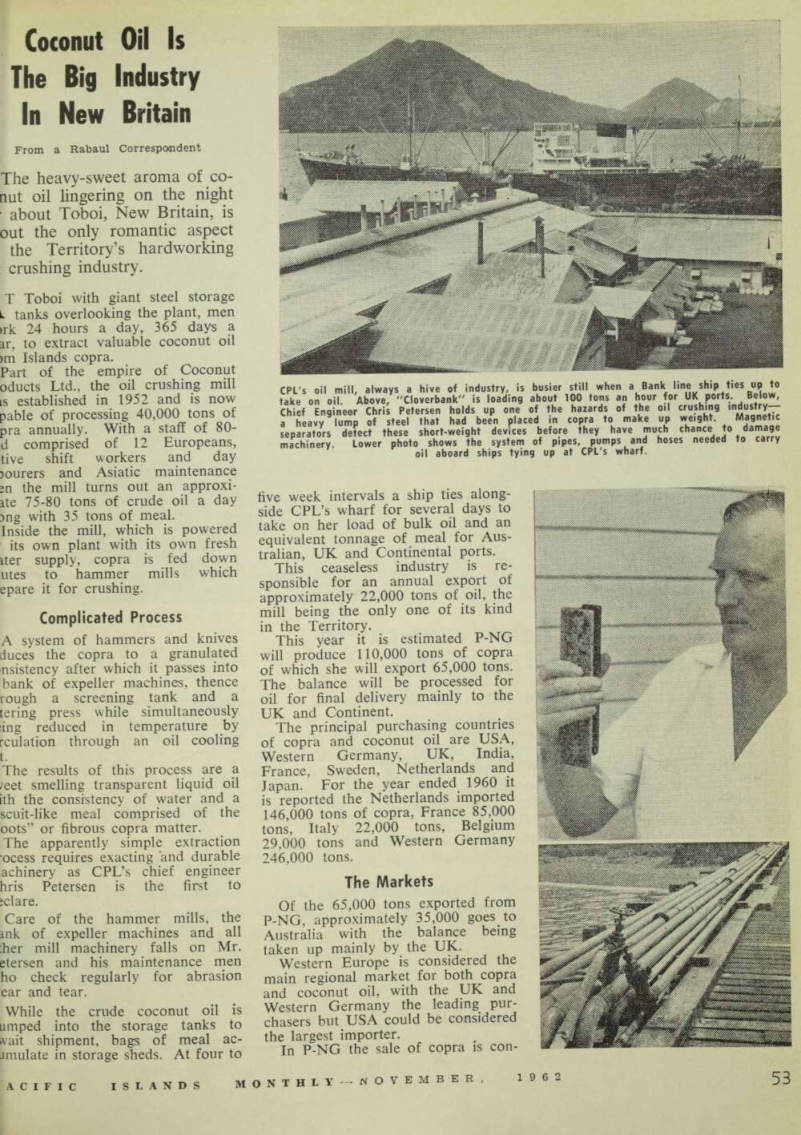
CPL's oil mill, always a hive of industry, is busier still when Bank line ship ties up to take on oil. Above, "Cloverbank" is loading about 100 tons an hour for UK ports. Below, Chief Engineer Chris Petersen holds up one of the hazards of the oil crushing . a heavy lump of steel that had been placed in copra to make up weight. Magnetic separators detect these short-weight devices before they have much chance machinery. Lower photo shows the system of pipes, pumps and hoses needed to carry oil aboard ships tying up at CPL's wharf.
•oiled by the P-NG Copra Market ig Board which came into existence fter World War 11. All copra xported is subjected to its inspection nd is classified into three grades— lot Aid, FMS, and Smoke. (These re grades and do not necessarily efer to the manner in which copra > produced).
Of the Territory’s total production f 110,000 tons the main concentra ion in the ports is through Rabaul 65.000 tons annually), Kavieng 13.000 tons), Lorengau (2,000 ons), Madang (14,000 tons) and Lae 1.000 tons). On the Papuan side jroductkm is in the vicinity of 5.000 tons distributed between Port Moresby (7,500 tons) and Samarai 7,500 tons).
Big Increase
Since the war and despite the liversification of interests with the ntroduction of cocoa, copra pro luction has increased considerably in he Territory. The introduction of x>pra inspection and grading for ;xport has been responsible for »reatly improved quality with Hot Mr now representing 42 per cent., FMS, 40 per cent, and Smoke 18 per cent.
New Guinea’s plantations range
from small to large holdings, many now company-owned (CPL itself owns 30) but copra from native owned and managed holdings is steadily increasing.
Along with increased quality pro duction has come the need for expanded markets and here New Guineans look with some hope to Australia, long a laggardly importer of coconut oil.
CPL’s example in setting up an oil crushing industry should be followed logically, many Territorians feel, by the establishment of more local secondary industry.
Australia’s encouragement of the oil industry could bring about the secondary industries necessary for the country’s development.
A £178,000 contract for the con struction of studios for the Australian Broadcasting Commission at Port Moresby has been let to D. C.
Watkins Limited. The building, for which plans have been prepared by the Commonwealth Department of Works, will have administrative offices in a two-storey wing and an adjoining wing will accommodate three sound studios and a large tape and record library. The building is expected to be finished within a year.
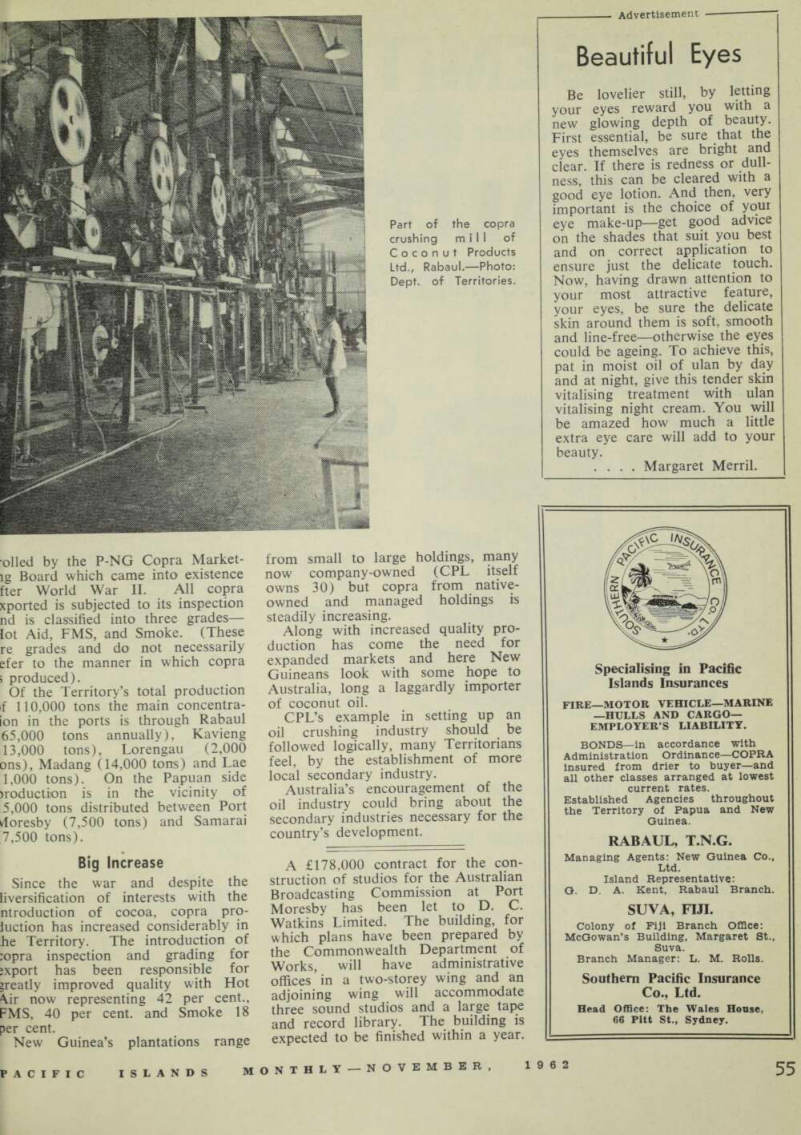
Part of the copra crushing mill of Coconut Products Ltd., Rabaul. —Photo; Dept, of Territories.