The End Of
pp. 49-50 · Read in the full issue
An Era
By Judy Tudor
The photographs of Hollandia, West New Guinea, on this page are part of a vanishing era.
They represent Dutch rule—by next May the town they depict will have changed its name and be administered as part of the Indonesian Re
public.
/ took the photographs in September , on the eve of the UN take-over of West New Guinea.
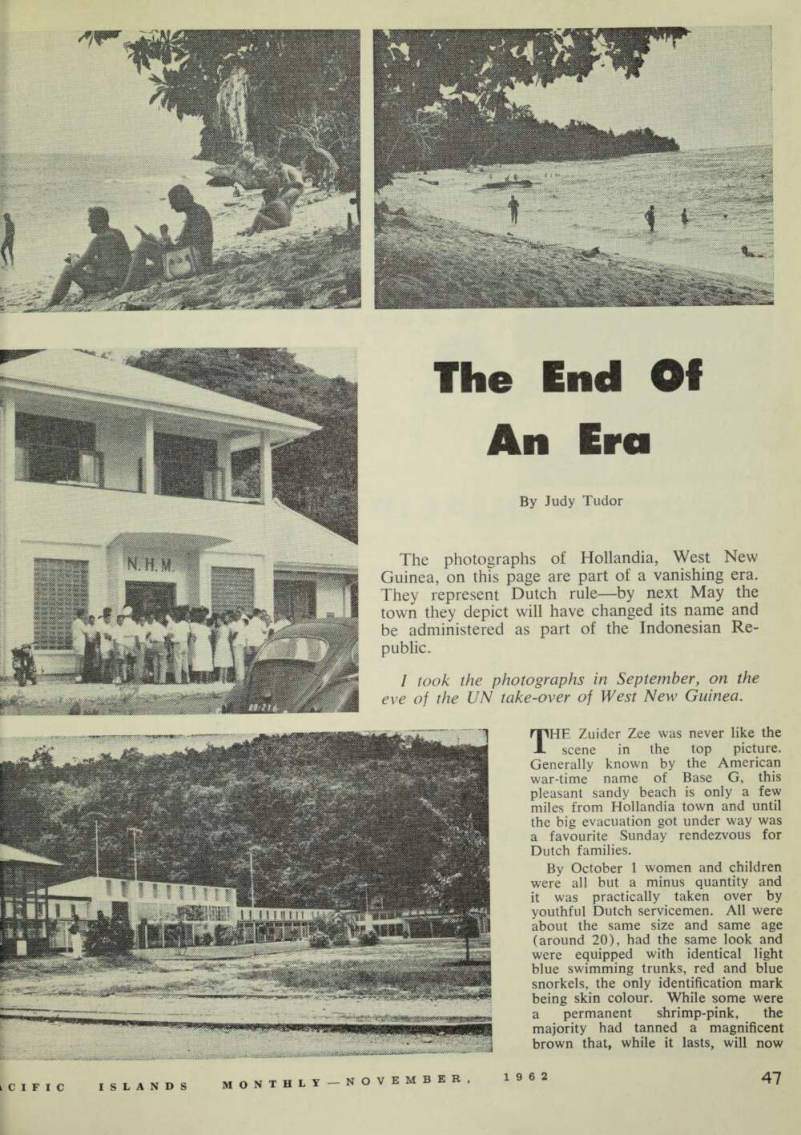
THE Zuider Zee was never like the scene in the top picture.
Generally known by the American war-time name of Base G, this pleasant sandy beach is only a few miles from Hollandia town and until the big evacuation got under way was a favourite Sunday rendezvous for Dutch families.
By October 1 women and children were all but a minus quantity and it was practically taken over by youthful Dutch servicemen. All were about the same size and same age (around 20), had the same look and were equipped with identical light blue swimming trunks, red and blue snorkels, the only identification mark being skin colour. While some were a permanent shrimp-pink, the majority had tanned a magnificent brown that, while it lasts, will now
be making them the envy of their mates back in Holland.
Base G has a break in the reef, a pale approximation of surf, warm blue water, yellow sand and is the pleasantest swimming beach in the whole of New Guinea—P-NG in cluded.
A focal point in Hollandia towards the end of September, when time was running out for the Dutch in New Guinea, was Hollandia’s one and only bank, the Nederlandse Handel Maatschappij. The centre picture shows the morning crowd waiting for the doors to open so that they could change their Dutch New Guinea guilders into hard currency— preferably sterling.
Because of this daily run on the bank, and because the United Nations Temporary Executive Authority had not then announced the convertibility of the NG currency, the bank announced on September 20 that it would close on September 24. This precipitated a bigger-than-ever run on the bank but stirred UNTEA’s financial brass to some action. It would guarantee the local guilder.
The bank then decided to keep functioning “at least until May 1, 1963”.
The lower picture on the page shows the present New Guinea Council building, Hollandia (centre) flanked by part of the new shopping centre. The shops are—were—
privately owned. The shopp centre-Council Chambers occup one side of the town square; fac it, on the opposite side, was to the new NG Council Chambers huge concrete building of which o the skeleton at present has b( completed.
The square was planned as gan and lawns— eventually; but at pres it is just an area of rough groi and weeds, and the Hollandia 5 anniversary memorial.
It will be a miracle if the lat long survives the Indonesian ta over on May 1, 1963, and the christening of the town as Kotaba The original Hollandia, founded a sort of patrol -post in 1910, was the site of what is now call Hollandia Binnen, and it was, in fa Hollandia until the present town v built on the foreshores of Humbo Bay in the last half-dozen years.
Hollandia Binnen occupies l narrow piece of land between I head of the Inner Harbour (whi has a narrow entrance to the Oui Harbour and Humboldt Bay) a Lake Sentani, which is now a fre water lake but is considered to ha once been an arm of the sea.
This Hollandia was so called answer to the Germans who, whi they owned what is the Australii Trusteeship Territory, called a stati near the border “Germania”. (T border is only about 20 miles frc Hollandia and, on a clear day, dista headlands of the Trusteeship Ter tory can be seen).
Building a settlement at Hollanc Binnen was an obvious choice there was comparatively flat la there, while in modern Hollandiai except for the foreshore area arou the shopping centre—the land ris steeply from the bay. But when t] Americans put Humboldt Bay to u during the war, they pushed roads everywhere and these gave the But! a start in building their modern tow Old Hollandia today is prei: much in eclipse, although it is som thing of an education centre wf several schools and teachers’ trainii college.
Hollandia was not the capital Dutch New Guinea until 1944 who during American occupation, it H came the centre of Netherlanr Administration. Before the DNG was administered from Ambca Netherlands Indies. The first But] Administrative centre—but not tJ capital—was at Manokwari, estas lished in 1898. This was follows shortly by the establishment Fakfak on the west coast and, 1902, by Merauke on the soul coast.