Fishin'
pp. 93-95 · Read in the full issue

Nino Goes
Creating a book with the im
mediate reader-appeal of They’re
a Weird Mob, would hoist any
writer by his own private petard
and, with Gone Fishin’, John O’Grady seems to have wrung the last drop of juice from the Nino Culotta situation.
AT that, the author should have no complaints. According to his publishers, no less than 450,000 copies of his first three books have been sold—which must constitute a record in Australian publishing.
Sales of They're a Weird Mob are responsible for 290,000 of this total, which still leaves the sales of Cop This Lot and No Kava for Johnny far beyond the dreams of most authors’ avarice.
Cop This Lot, a sort of Weird Mob in reverse, carried on the adventures of Nino and his dyed-in-the-wool Australian friends on a visit to Europe but No Kava for Johnny, was a departure from normal, being conceived and executed while the author was a pharmacist in Western Samoa.
In his latest book, O’Grady returns to the Culotta saga, Nino having gone to Australia from Italy and made good in the building business (Weird Mob), and returned to Europe with Australian wife and friends Dennis and Joe (Cop This Lot), now ( Gone Fishin’) is back
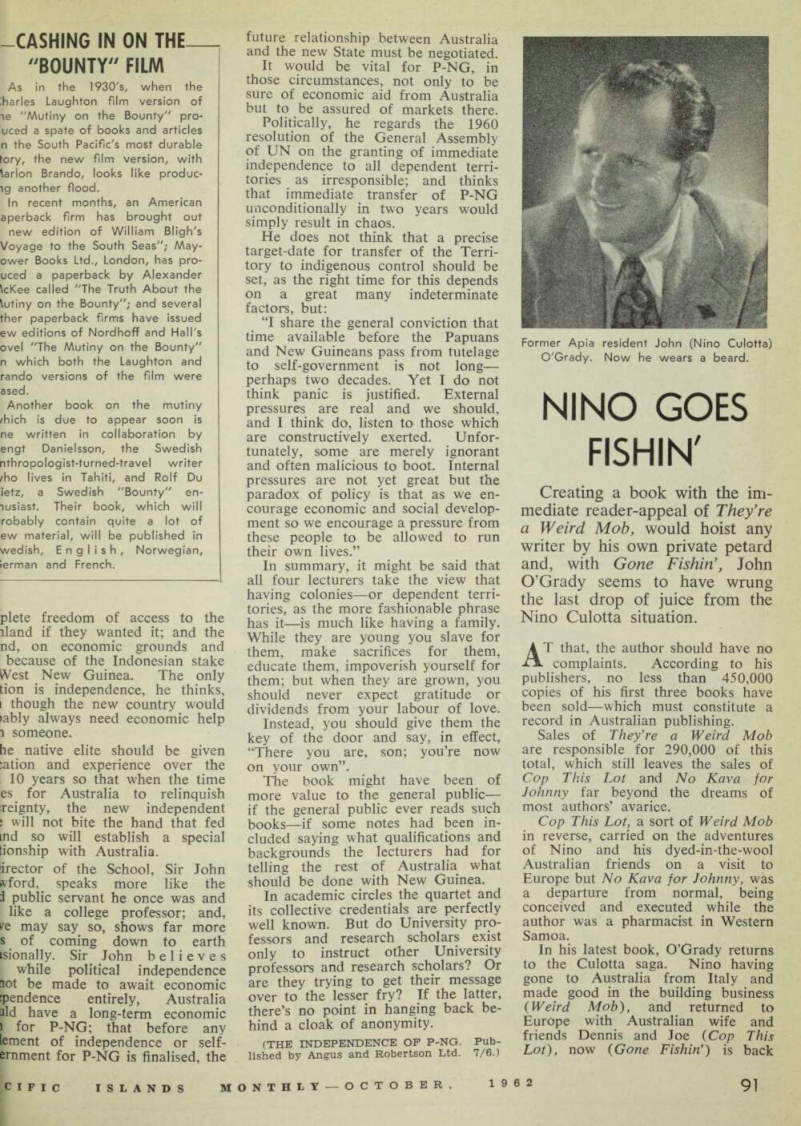
Former Apia resident John (Nino Culotta) O'Grady. Now he wears a beard.
Sydney in a building slump and a Ith breakdown. The doctor advises ing and a complete break for a r.
Jino interprets this in his own way goes in for fishing commercially, loesn’t repair the Culotta fortunes , story wise, it allows Nino to ;t a lot more weird Australians.
Tiere is Shorty who teaches Nino ropes and through his friend, the pector, gets him a licence.
'here is Rich, Shorty’s brother, > a fisherman, who explores the nomics of the interstate fish trade 1 ends up with a cheque for “three bloody ninepence” after vast lay for freight, commission, ice 1 boxes. ind there’s their old man. Old jrge, who has a passion for rum i prefers to do his fishing in gal, enclosed waters with a net of gal-sized mesh. Joe and Dennis ) make a brief reappearance. i.s with most of the O’Grady ies, it has something to it other n the Australian dialogue. Any ; contemplating fishing as a liveli id would probably find it illuminat , as it goes a long way towards laining why Australia, with the gest coastline of any country, pro es fish only as a luxury food item.
Jrady actually took to fishing (to ply a fish and chip shop he ight) so he knows what he is talk about. t also does a good promotion job the coastline south of Sydney, h. its miles of beaches and salt sons, usually referred to as lakes.
Tiere will always be academic uments as to whether O’Grady uld have called a halt after the ird Mob. Artistically it probably uld have been the right thing to economically more than anyone ild expect his publishers to stand Jut with O’Grady sales now push half a million, everyone should happy to call a halt before Nino, naive Australian, is completely le to death.
GONE FISHIN’. Published by Ure Ith Pty. Ltd. 18/9.
Fishing and cricket are two items fered in books for the sportsmen's vary this month—both books Itten by Australian experts on the iject.
ETTING sufficient out of the life of a 30-year-old man to make a ok would be enough to appal the erage biographer; but it doesn’t te A. G. (“Johnnie”) Moyes, who ss the cricket post-mortem tech jue on his subject-matter, Benaud.
Australian test-cricket captain,
Richie Benaud, began his “big cricket” career only in 1948 which leaves Moyes 13 years to write about.
He does this thoroughly, virtually over-by-over and ball-by-ball, through Australian Sheffield Shield and inter national matches in South Africa, India and Pakistan, the UK and West Indies. Every stroke of the bat, every ball he bowled (Benaud is an all rounder), is analysed.
This book is strictly for cricket fans —not the casual kind who occasion ally go to a Test, or watch it on TV or are mildly interested in the score while the tests are on, but the double-dyed fanatics who will love it.
Johnnie Moyes is a well-known cricket commentator on ABC radio.
When rain stops play, at tea breaks and in between overs, he can be guaranteed to give out with past records that reach right back beyond Dr. Grace, make dire predictions appropriate to any occasion and perform post-mortems on what has just happened, ad infinitum.
Fishing in Australia is by Lance Wedlick, who makes an exhaustive survey of the whole art as it applies to this Continent, from barramundi in the estuaries and tidal rivers of Northern Australia to trout fishing in Tasmania.
Every fish in the area is described, so is every method of catching them.
Trout fishing, rock fishing—which around NSW’s sandstone cliffs can be regarded as almost a lethal occupa tion —surf fishing, ocean fishing, big game fishing, all have a place in the book. There is also a long chapter on ancillary subjects—about tides, hiring a boat; why fish won’t bite; how to breed your own earthworms; camping, etc.
Bait, in general, and what bait to
use for which fish, is exhaustively discussed; so is gear and tackle, from the lowly handline or rowing-boat fishing to the expensive rods and reels of the devout trout fisherman.
The book is illustrated with dozens of diagrams on every fishing subject and with black and white
photographs.
Wedlick is a professional writer.
He supplies regular features on angling to several newspapers and magazines but writes also on other subjects. His book would make an ideal present for angling husbands and dads—even for wives and mums who are afflicted with the fishing bug, as many Australian women are.
(Benaud; 25/-; Fishing In Aus
TRALIA; 42/-; both published by Angus and Roberts \n Ltd.)