From Stone To
pp. 91-93 · Read in the full issue
The Month's New Reading
With Judy Tudor
Steel In
New Guinea
If New Guinea remains the least-known land under the sun, no blame at all attaches to the anthropologists of the world, who have given it almost undivided attention for half a century. Everything about the natives, from their biological urges to their neuroses, and from their off-duty activities to their method of building houses receives periodic attention. Conti nentals, Australians, New Zealanders and Americans have all taken part in it; in fact, the only kind of anthropologist New Guinea has not had is a native New Guinea one, and that surely is now only a matter of time.
LATEST addition to the accumula ted material on the area is From Stone to Steel, by R. F. Salisbury, who goes over with a fine-tooth comb the changing economic pattern of a small cultural segment of the Eastern Highlands people whom he calls the Siane.
As the name of the book indicates, he deals particularly with events dur ing the short period of changeover from stone axes to steel axes as this, more than any other material thing, was the most important impact Euro pean civilisation had had on these people at the time he knew them.
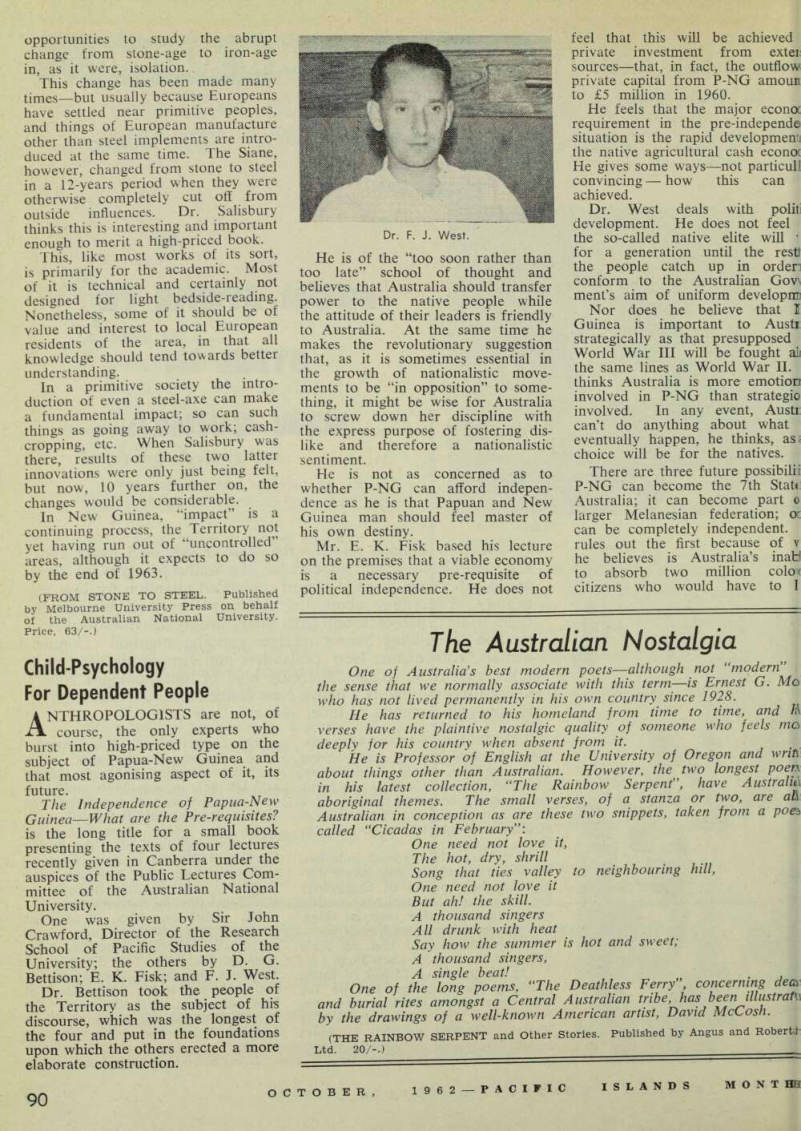
The Siane, about 15,000 of them, speaking one language, live on the high plains over 5,000 ft in elevation, between the Upper Asaro and Wahgi Rivers. Goroka is about 30 miles away, Chuave is the nearest patrol post on the main Highlands road.
The fringes of the Siane country were crossed by the first white explorers into the Highlands (Leahy and Dwyer), in early 1930, and again by more organised expeditions in 1933. At this time, the people used stone axes. No other Europeans went that way until after the Pacific War, in 1945, yet in that compara tively short time steel axes had found their way into the area through the traditional lines of native trade.
Dr. Salisbury, who is assistant Professor of Anthropology, Uni versity of California, conducted field work in the area, 1952-53, while a Research Scholar at the Australian National University, and found at that time that any adult over the age of 25 could tell him how things had been when stone tools were still in use.
This, he feels, gave him unique
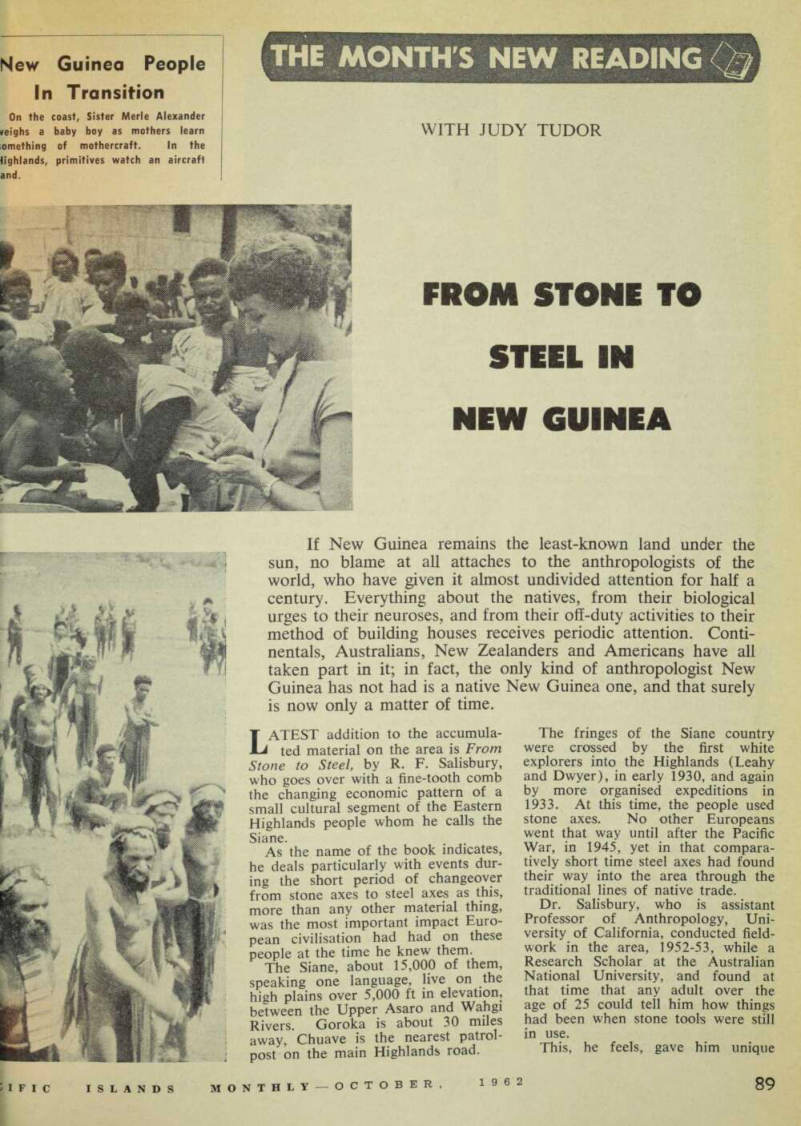
New Guinea People
In Transition
On the coast, Sister Merle Alexander [?]eighs a baby boy as mothers learn [?]omething of mothercraft. In the Highlands, primitives watch an aircraft and.
opportunities to study the abrupt change from stone-age to iron-age in, as it were, isolation.
This change has been made many times —but usually because Europeans have settled near primitive peoples, and things of European manufacture other than steel implements are intro duced at the same time. The Siane, however, changed from stone to steel in a 12-years period when they were otherwise completely cut off from outside influences. Dr. Salisbury thinks this is interesting and important enough to merit a high-priced book.
This, like most works of its sort, is primarily for the academic. Most of it is technical and certainly not designed for light bedside-reading.
Nonetheless, some of it should be of value and interest to local European residents of the area, in that all knowledge should tend towards better understanding.
In a primitive society the intro duction of even a steel-axe can make a fundamental impact; so can such things as going away to work; cash cropping, etc. When Salisbury was there, results of these two latter innovations were only just being felt, but now, 10 years further on, the changes would be considerable.
In New Guinea, “impact” is a continuing process, the Territory not yet having run out of “uncontrolled areas, although it expects to do so by the end of 1963. (FROM STONE TO STEEL. Published by Melbourne University Press on behalf of the Australian National University.
Price, 63/-.)
Child-Psychology
For Dependent People
Anthropologists are not, of course, the only experts who burst into high-priced type on the subject of Papua-New Guinea and that most agonising aspect of it, its future.
The Independence of Papua-New Guinea—What are the Pre-requisites? is the long title for a small book presenting the texts of four lectures recently given in Canberra under the auspices of the Public Lectures Com mittee of the Australian National University.
One was given by Sir John Crawford, Director of the Research School of Pacific Studies of the University; the others by D. G.
Bettison; E. K. Fisk; and F. J. West.
Dr. Bettison took the people of the Territory as the subject of his discourse, which was the longest of the four and put in the foundations upon which the others erected a more elaborate construction.
He is of the “too soon rather than too late” school of thought and believes that Australia should transfer power to the native people while the attitude of their leaders is friendly to Australia. At the same time he makes the revolutionary suggestion that, as it is sometimes essential in the growth of nationalistic move ments to be “in opposition” to some thing, it might be wise for Australia to screw down her discipline with the express purpose of fostering dis like and therefore a nationalistic sentiment.
He is not as concerned as to whether P-NG can afford indepen dence as he is that Papuan and New Guinea man should feel master of his own destiny.
Mr. E. K. Fisk based his lecture on the premises that a viable economy is a necessary pre-requisite of political independence. He does not
feel that this will be achieved private investment from extei; sources—that, in fact, the outflow private capital from P-NG amoun to £5 million in 1960.
He feels that the major econoc requirement in the pre-independe situation is the rapid development: the native agricultural cash econoc He gives some ways—not particull convincing how this can achieved.
Dr. West deals with politi development. He does not feel the so-called native elite will ’ for a generation until the rest! the people catch up in orden conform to the Australian ment’s aim of uniform developmi Nor does he believe that I Guinea is important to Austi; strategically as that presupposed World War 111 will be fought ali the same lines as World War 11. thinks Australia is more emotion involved in P-NG than strategic involved. In any event, Austi; can’t do anything about what eventually happen, he thinks, as< choice will be for the natives.
There are three future possibilii P-NG can become the 7th Staff; Australia; it can become part o larger Melanesian federation; oc can be completely independent, rules out the first because of v he believes is Australia’s inab to absorb two million colox citizens who would have to I
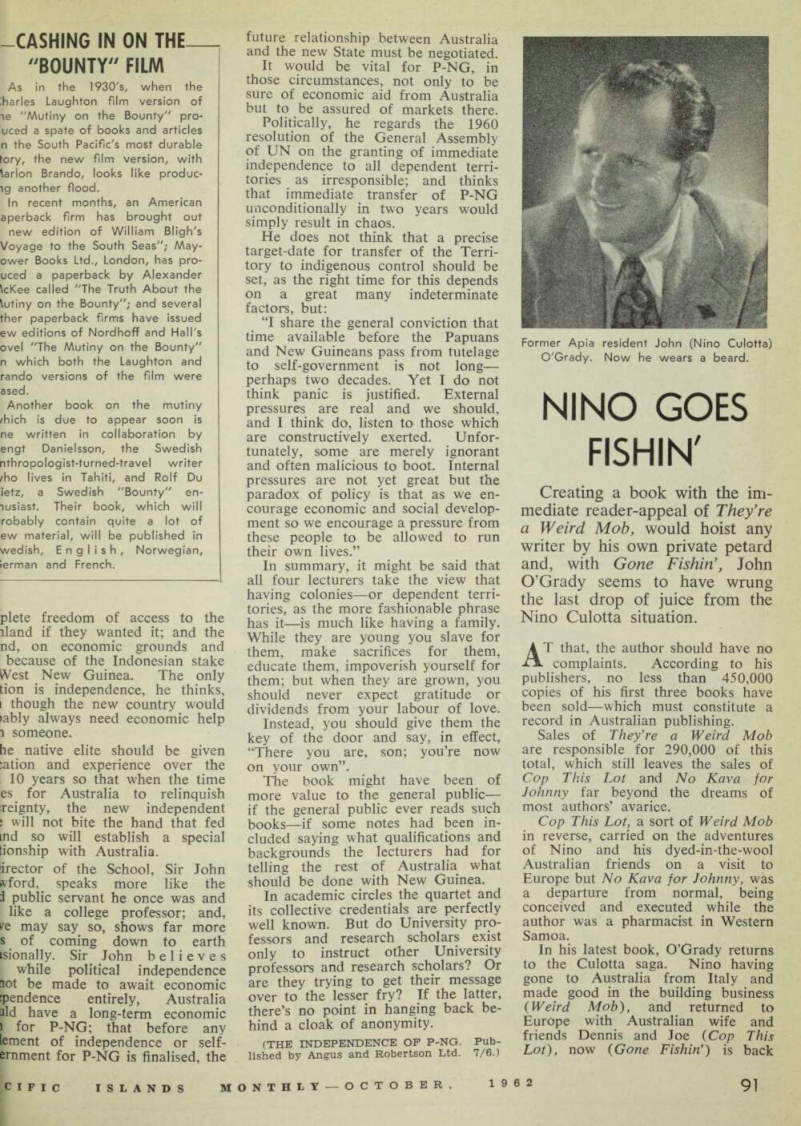
Dr. F. J. West.
plete freedom of access to the iland if they wanted it; and the nd, on economic grounds and because of the Indonesian stake West New Guinea. The only tion is independence, he thinks, i though the new country would tably always need economic help i someone. he native elite should be given ;ation and experience over the 10 years so that when the time es for Australia to relinquish Teignty, the new independent > will not bite the hand that fed md so will establish a special tionship with Australia, irector of the School, Sir John tvford, speaks more like the 1 public servant he once was and like a college professor; and, /e may say so, shows far more s of coming down to earth isionally. Sir John believes while political independence not be made to await economic ipendence entirely, Australia aid have a long-term economic i for P-NG; that before any lement of independence or self ernment for P-NG is finalised, the
future relationship between Australia and the new State must be negotiated.
It would be vital for P-NG, in those circumstances, not only to be sure of economic aid from Australia but to be assured of markets there.
Politically, he regards the 1960 resolution of the General Assembly of UN on the granting of immediate independence to all dependent terri tories as irresponsible; and thinks that immediate transfer of P-NG unconditionally in two years would simply result in chaos.
He does not think that a precise target-date for transfer of the Terri tory to indigenous control should be set, as the right time for this depends on a great many indeterminate factors, but: “I share the general conviction that time available before the Papuans and New Guineans pass from tutelage to self-government is not long— perhaps two decades. Yet I do not think panic is justified. External pressures are real and we should, and I think do, listen to those which are constructively exerted. Unfor tunately, some are merely ignorant and often malicious to boot. Internal pressures are not yet great but the paradox of policy is that as we en courage economic and social develop ment so we encourage a pressure from these people to be allowed to run their own lives.”
In summary, it might be said that all four lecturers take the view that having colonies —or dependent terri tories, as the more fashionable phrase has it—is much like having a family.
While they are young you slave for them, make sacrifices for them, educate them, impoverish yourself for them; but when they are grown, you should never expect gratitude or dividends from your labour of love.
Instead, you should give them the key of the door and say, in effect, “There you are, son; you’re now on your own”.
The book might have been of more value to the general public— if the general public ever reads such books —if some notes had been in cluded saying what qualifications and backgrounds the lecturers had for telling the rest of Australia what should be done with New Guinea.
In academic circles the quartet and its collective credentials are perfectly well known. But do University pro fessors and research scholars exist only to instruct other University professors and research scholars? Or are they trying to get their message over to the lesser fry? If the latter, there’s no point in hanging back be hind a cloak of anonymity.
(The Independence Op P-Ng. Pub
lished by Angus and Robertson Ltd. 7/6.)