Outlines
pp. 71-73 · Read in the full issue

Mr. Hasluck Outlines P-NG Aims
From “PlM’s” Port Moresby Correspondent The Australian Minister for rritories, Mr. Hasluck, made it tin that Australia expected to
minister Papua and New
linea for many years when he oke at the opening of the nual congress of the Public rvice Association of P-NG in rt Moresby on September 1. one of his most important addresses on Territory develop snts, he said Australian investment d Australian public servants would needed in the Territory for years d that Australia would not leave * Territory until the natives wanted r to leave, “We cannot succeed in the great ik we are doing unless we have the nfidence of the native peoples, the dicated service of our own officers d the enterprise and investment of Dse engaged in commerce and in stry,” he said.
Mr. Hasluck said changes and im nding changes in West New Guinea d apparently led to questioning out the future of P-NG, and news per accounts of the United Nations »ot Mission report had had “an un ttling effect” and had even brought sense of dismay among some of s native people.”
Mr. Hasluck said Australia had d sovereignty over Papua since 06 and a mandate over the former srman colony of New Guinea since 120—first from the League of ations, then from the United ations. There was thus no dispute, >r ground for dispute, on Australian ithority in the two territories.
Australia would maintain its rights the two territories if its rights were lallenged “in breach or disregard E international agreement”.
"We Will Defend P-NG"
“In matters of defence,” Mr. asluck said, “the Australian Gov ■nment regards Papua and New uinea in the same way as it regards le Australian mainland. It will de md both. [“Furthermore, the Territory of apua and New Guinea is regarded
as the same as any other Australian territory for the purpose of the ANZUS Treaty, which ensures that in any act} of aggression against Aus tralian territory we will have powerful Allies.”
Mr. Hasluck said Australia was working to bring the inhabitants of P-NG to a point where they could freely choose their own future.
“I want to give a further assur ance to all inhabitants of the Terri tory that the Australian Government will protect to the utmost your right to make your own choice and to make it freely,” Mr. Hasluck said.
“The consequence of this assur ance is that when the inhabitants of this Territory make their choice we will respect it.
“I say explicitly to the native people as I have said before: so long as you need our help we will give you our help. We are not leaving you
until you yourselves wish us to leave.
We are not going to abandon either the native people nor our own people who are working with them.”
Mr. Hasluck said that most of what the Foot Mission’s report said and what the UN Trusteeship Coun cil resolutions said on economic, social and educational advancement for P-NG were already part of Aus tralia’s planning.
The only proposal in the Foot Mission’s report that was novel to the Australian Government was that a “truly representative parliament” of about 100 members should be elected by direct elections on a common roll and that preparations for this should be completed no later than the end of December, 1963.
“The report is somewhat indefinite on various vital questions such as the powers to be confided to this en larged representative assembly and what other measures should be taken in the progress towards responsible government,” Mr. Hasluck said.
“I do not interpret its suggestions, however* to mean self-government by the end of two years. Such an in terpretation would indeed be contrary to the observations made in many other parts of the report about the difficult problems of the Territory.
What UN Really Said “Indeed, the greater part of the re port describes and comments on the situation in the Territory in terms that make it silly to suggest that the Mission advocated self-government in two years.
“The Government is carefully ex amining all aspects of the proposal for a representative assembly. (Over)
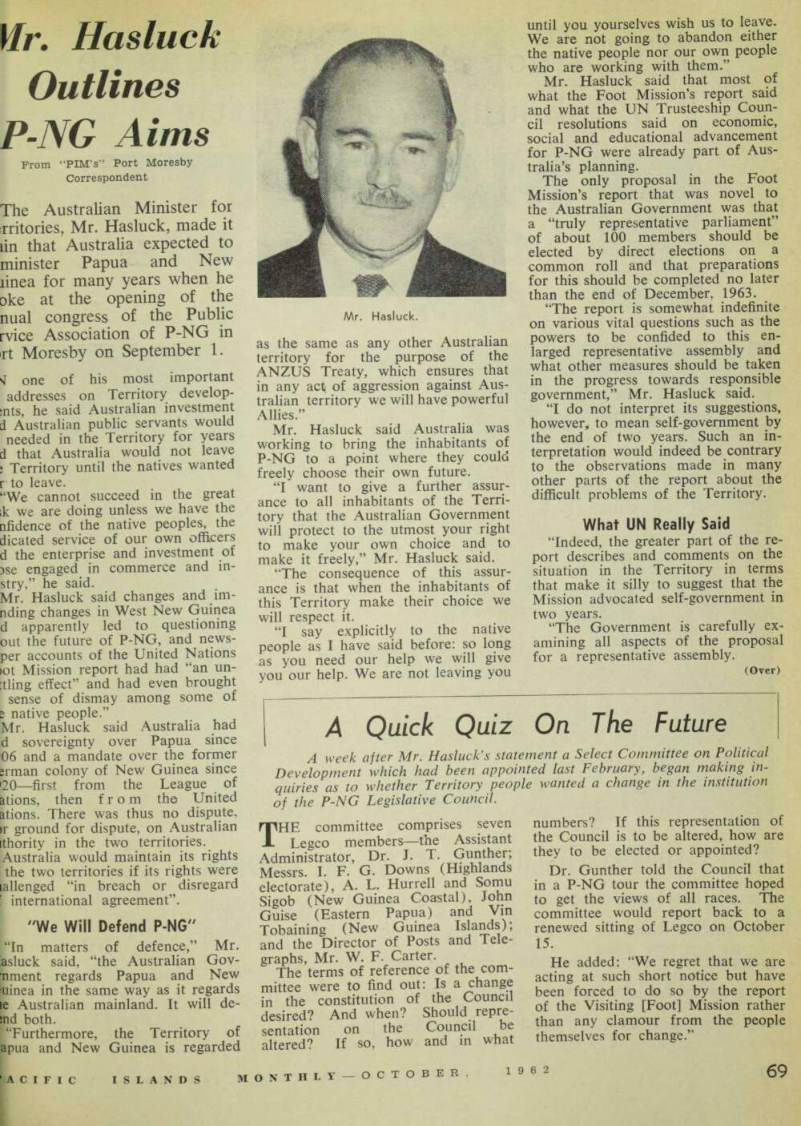
Mr. Hasluck.
“As is well known the Australian overnment has previously com itted itself to advancement towards If-government through a process of recessive extensions of the repre utative character, powers and re jonsibility of the Legislative Coun- I until the point is reached at which ie Legislative Council becomes fully ipresentative and responsible.
“We believe that it is an essential irt of a policy of respecting the mice of the inhabitants of the Terri »ry that constitutional changes lould not be imposed on the Terri fy, but should be made in consulta on with the people of the Terri iry. We will have such consulta on.
“The Australian Government will Dt hang back from political changes -we will continue to do our utmost » promote it—but we have to re ject the wishes of the people as ell as the wishes of the United ations. [Mr. Hasluck later explained that f the wishes of the United Nations mflict with the wishes of the people, ie wishes of the people are para iount.”] “We want a political system that ill work and will be deeply rooted i the needs and the aspirations of ie people. We look to their response 5 well as at our own planning.”
“When the choice by the people made it can be a choice of altera tives. The United Nations Charter lentions either self-government or idependence, as may be appropriate. /e hope and believe that when the ecision is made it will keep Papua nd New Guinea and Australia in a lose, friendly and interdependent re itionship to the mutual benefit of II our peoples.”
Public Service Plan Mr. Hasluck quoted a letter he had written on behalf of the Government ) the Public Service Association of '-NG in which the Government ssured members that there was no eason for “a feeling of insecurity mong expatriate public servants.”
Broadly, the letter guaranteed full uperannuation entitlements, un hanged salaries and conditions of ervice (unless the Government de ided otherwise) and help in finding Iteraative employment or reasonable ompensation if an officer was re >laced before normal retirement age by people serving under local con litions”.
Mr. Hasluck said the Government was now proposing to change the itructure of the Territory Public Ser vice “to provide for the present and
prospective increases in the number of indigenous public servants and for the day when the service will be predominantly an indigenous one”.
He said he had decided to adopt a proposal for a Territorial Service, organised on local conditions and rates of pay, assisted by an expatriate division.
He said the Public Service Com missioner could now start on “the tremendous task” of planning the internal structure of the new service, including its salary ranges and standards. It would be at least 12 months before this work was com pleted, and there would be con sultations with the Public Service Association during progress. Mr.
Hasluck said the Government planned that after the service was inaugurated there would be a period of “settling down” without general claims for arbitration.
"Cold Winds"
Mr. Hasluck said it had been suggested in New Guinea that public servants in the proposed expatriate service be appointed under Act of the Commonwealth Parliament in stead of a New Guinea Act, as this would give them a higher degree of security. But he could see little force in that argument, although there were other advantages. Expatriate salaries would be shown up separately and “these arrangements might expose the expatriate public servants to some cold Australian winds from which they are at present sheltered and I should like to be sure that the as sociation has fully examined all aspects of the proposal”. The Minister said his department would assist the New Guinea public servants in examining the proposal.
“For some time past, the policy has been not to appoint an expatri ate officer to any permanent position for which indigenous candidates will shortly be available,” Mr. Hasluck said.
“Our judgment is that in a great number of positions expatriate officers will be required for many years to come. For such positions permanent appointments will con tinue to be made.
A Guarantee “Hence, if in future a position is advertised for permanent appoint ment, it will have behind it the judg ment of the Public Service Commis sioner, and, through him, of the Gov ernment that we can confidently offer the selected officer a period of ser vice which will carry him through to the normal age of retirement.”
Speaking of people who had m
vested their property and devoted their life to various forms of enter prise in the Territory, Mr. Hasluck said: “Their enterprise will be needed for years to come to give Papua and New Guinea a stronger economic foundation.”
Mr. Hasluck said the Government “recognised that recent events have worried those who have assets in the Territory, and that any fall in their confidence will limit future invest ment, and the introduction and reten tion of new managerial and technical skills. Both are highly important for the more rapid development of P-NG’s resources”.
Will Consider Guarantees He said the Government was ready to examine any concrete proposals about guarantees. The president of the Papuan Planters’ Association [Mr.
B. Fairfax Ross] had said recently that it was not an expression of lack of confidence but simply a matter of prudence and commonsense for the expatriate land-holder to seek some measure of security or guarantee.
Mr. Hasluck said that he wanted to say frankly that none of the suggestions the Government had yet received had commended themselves as being practicable, but the way was open for further proposals.
The Minister added that it was unfortunate that outside the Territory there were those who appeared to devote most of their energy and eloquence to setting race against race.
Indigenous and expatriate leaders in P-NG would have to resist and over come misrepresentation as well as the difficulties of their own job.