All New Guinea Now Concedes: "Selt
pp. 65-69 · Read in the full issue

Government Is Inevitable"
From Judy Tudor, In Port Moresby
The Minister for Territories’ major policy assurances (made as an address at the opening of annual congress of the Public Service Assn., of P-NG in Port Moresby on Sept. I —see p. 69), s the fact that the Budget contained no increase in direct or indirect taxation, have been a miracle e for the mass hypertension that has been building up in the Territory in the last half year. In a ’k they reduced it to a point probably out of proportion to the lasting benefits that are likely accrue from either of the momentous events of September 1-3.
Whether the Ministerial assurances were astutely timed—l 2 months ago they would not have had the same npact and, delayed any longer, the rot would have gone too far to be retrieved—or just a happy accident, the esult has been welcomed throughout the Territory.
)UPLED with the annual Budget that was delivered by the Acting asurer to the Legislative Assembly September 3, and which contained e of the expected blows, the assur es cut the ground from beneath the ted and unofficial members and rtened the session by about half, it the end of five days, the session turned until mid-October while Select Committee on Political De ipment went off into the districts :ourt the opinion of the populace to how, when and if any changes □ld be made in the Legislature. 5 p. 69). n the Council, one by one, mem -5 from both sides of the chamber up to sing the praises of the lister, without one discordant note, the popularity polls of this Terri 1, Federal Minister for Territories il Hasluck has never had it go d.
'he degree of crisis that the whole imunity was facing is indicated by profundity of its gratitude for tething which, only a short while L it would have taken as its un nable right.
Crisis Point
fhere have been crises in P-NG ore; but this time they built up iultaneously from three separate tions the native people, the fiic Service and private enterprise, lach sub-crisis has somewhat dif snt manifestations; but all had the ie root-causes—the recent United tions Visiting Mission Report to [ Trusteeship Council; and the suc s of the Indonesian take-over bid West New Guinea.
Inadequate understanding of Aus lia’s rights in the Territory and of
the implications of the mission’s NG report caused a wide-spread fear among the native people that Aus tralia was about to be forced out of the Territory by the United Nations.
When this was followed by the West New Guinea natives being handed over to the Indonesians through the offices—as they under stand it—of the same United Nations, something like panic de veloped.
Behind it all was some prior knowledge, sketchy perhaps, of what
had happened in the Congo when the Belgians withdrew and the United Nations went in “to fix things up”.
The mana of UNO around these parts is very, very low.
The Public Service—and there are approximately 4,000 European public servants out of a total P-NG Euro pean population of 25,000 was worried on two security counts. The older members of the service, those within 10 years of retirement, had fears about their superannuation on retirement; the younger members on how long their career would last.
As things stand at present the fund that supports the contributory super annuation scheme is guaranteed by the P-NG Administration. Presum ably, if the present Administration is superseded by self-government, the new government takes on the re sponsibilities of the superannuation scheme along with everyone else.
Relief!
Working from that point, older public servants could see the pos sibility, through muddle, mismanage ment or sheer inability to cope with financial matters on a pre - self government scale, of a failure in the job of paying expatriates’ pensions especially as those expatriates would by then be well out of the Territory.
The Minister’s statement of Sep tember 1 has, for the moment at any rate, relieved the considerable anxiety that the PS had on this score and it is likely that the Public Service Association will accept, through the Minister, the Australian Govern ment’s assurances on remuneration and conditions of service.
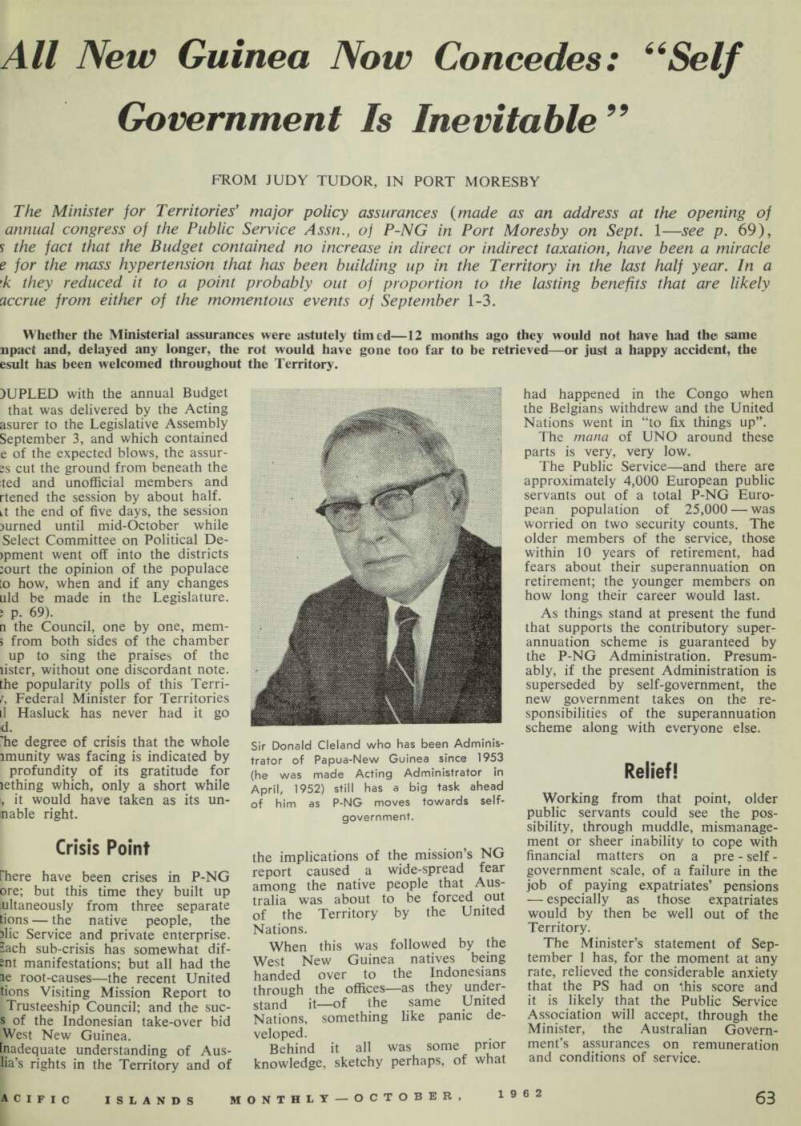
Sir Donald Cleland who has been Adminis trator of Papua-New Guinea since 1953 (he was made Acting Administrator in April, 1952) still has a big task ahead of him as P-NG moves towards self government.
deanwhile they will take a longer k at the plan for a Territory entirely recruited locally and, side that, an expatriates’ division ich would be set up under the jet control of the Commonwealth d not P-NG) Government. )ne reason for taking a longer look this proposal was the paragraph the Minister’s statement which i: “These arrangements might ex e the expatriate public servants to le cold Australian winds from ich they are at present sheltered, I I should like to be sure that your jociation has fully examined all ects of the proposals.”
Dne of the “cold winds” might be ve privileges which, in compari i with those of the Commonwealth die Service (three weeks’ annual ve), are generous in the extreme I are still based on the pre-war iceptions of tropical health :ards. fhe younger generation’s fears died especially to field staff, ose specialised training and ser e in native administration fit them no occupation in an advanced iety.
According to Mr. Hasluck’s read of the situation, any officer who hired in future as a permanent cer can still look forward con sntly to a period of service that ill carry him through to retire nt”.
Shot in the Arm
Private enterprise was worried by flight of capital over recent years; difficulty of attracting new )ital to the Territory under existing iditions of political uncertainty; 1 because established assets could predate under certain conditions, ;h as inept government, immature as of finance or a flamboyant wage iicture that would render economic )duction impossible.
Fhe Minister’s assurances have ne as a shot in the arm to this ;tion of the community also, hough if what he actually said is imined, the assurances amount to le more than the reiteration that vate enterprise, established and jspective, is wanted and even vital the Territory.
No system of Government arantees has yet commended itself the Minister, but it is obvious that, fore private investment can fully ;over confidence in this country, mething of the sort is essential, thout wasting any more time.
A suggestion put up at the Legis :ive Council meeting by Mr. B. E. lirfax-Ross —namely, what amounts a contributory insurance scheme r land and property holders (re
ported fully elsewhere) received general acclaim. This nominated member bases his proposition on an assumption that at least 10 years will elapse before a new government takes over, at which stage private residents would have to decide whether they will remain or repatriate their assets.
The feeling here, then, in mid- September, is generally one of re prieve. How long the present period of calm lasts depends largely on what is done practically to follow up the Minister’s verbal assurances, especially as they relate to private industry; and to an extent, on what
the Committee on Political Develop ment comes up with in its interim re port to the Legco in mid-October.
One thing that has to be reckoned with in this Territory is the complete lack of over-all opinion on any sub ject—including that of the proble matical future. The native people’s lack of homogeneity is often re marked upon; but in many ways native thinking is solid in compari son with that of the 25,000 Euro peans who seem to have at least 25.000 opinions—and, to an extent, 29.000 in that the 4,000 public servants are each apt to have two
he official line and their own per al view! n three days here, among public /ants of all ranks, you will collect re sotto voce, off - the - record ements than in three years of linary newspaper reporting any ere else.
There are, therefore, innumber e estimates of the time left before -government, ranging from “im iiately” to “30 years from now”, ne say that the natives are terri -1 at the thought that they will be to go it alone, while a few claim t some big-heads would take it v, if it were possible. have heard the United Nations iting Mission report described as iculous and dishonest and a pipe am; also as brilliant and penetrat and realistic, fhe vague terms in which the re •t left the functions of the sug ted 100-man parliament are held some exalted circles) to have been verly and deliberately engineered precisely that, so that Australia ild put what interpretation it liked 3n them.
A.nd I was told by a VIP that Sir igh Foot said before he left the rritory that his task was then to spare a report that would not en ely outrage Australian public inion while still managing to ent ice the principles of the Trustee ip Council.
Out of all that, the objective
observer is left with little firm ground from which to comment. But it is clear that whatever might have been the intention of the report and its masterly vagueness, it did in fact be come an instrument of complete con fusion; it terrified the people it was designed to reassure most the natives; it undermined confidence in all sections of the community; it per mitted the wildest speculations to sprout from it.
Yet some qualified support came for it, from such people as Mr. lan Downs, MLC for New Guinea High lands, who believes that the people are ready for a common-roll (some how without achieving self-govern ment). He stated also, at the Sep tember Legislative Council meeting, that he and other Australians in the Territory “look forward urgently” to the time when the Papuans and New Guineans are running the place them selves.
Rhetoric?
One may take it for granted that Mr, Downs, in that, was indulging in rhetoric rather than plain fact.
Few Australians in the Territory would agree with anything of the sort—not at least until they have more practical safeguards for the future than they have at the moment.
Nonetheless, it is completely accepted by everyone now that self government is inevitable, and how ever divergent the ideas are in de tail, few stable citizens are permitting themselves to look further ahead than 10 years.
Neither does the thought of a largely increased native representa tion on Legislative Council, or even a majority in the Council, appeal as it once would have done. At this stage of native development it is be lieved that “they can be guided”.
But a legislature of 100, elected on a common-roll, of which at least 60 per cent, would be illiterate and— what is worse—virtually inarticulate, and on which there was representa tion for neither the Australian Gov ernment, which privides two-thirds of the revenue, or for expatriates, who produce the other third, is not ex pected by the indigenes nor looked forward to, urgently or otherwise, by anyone else.
Hugh Foot, leader of this year's UN [?]ion to New Guinea —whose report helped precipitate developments to [?]rds self-government in the Territory.