They’re Cutting Their
pp. 41-43 · Read in the full issue
industrial Progress in the Cooks
They’re Cutting Their Cloth To Fit
From W. H. Percival, in Rarotonga When William H. Watson and Harry Scott entered the Cook Islands clothing trade together in 1943 they knew prac tically nothing about it except that it held possibilities.
Willie” Watson, A Hard
headed Scot and established Cook Islands trader, was searching for a new line of business after the bottom fell out of the New Zealand trade in pearl-shell brooches and similar “jewellery”. The American servicemen then stationed in New Zealand were the principal buyers of these Islands novelties, and when they left for the north the market for curios dried up.
After meeting Mr. Tearaia Marsters, a Cook Islander who had learned tailoring and cutting in New Zealand, Willie Watson’s idea for a Rarotonga clothing factory took shape. He put Teraia on his payroll and Teraia quickly ran up some sample shorts and shirts on his own sewing machine.
Willie Watson sent them to his New Zealand agent, who promptly asked for 800 more.
This was tremendously encourag ing—but how to fill the order?
Five privately-owned sewing machines were hired and seamstresses
engaged. Stocks of material were purchased from local stores. The cutting was done by hand and all buttons were hand-sewn. They worked around the clock—and filled the order on time.
Willie Watson then flew from Rarotonga to New Zealand (by RNZAF plane—thus becoming the first paying passenger to make this flight).
Under wartime conditions, the khaki-drill material he required was almost unobtainable for civilian use, so he managed an interview with the then Prime Minister, Mr. Peter Fraser. The PM proved sympathetic and Willie Watson got his stocks of drill.
Machines for the embryo factory were also needed. In Auckland Willie bought a second-hand cloth cutter, a buttonhole machine and eight plain sewers, all electrically operated. At that time there was no electric power supply in Rarotonga, so a five h.p. diesel engine and a generator were also bought to supply power and lighting.
No Sinecure Back in Rarotonga, Willie set up his machines and he and Harry Scott went to work, Willie taking care of all business matters and Harry run ning the factory.
It was no sinecure for either partner. Harry was an ex-manager for an Islands trading firm, but he soon discovered that what he needed most was an engineering background —which he lacked. The complicated and worn machines often broke down.
New Zealand and its mechanics were over 1,600 sea miles away. The machines had to be repaired on the spot —and quickly—if the newly-born firm was to survive.
Harry Scott spent sleepless nights puzzling over the mechanisms of recalcitrant machines. After a full day’s work in enervating heat he would often spend many additional
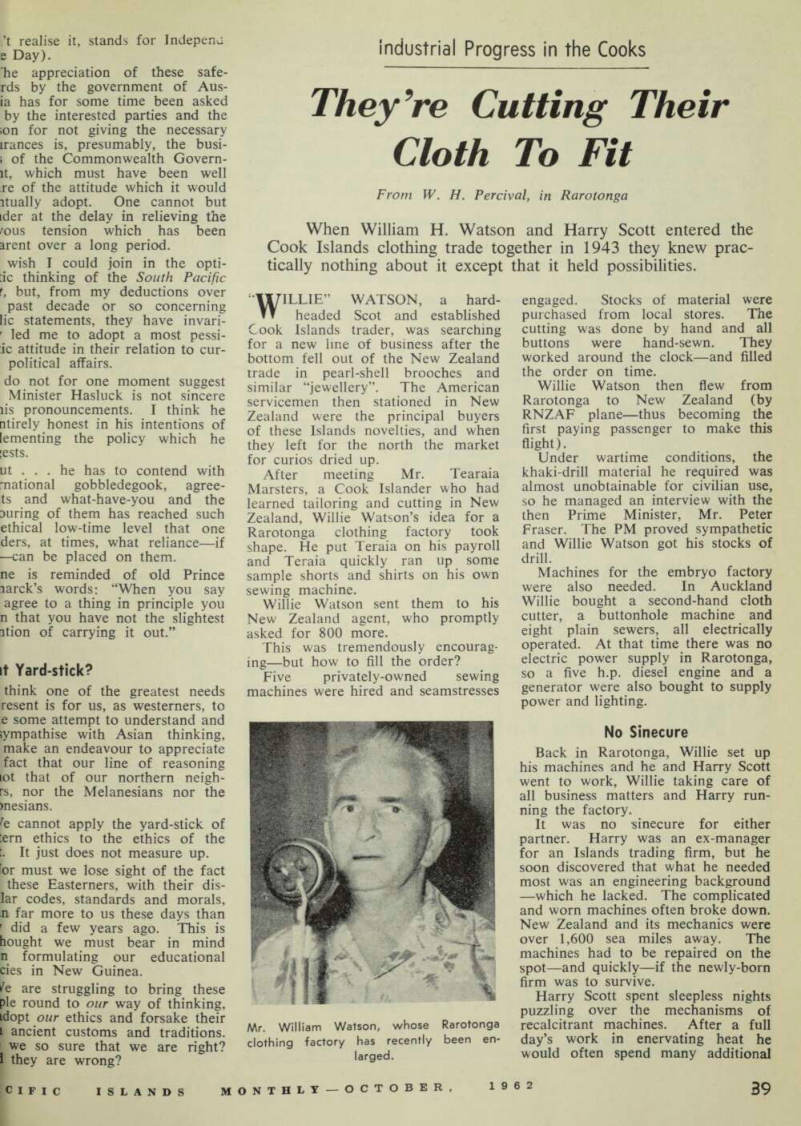
Mr. William Watson, whose Rarotonga clothing factory has recently been en larged.
hours tracking down a faulty part.
Sometimes the part would have to be replaced—and that meant making a spare part that night.
Without previous experience he tackled the mysteries of lathe and welding torch. He made the parts and kept the machines clicking busily and the business from dying. In spite of business-maiming setbacks the infant industry began to thrive.
Fifteen years later, in 1958, Mr.
Duncan Bertram, a young and adventurous Kiwi who had worked his way around the world, joined the firm. He quickly mastered the rudiments of the trade and showed such interest and aptitude for the
work that he was appointed manager of Scott and Watson’s when Harry retired to live in Auckland, For the last few years, Bertram has worked seven days a week. He does his bookwork and paperwork on Sundays. A bachelor, he barely finds time to cook himself one good meal a day. Mainly due to his energy and enthusiasm the business boomed to such an extent that it was obvious a larger factory would have to be built.
Two months ago, Mr. W. Finlay, an expert supervisor, and his wife, who is a cutter, and both with exten sive overseas trade experience, also joined forces with Scott and Watson.
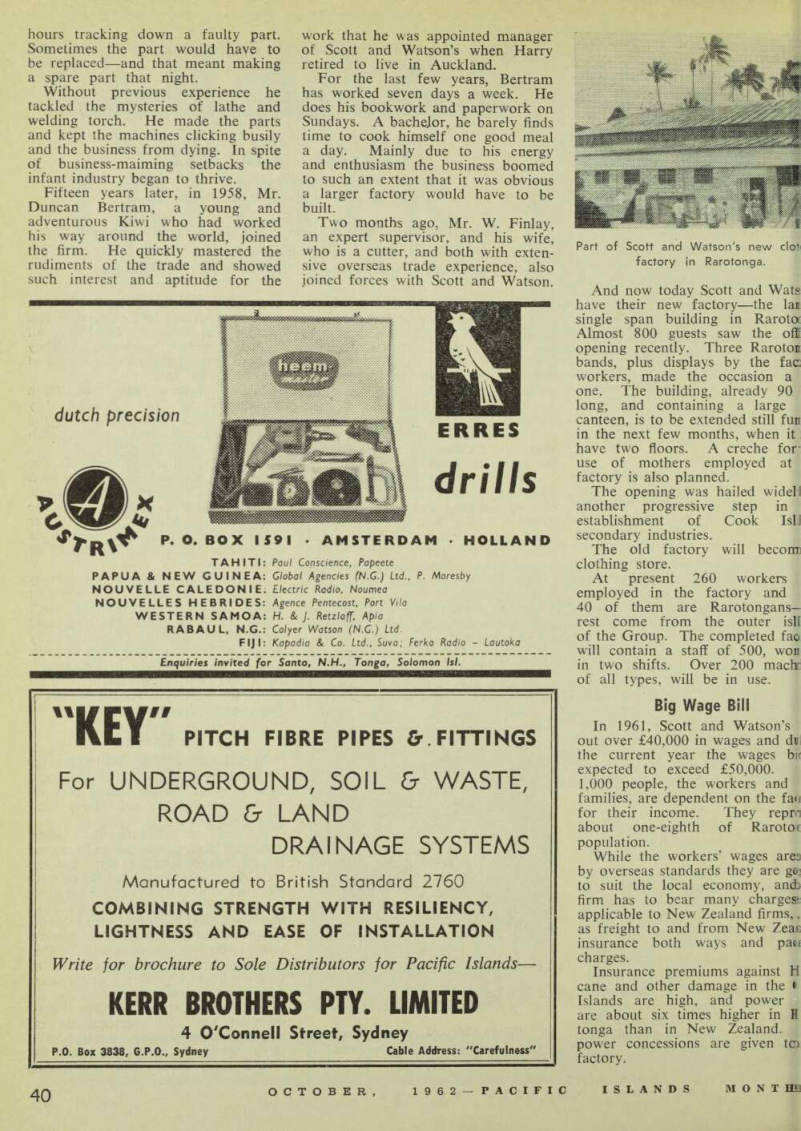
And now today Scott and Wats have their new factory—the lan single span building in Rarotoc Almost 800 guests saw the offi opening recently. Three Rarotoit bands, plus displays by the fac workers, made the occasion a one. The building, already 90 long, and containing a large canteen, is to be extended still fun in the next few months, when it have two floors. A creche tor use of mothers employed at factory is also planned.
The opening was hailed widelJ another progressive step in establishment of Cook IslJ secondary industries.
The old factory will becorm clothing store.
At present 260 workers employed in the factory and 40 of them are Rarotongans— rest come from the outer isll of the Group. The completed fao will contain a staff of 500, won in two shifts. Over 200 mack of all types, will be in use.
Big Wage Bill
In 1961, Scott and Watson’s out over £40,000 in wages and dir, the current year the wages bk expected to exceed £50,000. 1,000 people, the workers and families, are dependent on the fan for their income. They reprn about one-eighth of Rarotoc population.
While the workers’ wages ares by overseas standards they are ge; to suit the local economy, ancb firm has to bear many charges: applicable to New Zealand firms,, as freight to and from New Zeae insurance both ways and pact charges.
Insurance premiums against H cane and other damage in the f Islands are high, and power are about six times higher in H tonga than in New Zealand, power concessions are given tm factory.
Part of Scott and Watson's new clot factory in Rarotonga.
cott and Watson’s is a “cut, make trim” firm, which means New land firms send them bulk stocks material for making up into imas, mens’ and boys’ shirts, :ts, trousers, etc. The finished lucts are then shipped to New land. ast year 250,000 garments were le from 750,000 yards of material this year’s total is expected to :ed 300,000 garments. harmonious relationship has lys existed between the manage t and the workers. During the years of the factory’s existence e have been no work stoppages to industrial disputes.
Tien all the machines have been sferred from the old factory to new, 70 new positions will be i to Cook Islands Maoris, fin the next year this figure ild increase to 150.