Territories TALK-TALKI
pp. 35-41 · Read in the full issue
With Tolala
When old-timers like Freddie Werner sell out and make ir Australia {PIM, August, p. 11) one begins to wonder hether the ex-patriates’ position in the Territory is deteriorat g. But, then again, after sixty years’ residence in New Guinea suppose it’s a fair thing to “call it a day”.
:RST met Fred on Galtum plan ition in the Bainings back in the twenties when he was a gang youth with his bearded father ise initials were also F. 0.). far as I remember now, the lers were one of the families ght out from Queensland by the lan administration following the aul mission massacre in August, , for the purpose of “civilising” district, which was a wild and ly section of the colony, tall areas were surveyed, consist ff a few hundred hectares, and general idea was to constitute a of peasant-farming settlement iding from the western tip of klikum Bay to Cape Lambert on coast as well as several inland d Massawa plantation was ex -sd, for it had already been chosen I sort of penal estate, where the wers of To Maria (the gent who nised the St. Paul massacre) were o work terracing the hillsides and ting coconuts, and later became property of the Neu Guinea ipagnie. lese early settlers from Queens included the Janke, Batze, and ner families, the Bolten brothers I'then later came Till, Porteau [Ortloff. There were others, but rget their names. he Jankes developed Neinduk on
the coast, with Upper and Lower Seeberg inland; the Batzes opened up Lilinakaia and New Mobisberg; the Werners the Galtum area, while the Boltens established a sawmill at Nam bung and also had a plantation some whereabout. One of the Bo 11 e n brothers died not long ago in Ger many.
The original plantations were New Mobisberg, New Kauern, Old and New Massawa, Guntershoehe, Lassul, Neinduk, Nambung, Upper and Lower Seeberg, Galtum, Gavite, Lilinakaia and Rangarere; and then further down the coast there was Pondo, but that was more in the Nakanai area.
Later came Stockholm and Notre Mai. The latter was started some time in the twenties by a Swede named Klingstrom, I think, and the somewhat peculiar name was the maiden name of his wife spelt back wards—Lamerton.
For many years the Bainings was a “forgotten” district —that is offici ally so, for there was no district or patrol office there (except for a short while in the twenties when Bill Ed wards—later of PIM fame—estab lished a medical post).
The picture now, I expect, is an entirely different one. It was, at least, one of the first areas to plant coffee and cacao which, no doubt, are flour ishing now.
A happy retirement to Freddie Werner in Australia. So far as I re member that leaves only George Janke of all those old-timers who is still ticking over up in the Ter ritory.
Footnote : This does not apply to missionaries. I expect there are still a few real old-timers amongst these workers. (Over)
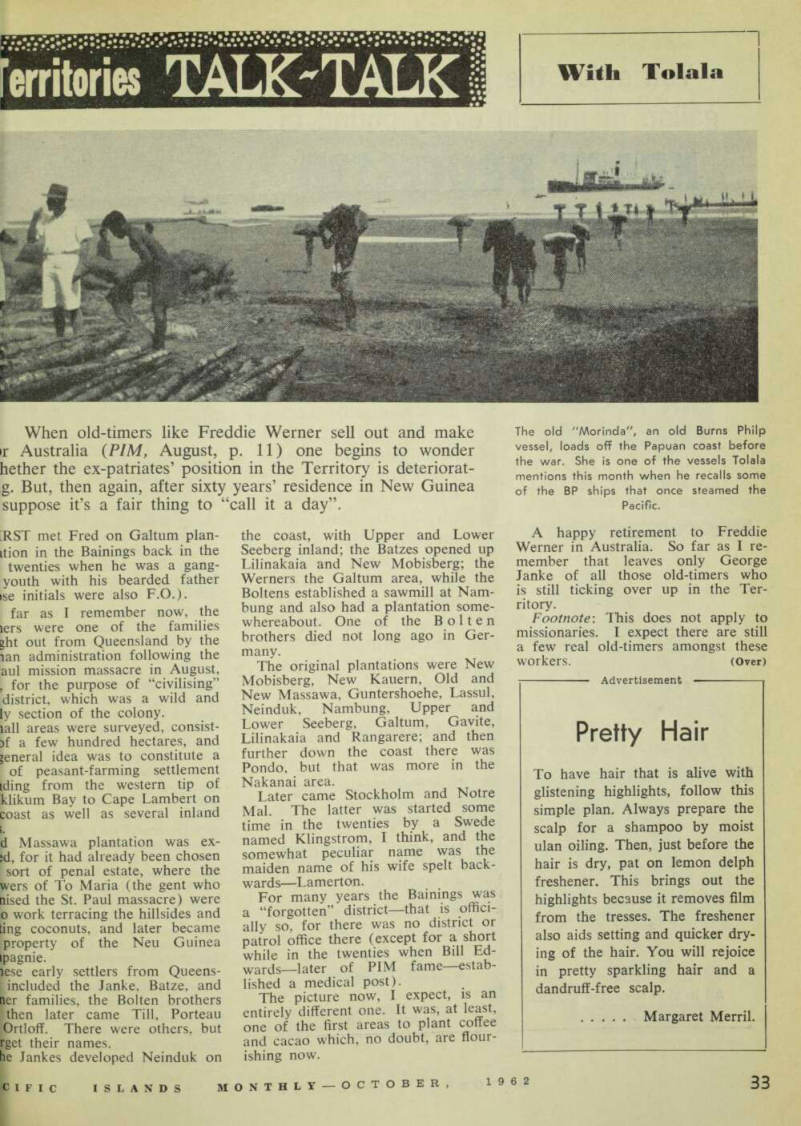
The old "Morinda", an old Burns Philp vessel, loads off the Papuan coast before the war. She is one of the vessels Tolala mentions this month when he recalls some of the BP ships that once steamed the Pacific.
Old Ties
Weakening
Old settlers throughout Mel must have felt a sad sense o pending loss of links, forged over half a century, when they Burns Philp chairman James remarks about discontinuing the pany’s passenger services when ent vessels were “beyond overhi Despite the fact these sell; Islanders have been amongsa harshest critics of the BP boats dering through the isles, calli. out-of-the-way ports and plant.: nevertheless they realise son their happiest days and nights been spent on the decks and smoke rooms of these catchers”—from the close-pt smoky atmosphere of the old M and Morinda to the more spc lounges of Bulolo and Macdhui'i My first experience of BP C travelling was in 1915 when I bo Matunga at Faisi and we travel Rabaul, a town at the time with brass hats and military sonnel. Donaldson was the s* and a chap named Brush was cargo. (We didn’t call them p] in those days).
Willy Dupain, who had beenr aging Faisi store, came as ft Rabaul with us where he took « of the newly-organised BP From Rabaul we went to Sau back to Rabaul and then throuj Solomons to Sydney.
Matunga was scuttled in 19< the German raider Wolf. There no casualties, the passengers ano were eventually interned in E 3 and Donaldson wrote quite an esting book on the whole bush Returning from leave on that! sion, I came in Mindini, with s!« Voy and Corrigan as chief eng (Later he became No. 1 engines the company).
I remember as passengers Sydney were Phil Coote, oc Makambo BP branch; Mrs. “Mar Scott (mother of Hughie Set: Orlofe, near Faisi) with her dan Rhoda (the same Rhoda Coote; now lives just out of Rabaul air years has been one of the t most popular hostesses. A ship} romance? I suspect so.) There was also Jimmy Gibs< noted pearlshell diver from the: ning Straits. And there were inn ing characters to be met with atJ port of call: Norman Wheatleyy Cromer, Phil Shelley, Brodhun Fred Green, Rev. Goldie, R. R. .
Curry Barley, Dr. Crichlow, Oien, Sam Atkinson, the Brothers are names and persom I still remember.
ncidentally, I was sorry to read he passing of J. M. Clift only the ;r day (he died on September 9) foowoomba. I never realised that was the father of Mrs. R. M. do, of Rabaul.
Old dition : was a recognised custom for ly a year that the BP ships with chequer-board funnels and flying BP house-flag with its thistle, fld carry a name commencing i M and consisting of seven let- And when that practice ceased, >rding to some of the old-time 5, the line would decline. Time proved those old salts to have i” something. think it was Neptuna (purchased n the NDL in the thirties) that :e the sequence, although one of company’s pioneers in the Pacific named Titus (on which the noted H. Lucas was supercargo for e years). he following is a list of vessels npiled only from memory) that >wed the tradition: oresby Mindini atunga Morinda arsina Makambo elusia Mon toro ataram Macdhui arella Malaita uliama Maiwara angola he outsiders have included: gi, Bulolo, Mirani, Malekula, side, Burnside and Neptuna. r-lsiands s was a common practice in the lie twenties for Rabaul company utives and others to avail iselves of a “round-trip” on one le BP liners. he executives, naturally, had to k-up on branch activities; while “others” were honest enough to it they went for a change of kai to meet new faces and to relax e at the same time they saw (in Tdance with the BP tourist ad isements) “beautiful scenery and
‘esting people.”
he ports of call in those days in ed Kavieng, Lorengau, the Her i Ninigo, Matty, Seleo, Awar ional), Madang, Witu and so : to Rabaul. was fortunate enough to make ral of these trips and I shall al s remember the rush at the vari ports of shore folk coming aboard cold beers and the passengers’ onal servants rushing ashore to some washing for the master or Missus.
One of the most memorable trips, I think, was while the vessel was proceeding from Manus to the West ern Islands when a time-expired native labourer, being returned to his home in the Sepik area, ran amok and started attacking his fellow passengers with a tomahawk. Most of his activities took place ’tween decks in one of the after-holds of the ship, set aside for their accom modation.
The lad became a veritable menace; attempts were made to gas him by various means; there were about four
doctors aboard to work out a for mula; but nothing availed.
Eventually the master of the ship declared him an outlaw and, after a night of terror, during which pas sengers, all locked behind closed doors, expected to be tomahawked, he was pacified. And round-trippers, especially those from Sydney, breathed a sigh of relief.
Winds of
Change
Actually, I suppose, one cannot expect any other decision than that
made by chairman Burns when takes into consideration such a riding factors as competition fl air services, rival shipping 1 manned by Asian crews—which iii small factor by any means.
Also, the attitude of the a tralian trade unionists appears* be embarrassing more and n the activities of Australian shipc companies and prejudicing the gen run of sea-travellers from mat tours in ships manned by Austn crews, due in the main to restri hours of service and the pec: idiosyncrasy of crews that civ suggests servility.
But, perhaps after all, it is mt the writing on the wall; a breath 1 the Winds of Change.
They Pass On One of the realities of life is with the effluxion of time, we on to, we hope, whatever afte: our world beliefs have inspired iii And so it is that we hear of the ing of our pioneers with symp for those loved ones who remaij feel their loneliness, as well as sadness of a broken link withe past.
There have been three pio passings in more recent days nected with New Guinea: Willis, Bill Royal and Harold I wood.
All of them have contributes one way and another to the T tory’s development, and that to mind is the main attribute < pioneer. Willis gave an es knowledge to agriculture; Roys 1 mining and Hindwood to avisl All three are important aspect: territorial progress for which pos? (usually a begrudging jade) si; give them due credit.
I first met Willis in January, when, as an overseer for the E: priation Board, he proceeded to < gainville and took over the mar ment of Raua plantation—possible first experience of tropical agricuti A fellow-passenger at that was A. Richards, who was bounn Arawa plantation, near Kieta, < who is still an important cog iii Territory’s Coconut Kingdom j now residing in Rabaul. I shas ways associate Alan Willis wv legibile calligraphy, an orderly and initiative.
Well do I remember Bill Roy( the early twenties in Rabaul:l maculately dressed, pince-nez sH; and his smiling round face a stepped from his T-model FordJ all daily landmarks in the towm
nvariably parked in the vicinity le Rabaul Club. ; that time he was a partner in firm of Royal & Dow, an engi ing and ship-repairing outfit, 10l l somewhere along the water t near Komine’s and Ah Tam’s building yards. Dow was the lical man; Bill was the outside contact man.” remember how in 1924 Bill told over a game of billiards in the j of his intentions to go over to naua after the elusive nugget, that Chisholm who at that time secretary of the Expropriation d, was also toying with the idea.
Id I be interested? No. I was ling a round-the-world tour. Why Id I want to go to Salamaua? net Bill in 1926 when he returned 1 the field. I was on The Rabaul then. He was bubbling over ■ excitement, but would tell me
Ing—for publication,
icrtly afterwards there was the il Commission investigating the fields and the leases. The Com [oner was L, R. MacGregor r Trade Commissioner for Aus i in USA and Minister in il); counsel representing the I Six” was F. S. B. Boyce (later 3ge) and a brother-in-law of Bill •son’s; for the miners contesting klaim of the “Big Six,” was W. B. pson (later Supreme Court judge Canberra) and there were some
good arguments to be heard on both sides.
One thing that I do remember that came out of the inquiry was an 0.8. E. for Doris Booth, for her most excellent work during a dysentery epidemic up on the fields gained her the name of “Angel of Bulolo,” which would probably have gone un noticed by the Powers That Be had it not been a feature of the evidence heard at the Commission.
Harold Hindwood I met in Rabaul on various occasions in the late twenties and then later on the gold fields. I knew him for a conscien tious worker, dedicated to his job.
He was one of the smiling faces that greeted me when, after being evacu
ated from Rabaul in 1945, I spent some time—happy, relaxing days—in the ANGAU mess at Malahang.
In Prospect
After reading and listening to so many pessimistic tirades over the air, it is quite a change to digest a New Guinea newspaper’s editorial of “Big Reassurances,” following Minister Hasluck’s whirlwind visit to Port Moresby, which is, if nothing else, optimistic.
No one more than myself hopes these “reassurances” are justified and, furthermore, will be carried out in relation to public servants’ and ex patriates’ security in the Territory after “I” Day (which, in case you
A milliner never lost for an idea is Brian Darcey of Rabaul. Here she [?]ls a striking volcanic creation in [?]r mache which she made for a re crazy hat" competition. A replica atupi Volcano, the "hat" erupts from a burning cigarette when air is drawn through a tube.
,’t realise it, stands for Indepenu e Day).
'he appreciation of these safe rds by the government of Aus ia has for some time been asked by the interested parties and the :on for not giving the necessary irances is, presumably, the busi > of the Commonwealth Govern it, which must have been well re of the attitude which it would itually adopt. One cannot but ider at the delay in relieving the rous tension which has been arent over a long period, wish I could join in the opti dc thinking of the South Pacific t, but, from my deductions over past decade or so concerning lie statements, they have invari r led me to adopt a most pessi ;ic attitude in their relation to cur political affairs, do not for one moment suggest Minister Hasluck is not sincere lis pronouncements. I think he ntirely honest in his intentions of lementing the policy which he tests. ut . . . he has to contend with ■national gobbledegook, agree ts and what-have-you and the During of them has reached such ethical low-time level that one ders, at times, what reliance—if —can be placed on them, ne is reminded of old Prince larck’s words: “When you say agree to a thing in principle you n that you have not the slightest ition of carrying it out.” it Yard-stick? think one of the greatest needs resent is for us, as westerners, to e some attempt to understand and sympathise with Asian thinking, make an endeavour to appreciate fact that our line of reasoning lot that of our northern neigh rs, nor the Melanesians nor the mesians. te cannot apply the yard-stick of tern ethics to the ethics of the t. It just does not measure up, tor must we lose sight of the fact these Easterners, with their dis lar codes, standards and morals, n far more to us these days than r did a few years ago. This is bought we must bear in mind n formulating our educational cies in New Guinea. /e are struggling to bring these pie round to our way of thinking, idopt our ethics and forsake their \ ancient customs and traditions. we so sure that we are right? 1 they are wrong?