BP Pasenger
p. 25 · Read in the full issue
Services 'On The Way Out'
Burns, Philp and Co. Ltd. will discontinue passenger shipping services as soon as its present vessels are beyond overhaul.
ANNOUNCING this at the com pany’s annual meeting, chair man, Mr. James Burns, said that to carry passengers entailed larger crews and only meant higher losses while loading and discharging cargo.
“All our vessels are getting older and to replace them would cost about double their original building price,” he said.
“We have some millions invested in Papua-New Guinea and we are thus tied to that trade.
“We cannot very well increase our freights to any extent as it would only encourage overseas vessels to cut further into the trade.
“A few years back we were the only company running a regular ser vice to Papua-New Guinea. Now there are direct services from many other parts of the world cutting into the expanding trade we have built up in the last 80 years.” [See "Territories Talk-Talk", p. 33]
While in Canberra the Nauruans were hopeful of getting a direct answer from Mr. Hasluck on the pro posal put up by Hammer Deßoburt in June for the creation of sovereign Nauruan nation, related to Australia by a Treaty of Friendship.
On the final day of their stay in Australia the Nauruan delegates were handed a letter on the proposal, the details of which were not revealed, but which reportedly made the Nauruans “not entirely happy”.
During their tour the Nauruans were not always in the bosoms of the Government and its servants.
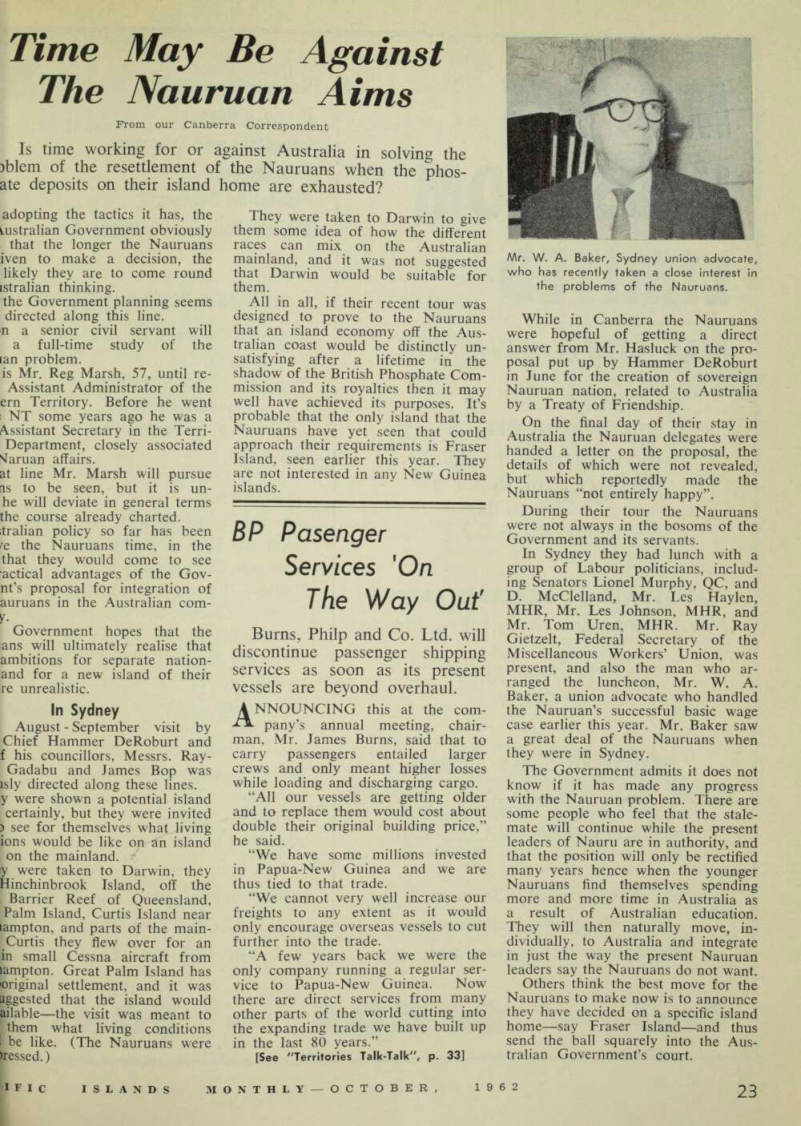
In Sydney they had lunch with a group of Labour politicians, includ ing Senators Lionel Murphy, QC, and D. McClelland, Mr. Les Haylen, MHR, Mr. Les Johnson, MHR, and Mr. Tom Uren, MHR. Mr. Ray Gietzelt, Federal Secretary of the Miscellaneous Workers’ Union, was present, and also the man who ar ranged the luncheon, Mr. W. A, Baker, a union advocate who handled the Nauruan’s successful basic wage case earlier this year. Mr. Baker saw a great deal of the Nauruans when they were in Sydney.
The Government admits it does not know if it has made any progress with the Nauruan problem. There are some people who feel that the stale mate will continue while the present leaders of Nauru are in authority, and that the position will only be rectified many years hence when the younger Nauruans find themselves spending more and more time in Australia as a result of Australian education.
They will then naturally move, in dividually, to Australia and integrate in just the way the present Nauruan leaders say the Nauruans do not want.
Others think the best move for the Nauruans to make now is to announce they have decided on a specific island home—say Fraser Island—and thus send the ball squarely into the Aus tralian Government’s court.
Mr. W. A. Baker, Sydney union advocate, who has recently taken a close interest in the problems of the Nauruans.