Troubled Elite Ask: Where
pp. 17-18 · Read in the full issue
Nng Nationalism "Amazingly Strong"
Troubled Elite Ask: Where Do We Go From Here?
From Judy Tudor, in Hollandia
On how three West New Guinea native observers interpret the attitude of Australia and the USA at the September meeting of the General Assembly of the United Nations might hang the immediate fate of West New Guinea as a nation.
ALREADY there is a section of the Papuans predisposed to believing that if Australians and Americans, as well as the Dutch, abandon them, they might as well throw in their lot with the Indonesians.
Opposed to them are the national ists—in numbers a drop in the bucket of the 700,000-odd native people who go to make up this Territory, but nevertheless constituting the only glimmer of hope in the present dis mal and depressing scene.
The three Papuans who have gone to New York are Herman Womsi wor, Nicolas Jouwe and Marcus Kaisiepo. They do not expect to be asked to address the Assembly of the world organisation that has consis
tently ignored their claims in favour of the Indonesians but go in order to talk to their “African friends” and observe the Australians and Ameri cans, of whom they are probably even more resentful than of the Dutch.
It is likely that two at least of the three will remain abroad as a sort of committee-of-freedom in exile.
Jouwe already has his wife and family in Holland and will probably live there himself. Kaisiepo is unde cided what he will do or where he will go but says he “might live in Australia” by which he possibly means Australian New Guinea. (He speaks only Malay.) Womsiwor says he will return to Hollandia to help hold the fort from within, but this may depend on cir cumstances. The most important leader here at present, who will stay, is Nicolaas Tanggahma, now presi dent of the new National Congress.
He also originally intended to go to New York.
He's Sticking
This slight, dandyish man, some times wearing a grey business-suit, sometimes an embroidered shirt with a sort of beaded bib, feels that Con gress is the more important job at the moment even while he is aware that by sticking his head above the ruck he is asking to have it knocked off.
The spirit of nationalism here, which the Dutch say manifested it self only in the last few years is amazingly strong, vital and inde pendent in comparison with the Ad ministration-sponsored and designed variety that exists on the Australian side of the border.
At the same time only a super optimist has much hope that these people and their leaders will success fully withstand the propaganda bar rage and blandishments to which they will be subjected in the next seven years.
Like a lot of other things in this Territory, the formation of the
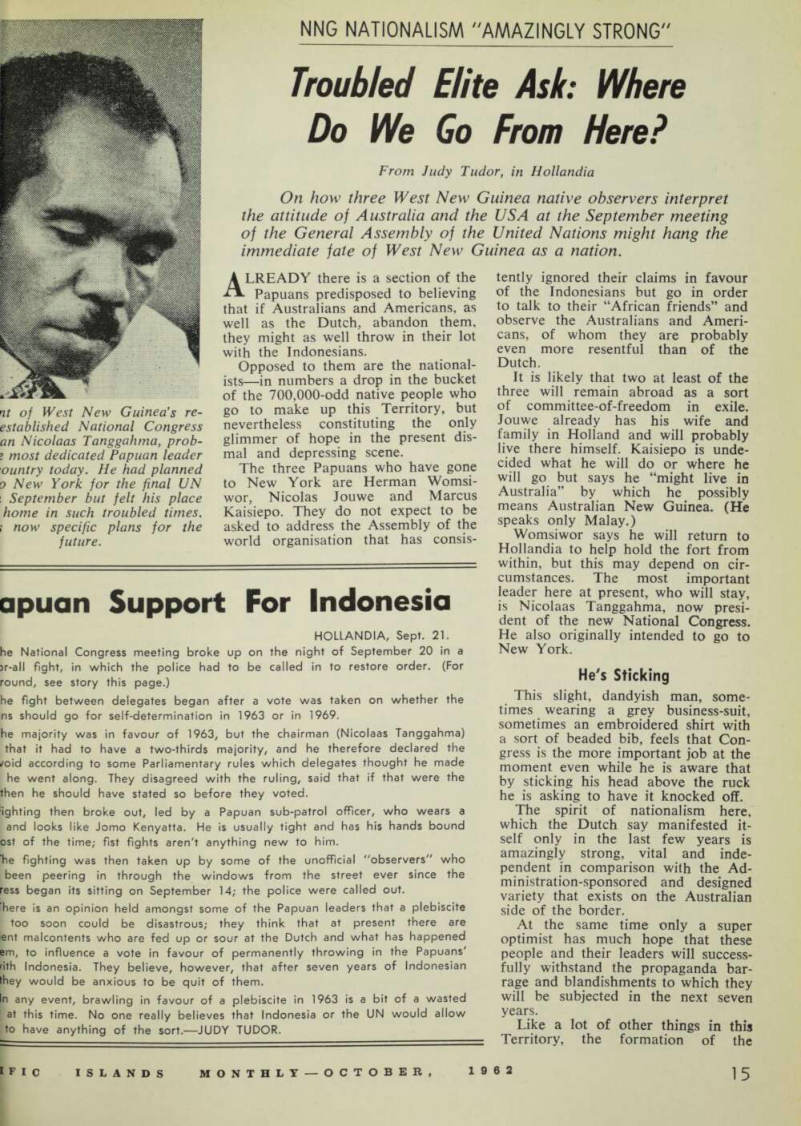
[?]t of West New Guinea’s re established National Congress [?]an Nicolaas Tanggahma, prob [?] most dedicated Papuan leader [?]ountry today. He had planned [?]o New York for the final UN [?] September but felt his place home in such troubled times. [?] now specific plans for the future.
National Congress came only when the writing was on the wall. Its first real meeting took place in mid-Sep tember when 80-90 delegates from all over the Territory met in Hol landia.
Wholly inspired by Papuan leaders, it was carefully avoided by the Dutch whose interest would have prejudiced its continued existence. Even so, how long the Congress will continue to exist under the Indonesian regime is problematical. How long its leaders will be allowed to lead, and not be promoted out of sight or brain washed or manoeuvred out of the lime-light only time will tell.
In the meantime they had 10 days of debate and addresses from most of which the Press was excluded. The subject, broadly, was on how best they can withstand the seven years of Indonesian rule before they are given opportunity of free expression by the plebescite of 1969. (See panel.) A Dirty Word The expression “the future” has so long been bandied about in both New Guineas, it has lost most of its validity. But while on the Australian side of the border it may still mean “more time”, here it has become something of a dirty word. Here, future, past and present have sud denly become telescoped together, leaving a mental vacuum that prob ably few as yet have fully grasped.
Even a visitor, after only a few days, becomes mentally numbed by going around in verbal circles, look ing for an element of essential truth, something he can pin down as real or see as a fact, and not as mere conjecture.
Dutchmen who have lived with the situation for years feel that the de ciding factor in whether the Papuans try to go it alone might well be in
the field of economic development.
With all the money the Dutch have poured into the place, they still have been unable to attract outside interest and large-scale development, except in the oil production that looked promising but has now run its course.
If the Indonesians were able to in duce some outside interests to open up something like nickel production —something that would create a big demand for labour and put more money in the pockets of Papuans— then the natives would have very great difficulty in deliberately voting, in 1969, to stay aloof.
If, on the other hand, the Indo nesians merely shop-dress the front of the window, allow things to de teriorate, then seven years might be more than enough—especially if the Papuans could be assured of the friendship and help of Australians or Americans.
Another Side But it is, in the long run, probably in the Papuans themselves that lie the seeds of their own ultimate fate.
And this reveals another side of them. Even now they lean towards temporising: Once they are indepen dent, they have said—no longer second class citizens in their own country, is how they put it—they won’t care if five million Indonesians come to settle; there is room for them all! They are not anti-Indo nesian!
Not even the ablest of them has any real idea of economics; they, like the Australian New Guinea natives, speak of “development” as though it were something the more advanced nations turned off and on like a tap. They are carried away by
idealistic notions about equalitt fraternity; they quote Soekarnot words about freedom and colonialism and feel that 1 uttered them, he must act them—to do unto them as he be done by.
They think they can ride thu and dismount at will—to accen from anyone, including Indonese come the day they can simply t be free.
In this country, at this momr be white is to be ashamed anch ashamed is to be bitter in the ; ledge that if the wholesale sell-J these Papuan people had to would have been better for the years ago before the first spit nationalism had had time to sp As it is there are now enoc these people sufficiently advam see this thing as a sell-out, a ! that was, moreover, accomplisa indecent haste and aided and : by a supposedly altruistic insi? whose main purpose was to c their rights.
All in all it adds up to a sit; that could poison racial relatit this part of the world for a « to come. • Hollandia Yacht Club Blaze* It a "Scorched Earth" H See p. 29.
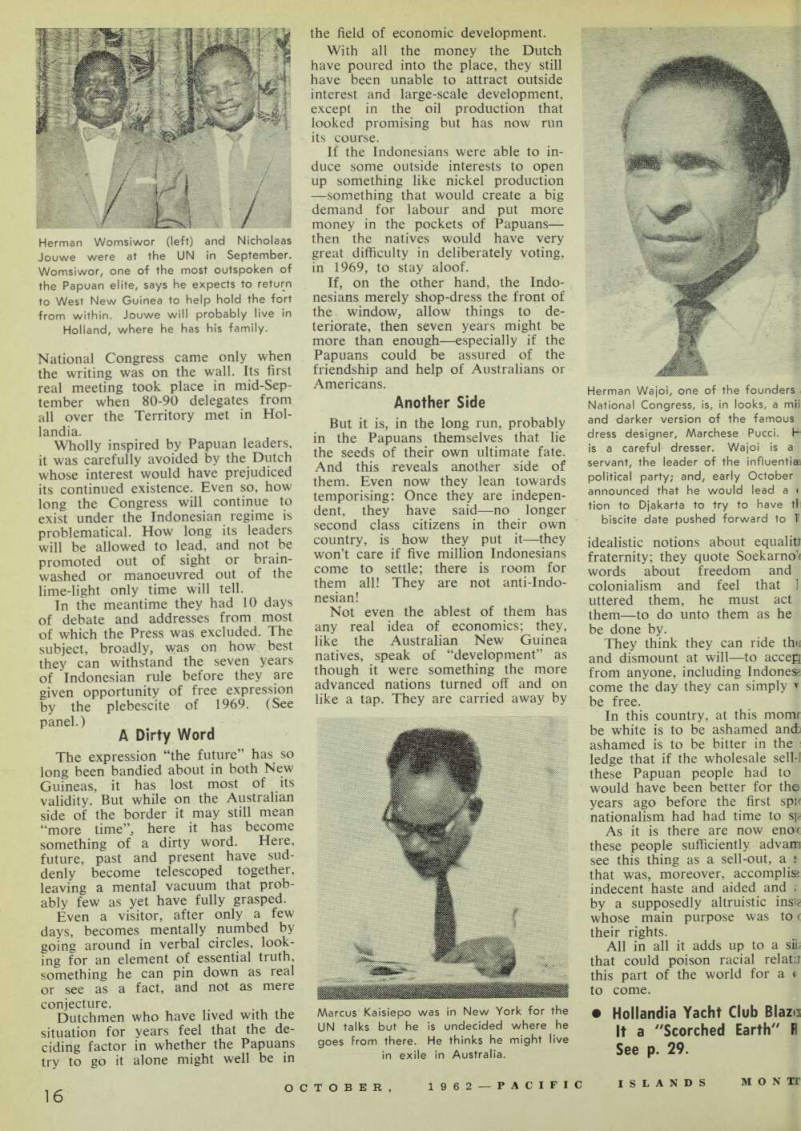
Herman Womsiwor (left) and Nicholaas Jouwe were at the UN in September.
Womsiwor, one of the most outspoken of the Papuan elite, says he expects to return to West New Guinea to help hold the fort from within. Jouwe will probably live in Holland, where he has his family.
Herman Wajoi, one of the founders National Congress, is, in looks, a mi[?] and darker version of the famous dress designer, Marchese Pucci. [?] is a careful dresser. Wajoi is a servant, the leader of the influentia[?] political party; and, early October announced that he would lead a tion to Djakarta to try to have t[?] biscite date pushed forward to [?]
Marcus Kaisiepo was in New York for the UN talks but he is undecided where he goes From there. He thinks he might live in exile in Australia.