Complete £100-million Exodus
pp. 15-16 · Read in the full issue
Frustration, Shame, Bitterness as Dutch Complete £100-million Exodus
From Judy Tudor, in Hollandia As 350 years of time run out for the Dutch in this area, a spurious calm lies over the place. There may still be fireworks, but the problems of the moment are severely practical ones.
The UN, at least for publication, thinks it has the game vn up. But has it? As more and more people jam the out ing airways it begins to look more and more like organised aos.
spite of big monetary induce ents, only about 400 of the Dutch public servants have 1 to remain on here after Oc 1, and the UN commission is ore faced with replacing some ese as well as the 18 officials •ibed under the Dutch esian Agreement.
Jse 18 include the Governor, of departments, Information Press relations officers and the Istrict Commissioners.
Egyptian, Mr. Ali Khalil, ar on September 17 to fill the job Krector of Information along hstrange as it may seem in this i country—a South African grapher. f UN itself is providing a nu of other experts, financial and wise (it is understood that the Qt Dutch Director of Finance [come back as “adviser” on
finance for a few months after making a token withdrawal on Oct. 1). But the jobs it is finding most difficult to fill successfully are those in the field—the six District Com missionerships.
If the UN had showed as much realism about the situation as the Dutch, these would have been the very officials they would have begged to stay. Finding an expert to add up figures is one thing; getting a man who is used to bush conditions and the Papuan people is much more dif ficult.
Job Half Done
Probably the bitterest Dutchmen are those in the field, who must now get out, leaving the job half completed and to God-knows-who.
To these men has fallen the task of trying to explain to these partly civilised natives, the necessity for this
hasty withdrawal and the new poli tical situation, even while they re- JjJg 11 virtue°of^themselves. JUStlce ° r The retiring Dutch who have the welfare of these people at heart hope that new officers appointed to the job by the UN m the interim period will Malay-speaking Britishers who have had service in Borneo or Mala y a or > *** that > Malayans, For the rest, the big-wigs of UNTEA (United Nations Temporary Executive Authority), are convinced that they can carry on. They say that, as in all tropical countries, all ser vices are overstaffed and that these could be cut by 50 per cent, without the establishment ceasing to function, On the credit side they have the 400 Dutch who will remain until the end of the year—about a fifth of original strength—stray odds and sods from elsewhere and permanent UN staff. What they will be left with (they calculate) is a gap of 25 per cent, and the tip here is that this will be filled, at no late date, by Indo nesians. (Over)
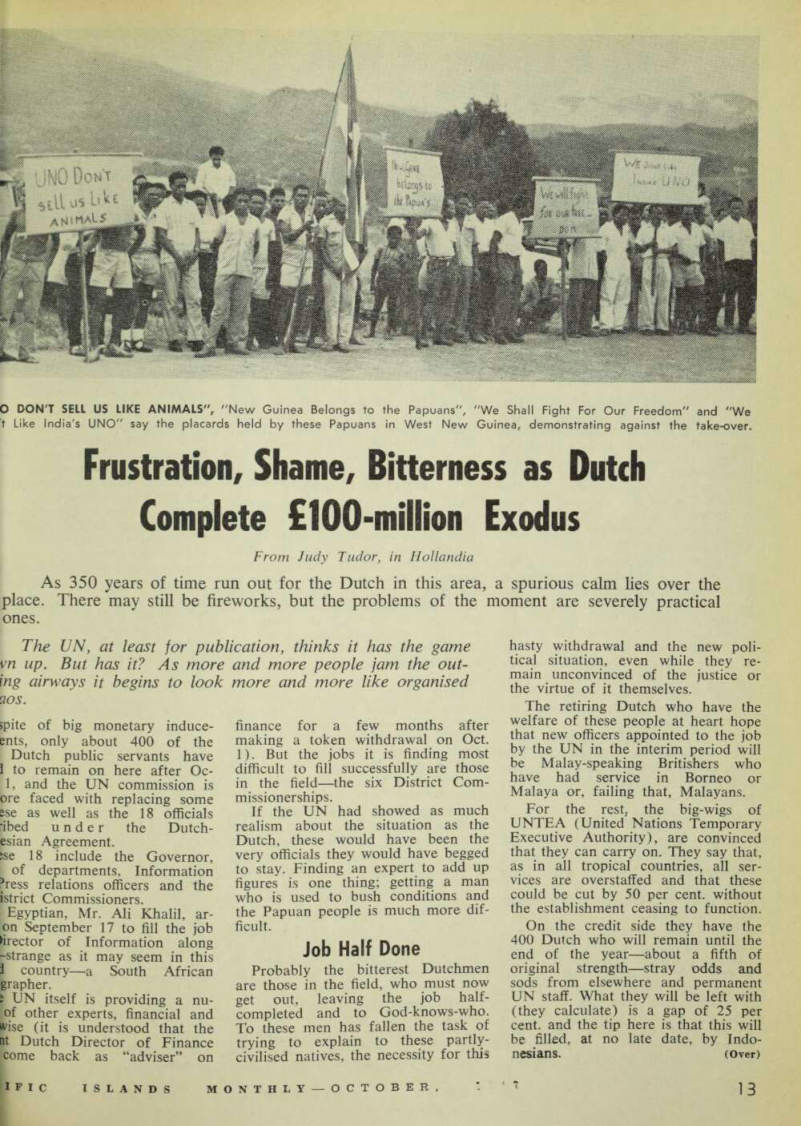
[?]O DON'T SELL US LIKE ANIMALS", "New Guinea Belongs to the Papuans", "We Shall Fight For Our Freedom" and "We [?]t Like India's UNO" say the placards held by these Papuans in West New Guinea, demonstrating against the take-over.
The agreement provides that this can be done and the Dutch are making no objections. Already they are taking the line that as the Indonesians will be here in force after May nothing will be achieved by quibbling; that in fact it might be to the Papuans’ advantage to have Indonesians, who have been used to Dutch colonising methods over 350 years and, being Malay-speaking themselves, will have no language difficulties.
If not an Indonesian it could in stead be an Ethiopian or an Irishman or a Nigerian, or any of the other dozen varieties of people who UNTEA seems capable of producing at the drop of a hat and pushing into a key job.
The haste with which this thing has been engineered is one of its big troubles. If the Dutch had been given six months to hand over to UNTEA, instead of six weeks, there would have been far less excuse for the pre sent run-down of morale, for the scramble to get out, the over-loading of transport services and the feeling of finality, frustration and even shame that pervades everything.
For the Dutch, it is a psychological as well as a physical milestone in their lives. Most are seeing a life time of work go down the drain.
Many have served here the full 17 years since 1945; others had service in the NEI before that.
A large number were born in Indo nesia; some have more than a trace of Indonesian ancestry in their back ground although they count them selves Dutch.
Except for periodic leaves, they have all spent years in tropical ser vice, adapting themselves with the pe culiar gift Dutchmen had for this sort of thing.
A New Start
A few, probably no more than 40, are going to Australia, having made arrangements to do this some time back. But for most it is the cold, grey skies of Holland and a brand new start in life.
The Government is making gen erous allowances for its public ser vants in a scheme that cushions them against cold economic winds for up to five years, depending on the length of service they have had.
In the top salary brackets, up to 80 per cent, of retiring salary will be paid for the first year and salary made up to that amount by the gov
ernment should the officer take a job that pays less.
After the first year, the gratuity payments will fall progressively, but most ex-public servants in the first years, because of the lower cost of living in Holland, will find themselves comparatively well off.
At the New Guinea end, after Oc tober 1, all the public servant has to do is walk out of his house, close the door, and take the plane. The Government packs his goods and his car and loads them—eventually—on to a ship to follow him to Holland.
For most the big exodus comes on October 5, when the first planes leave after the take-over date. About 400 are to go in the Greek ship Patris, which is making a deviation to Hol landia about October 4 from its usual tourist run between Sydney and Athens. About 7,000 others, mostly wives and children, have departed in the last two months.
What of Chinese?
Most of the Chinese community, which runs large as well as small retail businesses in this Territory as in Australian New Guinea, sent wives and children out to Hongkong and Singapore some time ago. Some of the men plan to go themselves and some have tried, unsuccessfully, to get visas to Red China. Some are prepared to stay on although few en tertain high hopes of success in view of Soekarno’s treatment of Chinese in Indonesia.
Most of the Eurasians, many of whom had lived here for years as small landowners, especially around Merauke and in the Sentani area near Hollandia, just closed their doors and quit around June and July when several ships were here offering less than normal fares to Holland.
Amongst the smaller European traders, many have already left; others plan to go either around Oc tober 1 or before May 1. Some just shut up their shops and walked out; others have tried to find a respon sible Papuan or someone else who is staying on to leave in charge.
This is a gesture to desperation rather than to any real hope that they will be able to come back at some subsequent time or make any thing from the business.
Here again, in the matter of pro tecting private enterprise, too little was done and far too late. A bill that will give a modicum of protection under certain circumstances is only
coming before the Dutch Parli in the latter weeks of Sept© Only still in draft form, it effect, an insurance agreemen tween the Dutch Government a* private individual that will p: some compensation against p«< risk and what is called “ri molestation”.
As the draft now stands, tt suree must, however, stand tH 50 per cent, of loss and haa until the end of December tc out the policy, and is then c: for only a year.
In mid-September, Mr. I Wertwijn, managing director local Big Firm, usually knot NIGIMY (Netherlands Impo:( Export Co.) and Mr. D.
Ryjke, a leading lawyer and nr for Hollandia in the New < Council, left for Holland to IoK a change in the draft legislafj provide 80 per cent, cover foi< taking out insurance.
Already stocks are pitifully most shops that remain op© customers are few. Most of tha businesses are situated in tH shopping centre that was con not much more than a year ag present New Guinea 0 chambers are in the middle block but the shops themsehj individually owned.
If they are abandoned, pres? they are just added to the otM lions of pounds worth of reai which the Indonesians will ; nothing in the shape of housi offices. The estimate is that the are leaving behind in roads, s houses and real estate asses over £100,000,000.
Money Problems
Those who contemplate stas business face not only the h of living and trading with thd nesians after May but also based rupiah currency. It is pq this that alarms them most. .
In communications it is antfj that a high proportion of thes cable and radio staff will der UN control. Dutch ships pected to operate as long as t permitted and KLM will cone operate its international through Biak and perhaps P-NG. It was announced ow landia radio in mid-SeptemUi the Indonesian airline Garni commence a service between i and Biak on October 1. Thin confirmed but it seems likd could well be the thin endb wedge as far as the local ain de Kroonduif, a subsidiary oo is concerned.