Suva Tells A Story
pp. 85-86 · Read in the full issue
Of The Shoes
From Dorothea Baxter, in Suva This might be called the tale of the shoes, for in each case, shoes were the inspiration for what came afterwards.
LAURA HOLLIS was six, and being quite a young imp, had been put in the front row of her class so that her teacher could keep a close eye on her at her school in the village of Thorpe St. Andrew’s, two miles out of Norwich, England.
The year was 1881. Naturally it was quite an event when the teacher’s uncle, from faraway China, arrived to speak to the children. As he began his talk, Rev. J. (later Bishop) Hoare placed a tiny pair of exquisitely embroidered satin shoes on the desk in front of Laura Hollis, and though they were slightly mudspattered, Laura decided, there and then to have them—for her doll.
However, by the time Mr. Hoare had finished his talk. Laura had made a different decision.
“Who do you think wore these shoes 9 ” the missionary asked, holding them up before the class.
“A dolly!” Laura was quick with her reply.
But Mr. Hoare explained that, instead of a child’s doll, the shoes belonged to an old lady of 65 who had worn them on her bound feet.
On becoming a Christian, the woman had presented the shoes to the missionary. He told the English children that it was one of his problems in China at that time to dissuade mothers from binding their
daughters’ feet and he needed Englishwomen to go out and help him.
“I decided that day that as soon as I was old enough, I’d go and help him, and I’ve never regretted it,” Miss Hollis (“Hollie” to all her friends) said recently, Now 85, but always busy, Miss Hollis shares a flat in Gordon St., Suva, with another ex-missionary, New Zealander Miss Margaret Jennings, who was a teacher in Otago before she left for Canton in 1923.
When she arrived in Kowloon in 1903, Miss Hollis said, daughters of the richer Chinese families were not allowed to go out of doors, so pupils at the Church Missionary Society’s school comprised mainly rescued children from the streets.
"At times our orphanage was far too full but we never liked to refuse a child,” Miss Hollis said, Parents who sent their daughters to day schools run in connection with the orphanage felt the school should pay them for allowing their daughters to go there, but Miss Hollis said she always refused to accept this view, although at one time it meant a temporary fall-off in school attendances.
“The previous superintendent had been paying the mothers a dollar for
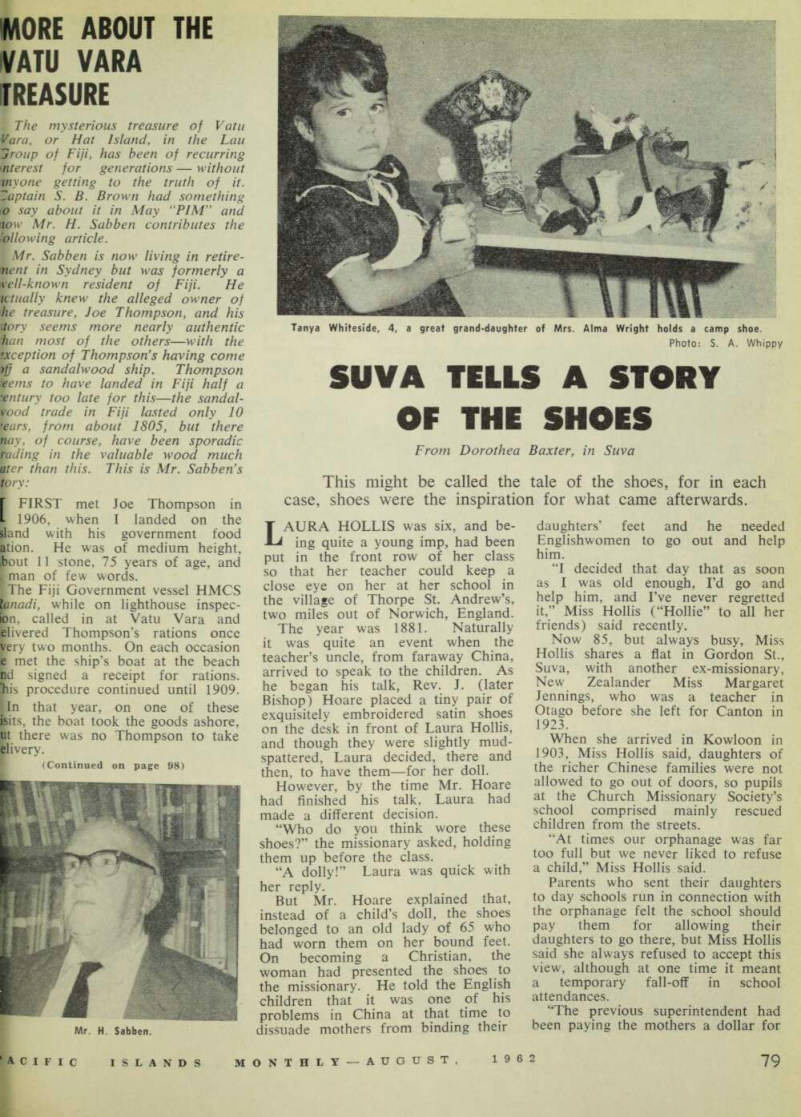
Tanya Whiteside, 4, a great grand-daughter of Mrs. Alma Wright holds a camp shoe.
Photo: S. A. Whippy
each child to come to school, and when I refused, the school went down tremendously, but after a while they realised the benefit of education.”
Eventually, Miss Hollis said, she had 16 day schools operating, and when the Japanese arrived in 1942, there were about 2,300 pupils. When other women were evacuated Miss Hollis stayed behind as interpreter at
Kowloon Hospital.
She does not have much to say of her years in Stanley Camp except that she used to look after some of the children of mothers who had to work in the camp.
On medical advice, she went to Australia at war’s end instead of home to England, and met some “of the kindest people in the world”, members of the Australian Church
Missionary Society.
After two years in Australia, Miss Hollis rejoined her old friend Miss Jennings who had gone to Fiji to take charge of the Chinese school in Suva.
And until 1959—she was then 82 —Miss Hollis coached Chinese boys at home.
“I thought I was getting too slow for them then so I stopped,” she admits with a twinkle.
She now restricts her activities mainly to work for the British and Foreign Bible Society, raising an appreciable sum with some be witching knitted animals as well as other knitting and crochet work.
In all her years in China Miss Hollis never met Miss Gladys Aylward, “the small woman” who has now become famous through book and film.
“She was always in the north and I was always in the south,” explained Miss Hollis, adding that she under stood Miss Aylward was now back in Kowloon, running at least one orphanage, with the help of a younger woman.
ANOTHER set of tiny Chinese satin slippers figures in the touching story of the late Mrs. Mary Wright’s unusual memorial to her daughter Alma, who in 1890 at the age of two, fell into a creek at Korovatu, Vanua Levu, and drowned.
Alma was Mrs. Wright’s only daughter—she had five boys after wards—and at her birth, a family friend presented her with a china lamp in the shape of a rose-trimmed shoe filled with gold coins.
When Alma died, her mother, inspired by the shoe-lamp, began collecting other shoes. As friends heard of the collection, they would send her shoes from all parts of the world, wherever they might be touring.
By the time Mrs. Wright died in 1958, the collection had grown into hundreds of “shoes”. Some were pincushions in the shape of shoes, others were ornaments, and others
such as the Chinese slippers, h; been included because of nation or historical interest.
Among the most interesting a the “wartime” shoes (of World W I): A large wooden sabot said have been worn by an Englii prisoner returning from Germany France “with rags as socks”, ai the clay “shoes” (they are real pipes) moulded and carved Turkish prisoners of war.
Most delicately carved is t miniature regimental boot sent fre Palestine in 1917 by one of M Wright’s sons, “Matey”, who nc lives at Nasese.
Sport is also represented in t collection, from the one inch loi shoes attached to roller skates w: wheels that really do turn, to sk to miniature football boots and black slipper from the doll that w the mascot of the Imperial Footh team.