Vatu Vara
pp. 85-104 · Read in the full issue
More About The
Treasure
; The mysterious treasure of Vatu Vara, or Hat Island, in the Lau 3roup of Fiji, has been of recurring interest for generations without vnyone getting to the truth of it.
Zaptain S. B. Brown had something 0 say about it in May “ PIM” and now Mr. H. Sabben contributes the following article. \ Mr. Sabben is now living in retire ment in Sydney but was formerly a well-known resident of Fiji. He I dually knew the alleged owner of he treasure, Joe Thompson, and his rtory seems more nearly authentic han most of the others—with the Reception of Thompson's having come iff a sandalwood ship. Thompson wems to have landed in Fiji half a zentury too late for this—the sandal wood trade in Fiji lasted only 10 Kars, from about 1805, but there nay. of course, have been sporadic fading in the valuable wood much a ter than this. This is Mr. Sabben's fory: FIRST met Joe Thompson in 1 1906, when I landed on the (dand with his government food ation. He was of medium height, ibout 11 stone, 75 years of age, and I man of few words, I The Fiji Government vessel HMCS ianadi, while on lighthouse inspec ion, called in at Vatu Vara and jelivered Thompson’s rations once pry two months. On each occasion e met the ship’s boat at the beach nd signed a receipt for rations, pis procedure continued until 1909. [in that year, on one of these pits, the boat took the goods ashore, ut there was no Thompson to take elivery.
(Continued on page 98)
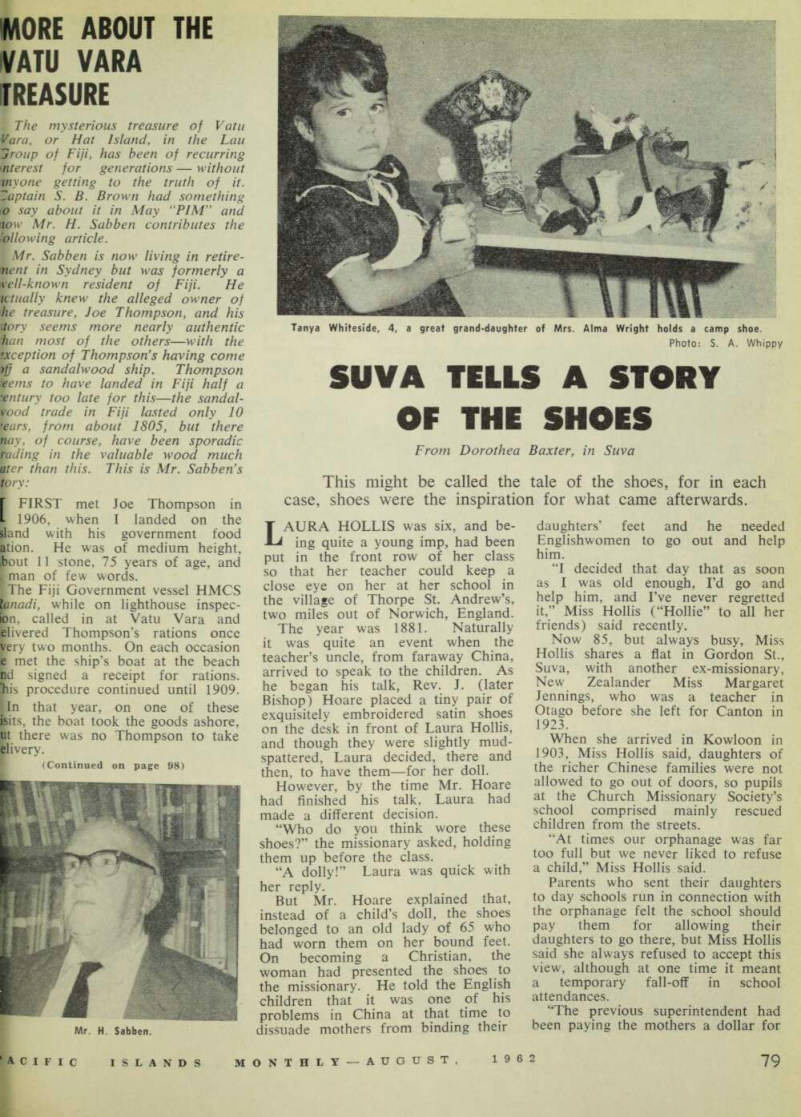
Mr. H. Sabben.
Captain Austin, Captain Wilson and I then went ashore and walked up to the bure which was situated in heavy forest at the base of the mountain. As we approached the house, we heard mournful wailing, and inside we discovered Mrs.
Thompson. She looked to be around 80, and no more than five stone in weight. She was alone, and in a very poor state of health.
She told us that her husband, Joe Thompson, had died three weeks earlier. She had scooped a shallow grave in the sand with her hands and had dragged his body out and buried him a week after he had died.
There was, in fact, very little sand over the body. Our crew collected a large number of stones and a cairn was built over the spot where he was buried, about eight feet from the bure entrance.
We decided that Mrs. Thompson should be taken to Suva for medical attention and the crew was ordered to pack her household goods. These with Mrs. Thompson were picked up bodily and carried to the boat land ing although she objected and fought against leaving the island.
In Suva Mrs. Thompson was placed in the hospital where she died about four weeks later. This was somewhere late in 1909. (Thompson had married twice —first a Fijian woman, and then this Tokelau woman who survived him).
The island was then purchased by Captain Wilson, who placed a Fijian manager there to collect the crop of approximately 30 tons of copra per annum.
Thompson's Story
Captain Wilson had been Harbour- Master at Levuka and had a great store of early Fiji history. He had first met Thompson when he, Wilson, was master of King Cakobau’s yacht, in the early 1870’s.
According to Wilson’s story, Thompson and two companions were on a journey from the coast of South America to Australia, in a small fore-and-aft schooner, when this was wrecked at night on the shore reef at Vatu Vara.
Not knowing whether the island was populated, and having coin and bullion aboard, the three seamen decided to divide the treasure into three equal portions. Each took his portion ashore, over the dry reef, to different parts of the island and buried it. The three returned to the stranded vessel before day light where they were discovered by
Fijian fishermen, who agreed t transport them to Levuka.
At Levuka, Thompson joined vessel loaded with sandalwood, bouni for Canton, and the other two signe up on a whaling ship. Before par ing, they agreed to meet at a plac and date in Port Jackson, Sydne; There they planned to get anoth® vessel, return to Vatu Vara an collect their buried treasure. Thomi son kept the appointment at tf Sydney meeting-place, but the oth« two were missing. Thompson got berth on a vessel going to Fiji for load of sandalwood, deserted Levuka and returned to Vatu Var after purchasing the island from native chief.
He found on arrival at the islai no indication that his two mates h: arrived before him, and these rm were never heard of again. Probab they were lost at sea.
Thompson spent the whole of H remaining life searching for the thr sections of the buried treasure. TH gradually affected his mind and, ju before his death he was paradii the beach with a stick over I shoulder. Natives on passing vesst took this to be a gun and kept cle:; Thompson was virtually insa when he died—or this was the co elusion I came to when I carried a conversation with him duri delivery of the rations.
It was not known whether he e T discovered any of the buried treasu According to Captain Wils<, Thompson was unable to locate spot where he had buried his portri The burial had been carried out night and in his three years’ abser from the island there had beerr severe hurricane in that area of II and numerous slides of rock off mountains had taken place. ProbaE the treasure, if any, is still under « of these rock slides.
My personal experience of treas? hunting on Vatu Vara took plac© the three hours in which the c: were building the stone cairn o the grave of Joe Thompson.
I left the bare and travel through the heavy timber around base of the mountain. After ab an hour, forcing my way throe tangled creepers, I discovered a sn hole about four feet in diamei in the cliff-face. I really that here was the long-lost trease I discovered it was a fair-se cave so I made a torch out of fronds of coconut leaves, and v in to discover the treasure. B'i received a shock —it was an native burial-cave, with about 2*! 30 human skeletons in it. Neeo; to say, 1 did not remain in tt very long.