Wage Problem: Nauruans Say
pp. 49-52 · Read in the full issue

Father Doesn't Know Best
Because of the island’s rich phosphate deposits, Nauruans have for years enjoyed perhaps the highest living standard of all the South Pacific’s indigenous people. But this has brought its problems.
PHE biggest is that the Nauruans, L having experienced the better lings of life, can’t be expected to ive them up. They want to con nue their high standard, and take it yen higher, and they refuse to be put in their place” by any European ho insists that they are entitled to f more financial privileges than, ly, the natives of the remotest part f New Guinea’s Sepik. nhis attitude of the Nauruans as brought home to many people [the end of May at a Commission E Inquiry set up to review the Nauru asic wage. There was some plain leaking by the Nauruans, and what ley had to say and what was said a their behalf is of special interest i light of the report of the UN siting mission, released in July (see lewhere).
As the mission’s report said, “More id more the young Nauruan men id women are turning to the occu itions and habits and tastes of ghly developed societies. With eadily improving education it can irdly be expected that they will rer wish to go back to the restricted id isolated life of a remote island ithout the peculiar advantages of ic island they now occupy.”
At the wage inquiry the Nauruans Jd bluntly that their present basic age of £6/4/7 a week, plus 13/8 ;pendant’s allowance for each child ader 16, wasn’t enough to keep iem in the manner to which they ad become accustomed as a result f their phosphate riches.
They asked for a weekly basic wage of £ll/4/7, plus a dependant’s allowance of 30/- a week for the third and subsequent child (and nothing for the first two), The Commissioner, Mr. W. Wil son, reserved his decision and his report is now in the hands of the Australian Minister for Territories, Mr. Hasluck. ( PIM, July, p. 16).
The Nauruan basic wage sets the standard on the island. The Nauruan Workers’ Organisation, in presenting its case, had the services of an ex perienced arbitration advocate, Mr.
W. A. Baker, of Sydney, who was supplied by the Australian Council of Trade Unions.
Mr. Baker made no bones about the fact that the Nauruans had a high standard of living and that generally they got more money than was pro vided by the basic wage extra money came from phosphate royalties distributed to them. There were, he said, probably more motor cycles on Nauru per head of population than anywhere else in the world, and “certainly there would be more womenfolk on motor than anywhere in the world.”
Nevertheless, he said, the basic wage had to be reviewed (it was last fixed in 1953) in light of the people’s needs and the capacity of the phos phate industry to pay.
He said when the wage is again reviewed in three years the Nauruans would ask for full European-standard pay rates. The economic aim of the Nauruans was to “achieve the highest
standard of living that the economic standard of the phosphate industry, fully exploited for their people, can afford.”
Mr. Baker said he found it impos sible to obtain any detailed informa tion concerning the finances of the British Phosphate Commission, but the trading figures given in the 1960- 61 annual report showed, “Phosphate sales, sundry credits, less freight, in surance and other charges, £3,901,710.”
The report showed that the BPC at that time also had more than £1 million cash in hand, and phosphate stocks in hand worth £4 million.
An extra £5 a week in the Nauruan basic wage would mean only a lOd. per ton increase in the price of phosphate sold abroad.
Mr. K. R. Miller, representing the Administration at the inquiry, told the Commissioner that the Nauruans wanted such things as refrigerators, sewing machines and motor bikes in cluded in the basic wage regimen, and the Administration felt they shouldn’t be included. If they were, the Nauruans wouldn’t then have the incentive to work harder and be thrifty so as to be able to buy them.
Industry's Capacity to Pay
Mr. Miller said the Administra tion agreed industry apparently had the capacity to pay, but this shouldn’t be an important factor in fixing the wage. In the future there no doubt would be other wage adjustments, providing better living standards. But in the long run future generations would have to reach, by their own efforts, a living standard that was not supported by the BPC.
Mr. Miller said that with the future economy of the Nauruan com munity still uncertain—and it would continue uncertain until a decision on resettlement had been reached— the Administration’s view of the bounty of the phosphate industry “must be tempered with sober thoughts” on the capacity of the Nauruans to sustain themselves at a standard of living they would have attained immediately prior to their resettlement.
Mr. Baker, in reply, described this attitude of the Administration’s as one of “extreme paternalism,” a “Father Knows Best” approach. The basic wage had nothing to do with incentive there would be margins for that. And if the Nauruans were asking for a wage merely on the ability of industry to pay they would be asking for far more than £5 a week increase.
He said it was true that the Nauruans might well have to accept
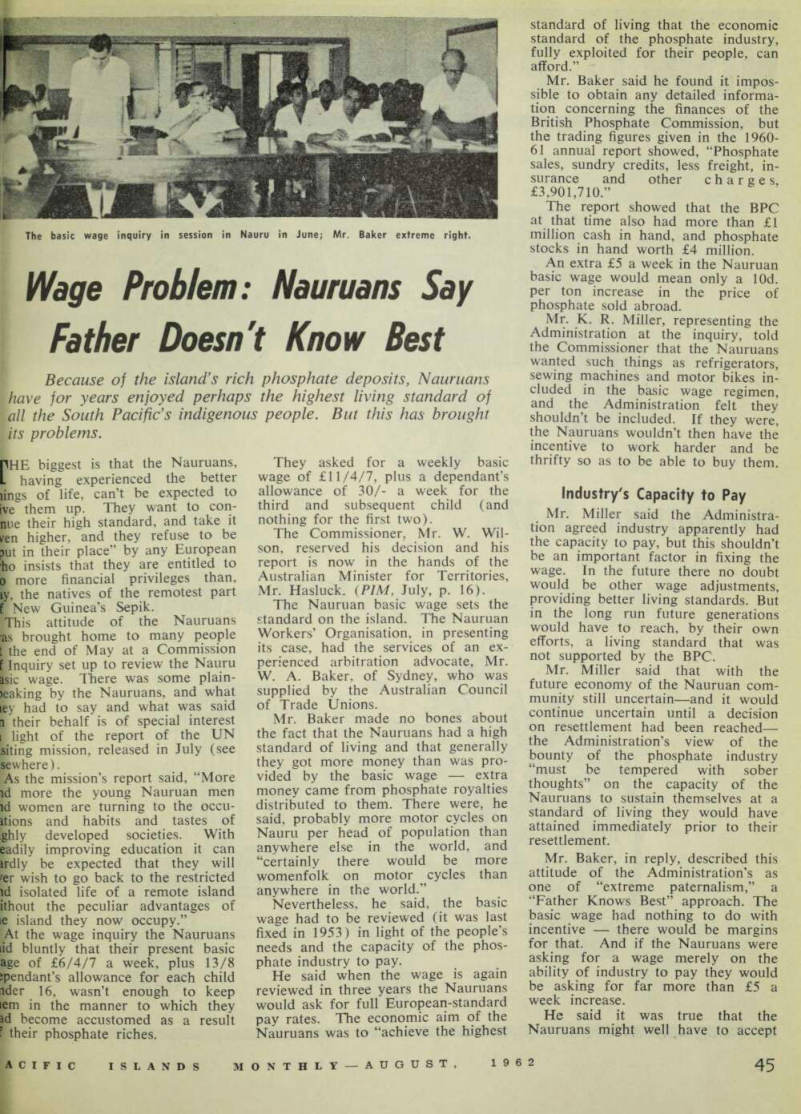
The basic wage inquiry in session in Nauru in June; Mr. Baker extreme right.
a lower living standard when the phosphate finished, but so did many Australians who were retired from work and had to live on an old-age pension. Their salaries in their working life were not fixed on the basis that since they wouldn’t have as much money when they were older they might as well get used to living on less now.
Also Europeans on Nauru paid no income tax, little indirect tax, had cheap servants and enjoyed a higher standard ofi living than they would have in Australia, but nobody had suggested they should not have this higher standard merely because they might have difficulty in adjusting when they got back to the main land.
Raymond Gadabu, a leading Nauruan, representing the Nauru Local Government Council at the inquiry, but himself an Administra tion employee, said Mr. Baker’s de scription of the Administration’s ap proach as “paternalism” was admir able.
The Council thought the Adminis tration’s approach was highly patron ising, and “well-flavoured with anti- Nauruanism which cannot be dis guised.” The Council was particu larly worried because the Adminis tration’s view appeared to be “very well entrenched,”
Mr. Gadabu said Nauruans ovei the years had had the chance to ob serve the officials who had come and gone and “who made up the entity which is perpetually known as the Administration of Nauru.” While the Nauruans bore these Europeans no malice, they were “plain jealous” of their better conditions, and certainly wanted them for themselves.
The Administration had fought to ensure the social and economic up lift of the Europeans, but when Nauruans sought social and economic advancement for themselves the Ad ministration came forward with all sorts of reasons why it couldn’t be done, such as “unsettling effects.”
Mr. Gadabu gave a long list of examples which he said showed Ad ministration discrimination against the Nauruans. It was doubtful if the Administration’s “proclaimed respectability and nobility of purpose and intents in its submisions to the inquiry would stand up under close examination.
The Commissioner did not give any indication of what view he would take in his report—whether he felt that Nauruan progress had now gone so far that it couldn’t be held back, or whether there was something to be said for the alleged Administra tion view of “Father Knows Best.”