Canberra
p. 48 · Read in the full issue
Commentary
From our Canberra Correspondent.
Territories Minister Paul Has luck has vigorously denied Press suggestions that he might be con sidered as Australia’s next High Commissioner to London.
THE suggestions stemmed from the fact that electoral commissioners have recommended that his electorate of Curtin should be merged with the neighbouring seat of Perth, held by the Government Whip, Mr. Fred Chaney.
The Government must soon ap point a High Commissioner to re place Sir Eric Harrison, and since the appointment is traditionally made from within the inner Cabinet, several commentators suggested that electoral redistribution might increase Mr. Hasluck’s chances of selection.
But his reaction has shown that he has no interest in the job.
Quite apart from the Minister’s position, major changes are pending in his department.
A vacancy has been created at the top by the tragic sudden death of Mr.
John Willoughby, the First Assistant Secretary.
Most people regarded Mr. Wil loughby as the heir apparent when Mr. C. R. Lambert, who has been permanent head ever since the de partment was re-formed in 1951, reached retirement age about the end of next year.
Now moves are afoot for radical changes at the top.
A new post of deputy secretary is to be created between the existing es tablishments of secretary and first as sistant secretary.
In view of his outstanding perform ances at the UN Trusteeship Council as Australia’s Special Representative, Mr. Dudley McCarthy, at present As sistant Secretary (International Re lations and Information), is being strongly tipped for one of two higher posts.
Mr. McCarthy has made a deep impression on all who have seen him in action against powerful Soviet-led opposition in the Trusteeship Coun cil.
And his specialist field of inter national relations is becoming more and more important as Australia’s trusteeship problems come under closer world scrutiny and become an increasingly vital sector in territorial administration.
He is a man with notable powers of expression, shown both by his UN speeches and by his volume of the Official War History dealing with the New Guinea campaign. And this is a powerful asset in the higher eche lons of public administration.
However, the creation of the new post of deputy secretary raises a new question in the long-term future of the department.
Does it mean that when the time comes for Mr. Lambert to retire, the Government might decide to fill the position from outside the Territories Department?
Appointments as heads of depart ments are made by Cabinet, and the normal rule of progression within a department does not always apply.
There have been notable examples of this in recent years.
Not long ago the Government ap pointed a career diplomat, Mr. Peter Heydon, as head of the Department of Immigration.
Immigration is a field far removed from External Affairs, but the De partment of Territories, in the world context of the mid ’sixties, is tied very closely to foreign relations.
So the appointment of a diplomat would have special advantages.
If the Government were to follow this line of reasoning in filling the top
Territories job about the end of i year, one name which might be pected to crop up in its discussn would be that of Sir James P' soil, Australia’s Ambassador to UN.
By that time his normal term New York would be running out in view of his seniority he would eligible for appointment to onll few of Australia’s most impon overseas posts. * * * The Government has cle bowed to local opinion in awarr a major contract for house-build to cost £350,000 to P-NG builde When tenders were called fon houses in the Three-Mile Hill division at Port Moresby, the Moresby Chamber of Commerce tested hotly that the specificat. were loaded in favour of mainr builders of pre-fabricated housesg The chamber pointed out ths Territory builders were permittee tender, work would be providedt more local men, Territory tin would be used, the houses would ready for occupation sooner, and 1 all involved in the project wouldf local taxes on their earnings profits. The Government accepted) argument.
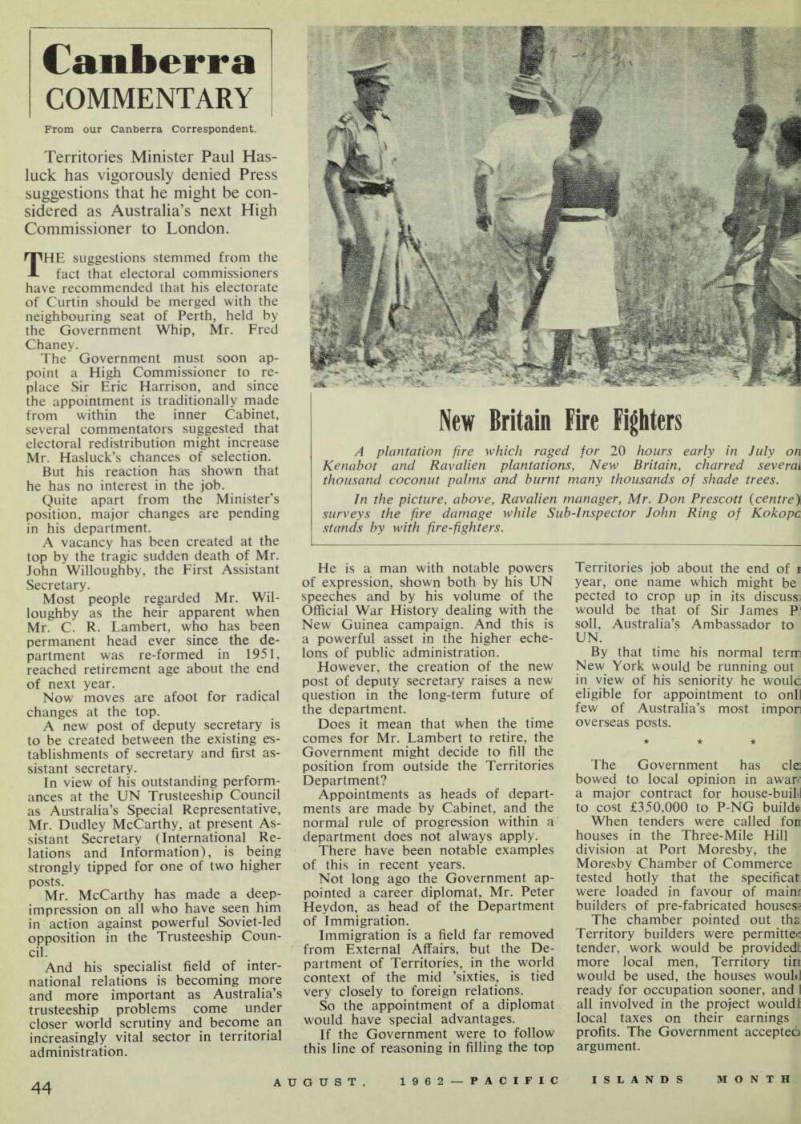
New Britain Fire Fighters
A plantation fire which raged for 20 hours early in July on [?] Kenabot and Ravalien plantations, New Britain, charred several [?] thousand coconut palms and burnt many thousands of shade trees.
In the picture, above, Ravalien manager, Mr. Don Prescott ( centre) [?] surveys the fire damage while Sub-Inspector John Ring of Kokop [?] stands by with fire-fighters.