The Report That Wasn't As
pp. 17-155 · Read in the full issue
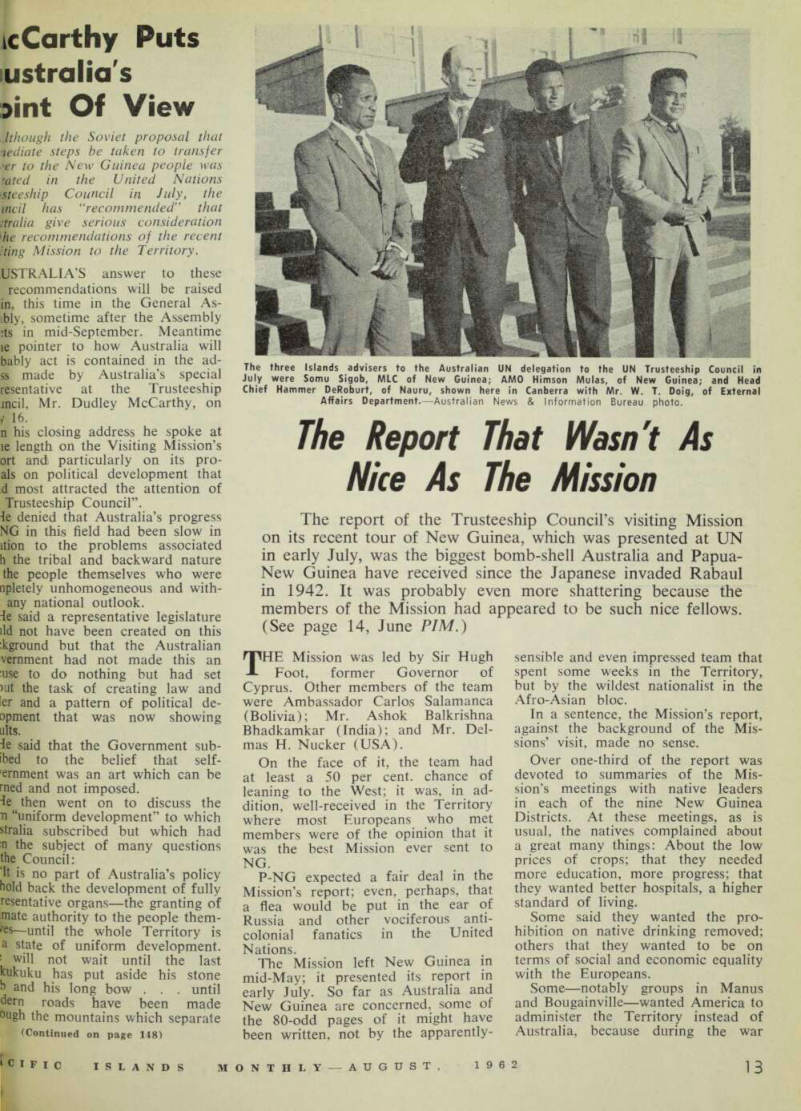
Nice As The Mission
The report of the Trusteeship Council’s visiting Mission on its recent tour of New Guinea, which was presented at UN in early July, was the biggest bomb-shell Australia and Papua- New Guinea have received since the Japanese invaded Rabaul in 1942. It was probably even more shattering because the members of the Mission had appeared to be such nice fellows. (See page 14, June PIM.)
THE Mission was led by Sir Hugh Foot, former Governor of Cyprus. Other members of the team were Ambassador Carlos Salamanca (Bolivia); Mr. Ashok Balkrishna Bhadkamkar (India); and Mr. Del mas H. Nucker (USA).
On the face of it, the team had at least a 50 per cent, chance of leaning to the West; it was, in ad dition, well-received in the Territory where most Europeans who met members were of the opinion that it was the best Mission ever sent to NG.
P-NG expected a fair deal in the Mission’s report; even, perhaps, that a flea would be put in the ear of Russia and other vociferous anti colonial fanatics in the United Nations.
The Mission left New Guinea in mid-May; it presented its report in early July. So far as Australia and New Guinea are concerned, some of the 80-odd pages of it might have been written, not by the apparently
sensible and even impressed team that spent some weeks in the Territory, but by the wildest nationalist in the Afro-Asian bloc.
In a sentence, the Mission’s report, against the background of the Mis sions’ visit, made no sense.
Over one-third of the report was devoted to summaries of the Mis sion’s meetings with native leaders in each of the nine New Guinea Districts. At these meetings, as is usual, the natives complained about a great many things: About the low prices of crops; that they needed more education, more progress; that they wanted better hospitals, a higher standard of living.
Some said they wanted the pro hibition on native drinking removed; others that they wanted to be on terms of social and economic equality with the Europeans.
Some—notably groups in Manus and Bougainville—wanted America to administer the Territory instead of Australia, because during the war
“the Americans brought in all sorts of supplies and food” and left most of it behind when they withdrew. In many places, however, the Adminis tration was praised and a great desire that the Australians stay “to con tinue to help the people” was ex pressed frequently.
In summary, what emerged from all these meetings between the people and the Mission was what anyone with a working knowledge of New Guinea people would expect: That they have little idea of the laws of supply and demand and how they affect commodity prices; that their political outlook is still limited to the village and not even to New Guinea as a whole, much less to the wider international sphere; that their idea of advancement is based on the idea of “ask and be given” preferably by the Government, and with very little idea of what they could of should do for themselves. (But one speaker in Madane told the Mission it was the New Guinea people who should wake up and do something, instead of leaving everything to the Australians who were doing what they could.)
At no time was there ever any re quest for self-government or inde pendence, or that these should be hurried along. To the contrary, if anything was to be learned from what the native leaders said to the Mission it was that at least these people, even if the Mission did not, realised their inadequacy to cope with the terrify ing prospect of going-it-alone.
Parliament by 1964 The Mission spent six weeks in the Territory, talking to the native people and Administration officials; and talk ing to and observing at least some of the 25,000 non-natives in the Terri tory who, however, rate no more than six words in the 80-page report. It was expected that members had seen enough, heard enough and observed enough to (as one senior Administra tion official put it) “get a firm grip on the Territory’s situation”.
Their report made numerous minor recommendations (including the “sweeping away” of all discrimination such as prohibition on native drinking and the censoring of motion pic tures); and three major “propo sitions”: (1) A full economic survey by the World Bank; (2) A new programme of uni versity and higher education for the native people; (3) Immediate preparation for the election of a representative Parliament of 100 in 1964.
Most of the criticism of the report has been on the last and third pro position of the Mission—that a Par
liament of 100, freely elected adult franchise from a commom should by 1964 replace the prr partly-elected (from separate indigenous and native rolls), ps nominated and Administration d nated Legislative Council.
In proposing this, the Mission visages what amounts to a perms union of the Australian Territoi Papua and the Trusteeship of Guinea which, while it may be 1c and even inevitable in the pn climate of world opinion, will please some European resident Papua who have imagined that though New Guinea may be Papua is irrevocably Australian.] The Mission sees the Parlia composed of 100 members each an electorate of about 20,000 pe It suggests that, in the early s< it would be essential to retain ii House about five officials who v be responsible for draft legisi and such things as the annual bir Mission members also hoped t'J number of Australian residem the Territory would stand for eh: under the common roll, but dii elaborate on this suggestion, wh: obviously considered of small! portance.
It is by no means impossible: a few Europeans, with considl influence amongst the natives, be elected under these circumsi but their voice in a House oc would be negligible.
The whole Parliamentary so as the Mission left it, is vagut inconclusive. Apparently it
(Continued on page 148)
“What’s pidgin for ‘a university educated elite to take over administer control by 1964’?” "Sydney Daily Te [?]
planned that the five official me:; who were left would still frami introduce legislation and that would still be formed hind the scenes in Administrate in Canberra.
On the face of what the says, it might then be imagine*; the legislation would thereafter bated by the 100 members ana what the majority wanted prevail. But would it?
At present the non-official hers of the Legislative Counu P-NG have a technical majorii all ordinances made in the Chr have to have the assent of thd ministrator and, in some case the Governor-General of Au;i The ultimate test of any legii: is in the matter of giving on holding assent.
If this right of veto is to i with Australia —which might d reasonable if Australia were ck to still go on paying the pip©' so-called Parliament simply b©(
nborate and expensive facade I which the will of both the Ity and that of the policy rS themselves could end in 1 frustration.
Non-Natives Ignored
most disappointing part of the I is in its total disregard for gitimate claims of the 25,000 digenous residents of the Terri- Although the fruits of their s over the last 50 years are sd by the Mission to be part t Territory’s assets, any idea he people who created those should have some voice in the management of the country has »y-passed. t-indigenous minorities are, of , troublesome, even unfor , but so far as P-NG is con they are part of history and be ignored. If Europeans had ne to New Guinea in the latter : the 19th century, New Guinea nd and its archipelagoes would been absorbed by Asia long But Europeans did go; they iefended it from Asia in war, iven it the only peace, order aterial progress that it knows. / settlement of the future of juinea, the rights of this group 0 be taken into consideration, ay or another. way Australia chose, was a 5 of gradualness, expecting that nents will be made over a ably long period. The way of Ission was to be swift, sudden :volutionary. If they had pur heir method to its honest con -1 they would have then added rth proposition to the other : all non-indigenous individuals iterests be paid off and com- Jd for the time, effort and [ they have invested in the >ry, and that they then return place from whence they came. [ stage thus would have been [ for the United Nations, or her altruistic body, to assume it and the task of financing and ing the New Guinea natives to s themselves. [report, however, wants some >oth ways: It likes the material re that has been erected and, in (ants more of it as this is the Pay in which the standard of of the native people will be r ed; at the same time, the Mis ants to put self-government in ids of the natives although they lot asked for it, don’t want it e, in fact, incapable of making than a pretence of it.
Economic Survey
The report’s two other propositions, concerning a World Bank survey and higher education, excited less public interest.
The survey by the World Bank was necessary, the Mission believed, as there should be much closer asso ciation, in the future, between the Administering Authority and the United Nations and its agencies. The survey should be directed to the preparation and execution of a full and concerted development plan for the Territory with the view of estab lishing new industries and interesting new investment so that the standard of living of the people might be raised.
This proposition concerning the World Bank survey produced little public reaction—and most of that favourable—although the Mission’s elaboration of this part of their recom mendations sits very oddly with their third proposition—a native elected Parliament by 1964.
It needs no UN Mission to show that what New Guinea wants before it becomes a viable State is more out side investment and more industry— European leaders have been saying so in Legislative Council and out for years. But what outside investor in his right senses would be likely to rush into a country that is to be governed by a Parliament of 100 natives, many of whom will be too illiterate to read a ballot paper, and five Government officials who will pull the strings and on which the chance of there being one representative of private enterprise is virtually nil?
Forced Tertiary Education Of its proposition on education the report said that New Guinea needed to approach its programme of secondary and higher education with greater imagination and boldness. It suggested that immediate plans should be made for selecting 100 of the most promising students in the Terri tory each year and preparing them for University—in Australia initially, until the Territory gets a University of its own.
The report said that the need for qualified personnel in all fields is so great and so urgent that this new approach is essential.
Most people agree that almost any thing that is done for education in New Guinea is good, although many have yet to be convinced that it will be of ultimate benefit to a demo cratic New Guinea to produce uni versity graduates in an educational
hothouse while the vast majority of the people are still denied even a basic education.