[?]cCarthy Puts
pp. 17-154 · Read in the full issue
Australia's [?]int Of View
Although the Soviet proposal that nediate steps be taken to transfer >er to the New Guinea people was tated in the United Nations me e ship Council in July, the incil has “recommended” that stralia give serious consideration i he recommendations of the recent iting Mission to the Territory.
USTRALIA’S answer to these recommendations will be raised in, this time in the General As ibly, sometime after the Assembly ;ts in mid-September. Meantime le pointer to how Australia will bably act is contained in the ad ss made by Australia’s special resentative at the Trusteeship incil, Mr. Dudley McCarthy, on / 16. n his closing address he spoke at le length on the Visiting Mission’s ort and particularly on its pro als on political development that .d most attracted the attention of Trusteeship Council”, le denied that Australia’s progress NG in this field had been slow in ition to the problems associated h the tribal and backward nature the people themselves who were npletely unhomogeneous and with any national outlook, le said a representative legislature ild not have been created on this :kground but that the Australian vernment had not made this an :use to do nothing but had set )ut the task of creating law and ler and a pattern of political de opment that was now showing ults. le said that the Government sub ibed to the belief that self 'ernment was an art which can be rned and not imposed.
Je then went on to discuss the n “uniform development” to which stralia subscribed but which had n the subject of many questions
the_ Council:
‘lt is no part of Australia’s policy hold back the development of fully resentative organs—the granting of mate authority to the people them es—until the whole Territory is a state of uniform development. * will not wait until the last kukuku has put aside his stone h and his long bow . . . until dern roads have been made °ugh the mountains which separate
(Continued on page 148)
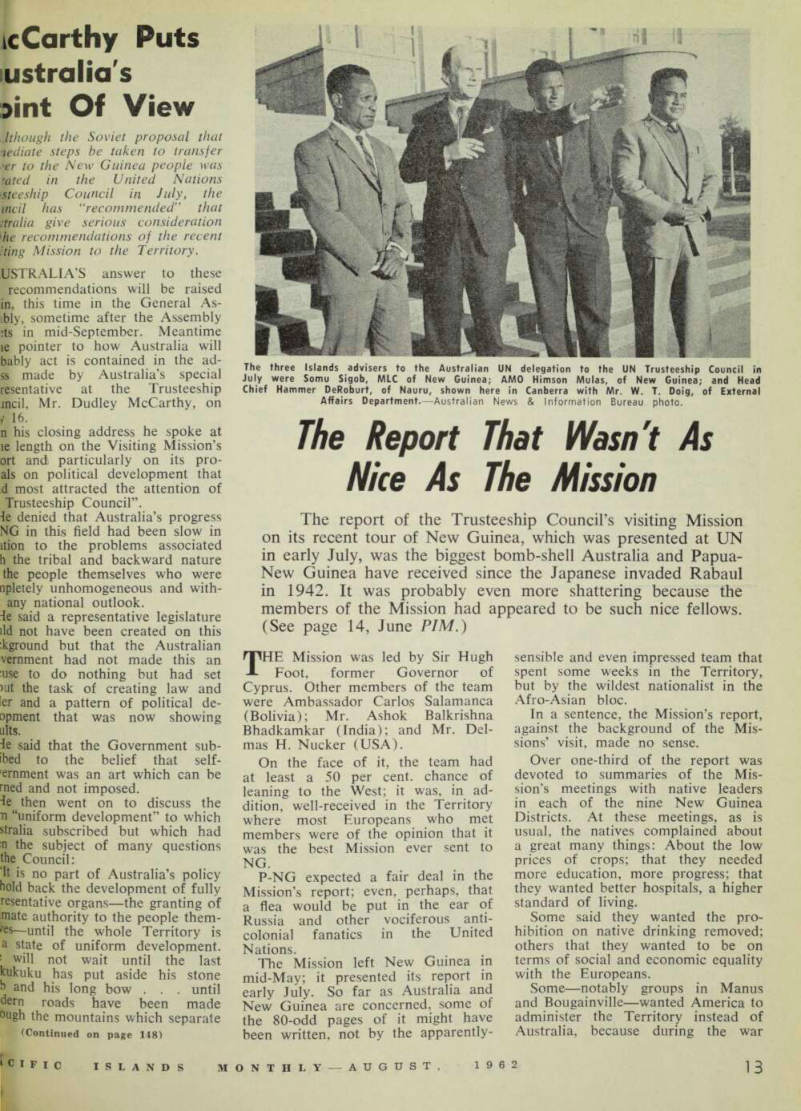
The three Islands advisers to the Australian UN delegation to the UN Trusteeship Council in July were Somu Sigob, MLC of New Guinea; AMO Himson Mulas, of New Guinea; and Head Chief Hammer DeRoburt, of Nauru, shown here in Canberra with Mr. W. T. Doig, of External Affairs Department.—Australian News & Information Bureau photo.
the Telefomins from the rest of New Guinea; until the last limestone mountains west of Mount Hagen have become highways. The Australian policy does not mean any of this.
“What it does mean, surely, is that a proper point of balance will have been reached when a significant section of each of the most significant groups in the Territory is able to ex press its aspirations, speak for the less advanced and voiceless sections of their tribes, and develop a frame work within which they will work in friendship (and if not friendship, at least understanding) with the other major groups in the Territory who have been alien to them.
“It is towards such a goal that the Australian Government is working when it says that self-government should be as broadly based as possible. It is no service to the Territory to reverse my over-hasty action the great advances which have been made.”
He then went on to answer the Indian representative in the Trustee ship Council who had criticised the method by which [electoral colleges] the New Guinea natives had elected their first members to the Legislative Council in 1960: “. . . Why should the Indian system of elections necessarily be more efficient than this? Or the Aus tralian system more efficient? He has referred to the complications of this New Guinea system. Is it more com plicated than the system by which the President of the United States is elected? What proof has he that it is less efficient than any other system?
“In an evolving period, why should the instrument to which the people themselves have evolved not be used?
This is not to say that this system will continue. But it may well prove, with variations, a system which the people themselves will prefer to graft on to the basic stem of the common rolls which are to be prepared. If they wish to do this why should they not?
Mr. McCarthy finally spoke a Australian grants to the Territor “I have no wish constantly tc mind this Council of the great increasing rate of the Australian g to the Territory . . . let me q another statement by the Ministei Territories, a promise made by personally to the people of the T tory: ‘So long as you need our you can depend on us to give it long as you want us to stay youi depend upon us not to desert We believe that Australia and Guinea need each other and can each other. Our wish is to won partnership with you, going han hand, doing things together for benefit of this country and al people’.
“In the face of such promise the light of the simple fact of provision by Australia of the of the financial means whichi Territory requires, what formula been suggested to guide the delii tions of the Territory legislate recognise the fact that the Austi Government has some duty to its payers who provide the mone: which the development of the tory depends; or that the Govern has a duty to ensure that that m is spent wisely towards the disc: of its international obligations ii Territory?”