Pacific Report
pp. 135-165 · Read in the full issue

The month’s round-up of news and pictures of people and mts, from PIM correspondents in the South Pacific.
Now Has Eighth
ical Party
ither native political party has created in Netherlands New a. s known as The People’s Party reedom and Justice, and has uarters at Merauke, in the ex south-east of Dutch New a. mbers of the party say they formed it as a common front t the Indonesian invasion, new party—there are eight now created by the Moejoe people itral Eastern New Guinea, who settled in the Merauke area, ■auke has a European popula f 800, more than 3,000 Papuans, ,000 Chinese and Indonesians.
Indonesians mainly are from loluccas, and have been there j time. is party is important because id despaired of an indigenous al movement in the Merauke said Mr. C. A. B. Pley, Neth s Liaison Officer in P-NG, in Moresby in June.
Opposition to New
ea's Courthouse Plans
ice is traditionally blind. And ; elaborate garb proposed for y Australian Territories Minis isluck, she must be stone deaf ill, else she would heed the >ioned outcry which has resulted the Minister’s proposed court plans in New Guinea, urprisingly, the sturdily indi istic citizens of Rabaul seem heading the rumpus, owing years of urging for bet diaryes, better roads, better facilities, better housing, they tunned by the recent announce that the Minister proposed to a courthouse in Rabaul which cost the princely sum of 100. ncillors at the next Town >ry Council meeting berated
the proposal, claiming that while the present makeshift arrangement of hearing civil and criminal cases in the Masonic Hall was inadequate, nevertheless justice was being done and the Crown’s dignity was being upheld.
A proposal to spend £lOO,OOO on a courthouse when other more urgent works needed fund allocations would be decidedly out of order, the coun cil implied. Other councils on the New Guinea mainland were also critical.
In an attempt to appease and clear the air, Mr. Hasluck then issued an article to a Territory newspaper in which he attempted to explain that Halls of Justice require a certain architectural dignity to impress their purpose upon the indigene.
In Rabaul, Councillor Brian Darcey delivered himself of a scathing speech against the Minister’s plans.
The proposed courthouse for Rabaul represented one quarter of this year’s estimated income tax revenue from the whole of New Guinea, Councillor Darcey said.
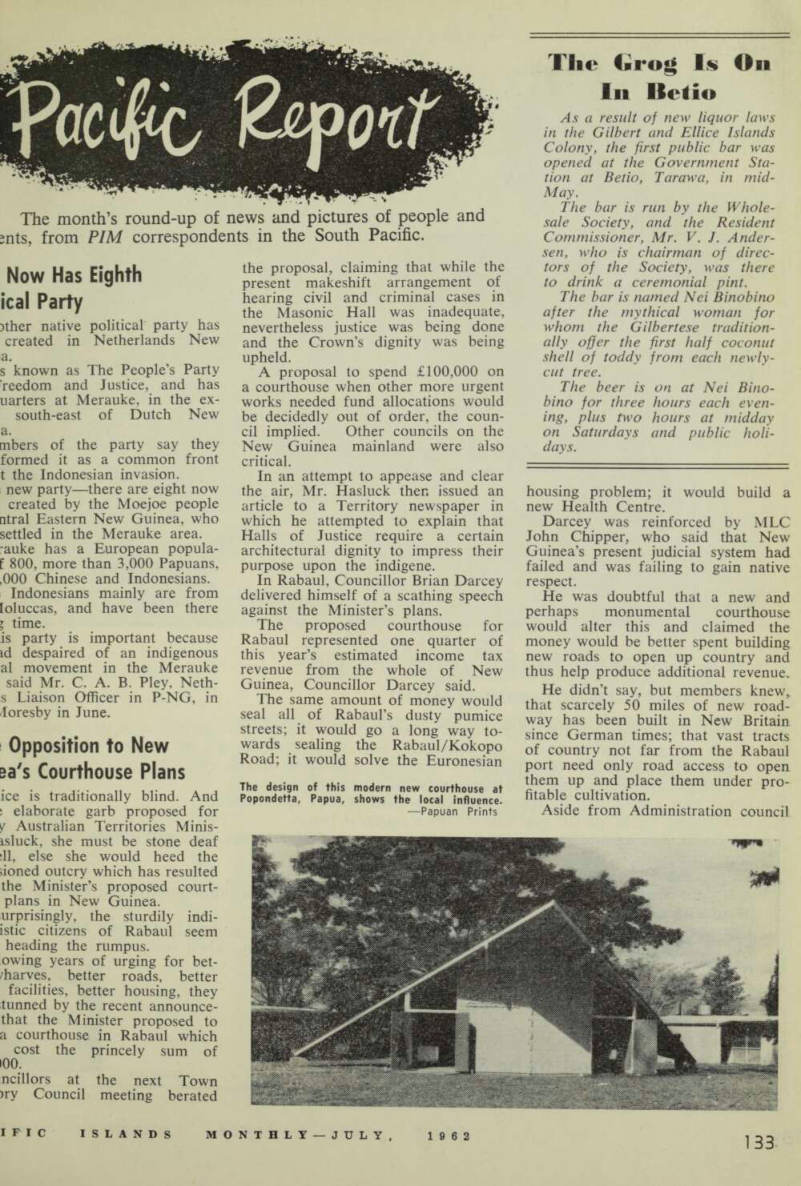
The same amount of money would seal all of Rabaul’s dusty pumice streets; it would go a long way to wards sealing the Rabaul/Kokopo Road; it would solve the Euronesian The design of this modern new courthouse at Popondetta, Papua, shows the local influence. —Papuan Prints
housing problem; it would build a new Health Centre.
Darcey was reinforced by MLC John Chipper, who said that New Guinea’s present judicial system had failed and was failing to gain native respect.
He was doubtful that a new and perhaps monumental courthouse would alter this and claimed the money would be better spent building new roads to open up country and thus help produce additional revenue.
He didn’t say, but members knew, that scarcely 50 miles of new road way has been built in New Britain since German times; that vast tracts of country not far from the Rabaul port need only road access to open them up and place them under pro fitable cultivation.
Aside from Administration council
itees who all refrained from , Councillor Darcey’s motion sed strong disapproval of the ouse proposal and requesting s construction be deferred until urgent works were completed, assed unanimously. /ever, some councillors are al. They fear that this motion, lany another in the past, will rridden by officials who accept Ivice of “Advisory” councils /hen it suits them.
'as perhaps inevitable that the ouse issue would come up There was quite an explosion P-NG Legislative Council last iber when the Administration iced it had ear-marked £70,000 ew courthouses at Kerema, , Popondetta, Finschhafen and ig, and that additions were to ade to the courthouse at u. ortunately, the Treasurer chose the House at the same time loney was short and that the istration planned to increase m beer and spirits, soft drinks, is, radios and cars to balance dget. e was no mention of a Rabaul Duse at that time, but elected rs protested about the expense other buildings and attempted i to reduce the Estimates by g the courthouses until next The modern Popondetta court (see picture) was opened re- It is a new departure in ry architecture.
sssful Health Fight
therlands New Guinea
attack on the main diseases g the people of Dutch New has been so succssful that ire less hospital beds in use territory than there were ears ago.
Assistant Director of Health :st New Guinea, Dr. Otto donk, said in June that in here were 1,200 beds in the uent’s hospitals. Today there bout 900. said this was brought about reventive rather than a cura proach to medicine in Dutch fuinea.
Kranendonk also said that in he then Director of Health, Bierdrager, decided to attack malaria, tuberculosis and He selected four doctors ide each of them responsible 3 fight against one of the Kranendonk was chosen to be campaign against yaws.
He said that when he started the anti-yaws campaign about 10 per cent. of the population were affected and his teams had to cover many miles of rugged country to give penicillin injections to the people.
By April, 1957, they had covered the whole area under Administrative control and had given injections to 275,000 people.
“We reckoned that each day we worked for three hours and walked for four hours to the next village,”
Dr. Kranendonk said. He also said that annual surveys showed that the
disease was on the way out. “You would not find a case in the ad ministered area now.”
Dr. Kranendonk said there were about 5,000 cases of leprosy in the territory today, of which about 800 were contagious. Of these 600 were in five treatment and isolation centres.
He feels that leprosy is on the way out.
He said that in the fight against tuberculosis the Health Department had established 18 X-ray centres, More than 2,000 cases were being
ed mostly as outpatients which, aid, was just as good as hospital ment. alaria is also on the way to being oiled. ic doctor said it was technically ble to eradicate malaria, but i were many difficulties in a >aign against mosquitoes. All es had to be sprayed twice a village house does not last more two or three years, so new ones :onstantly being built and must prayed, Dr. Kranendonk said. ; said the budget for the West Guinea Health Department has from £550,000 in 1954 to 8,500 last year.
r Caledonian Tourism Is
.test Developing"
ie rate of development of the st industry of New Caledonia become the highest in the ic, Mr. Henri G. Martinet, a ng figure in the tourist industry, at Wellington in early June, chemist in Noumea, Mr. Mar is also chairman of the directors lew Caledonia’s inter-island air- Transpac, and controls Relais de imera, a tourist resort on the of Pines. r. Martinet was visiting Welling o call on the de Havilland Air- Company, which services the ie’s equipment and to see the Caledonia team play its second ;r match with New Zealand. his diverse roles he said: “The ic is for my pleasure; the tourist t is for the future; the phar r makes all these interests ble.”
;age Named After
h of the 'Bounty'
ie passage by which Captain am Bligh entered the Fiji group lis historic voyage after the ity mutiny, is to be named ity Boat Passage, though earlier mariners had -d islands in the Fiji group, r credit for the discovery and ding of the islands goes to Cap- Bligh when he sailed through group on his open-boat voyage Tonga to Timor, e passage through which Bligh ed Fiji waters is in the Lau 3 between the islands of Moce Komo in the north and Namuka the Yaqasa cluster in the south, ar the passage has been un id. The new name was brought use from July 1.
One other stretch of water in the Colony, to the north of Viti Levu and the south-west of Vanua Levu, through which Captain Bligh passed, has been known as Bligh Water for many years.
Two NZ Visitors Drown
In New Caledonia
Two New Zealand tourists were drowned in a tragic accident in New Caledonia in early June. They were Dr. Lindsay Rogers, 65, and his mother-in-law, Mrs. Beatrice Downes, 85.
The tragedy occurred at the Tchamba River, not far from the tourist centre of Touho. Dr. Rogers
had hired a small car and was tour ing the East coast with his wife and her mother. He was unfamiliar with the road and in the dark ran down the ferry loading ramp of the river into 18 ft. of water. Mrs. Rogers, who was able to open a window, fought her way to the surface. After several diving attempts to rescue her mother and husband, Mrs. Rogers had to give up and swam to the shore. When the ferry arrived she enlisted the aid of the natives on board. The natives dived and brought the bodies ashore, where artificial respiration was applied to no avail.
It is thought that Dr. Rogers either saw the lights of a car on the ferry and thought that he was still some distance from the river, or else in
the dark failed to see the signs de noting the river crossing. Local newspapers were inclined to blame the lack of clear warning signs.
There'll Be New Guinea
Elite Under Another Name
Australia would not create or cul tivate an “elite” group of natives in Papua-New Guinea, Mr. J. K. Mc- Carthy, Director of Native Affairs, said in Port Moresby in May.
Mr. McCarthy had been asked to comment on a claim that whether Australia liked it or not, an elite had emerged or was emerging in the Territory.
The claim was made in Canberra by Dr. F. J. West, Senior Research Fellow in Pacific History in the School of Pacific Studies at Austra lian National University, who said that it was plain there was some emotional dislike for an elite.
“But whether it is liked or not, one has emerged in Papua-New Guinea,” he said during a lecture. (PIM , June, p. 122.) Mr. McCarthy said: “We are not deliberately encouraging an elite. As I see it, the word elite means the fostering of a special separate class of Papuans and New Guineans better educated than the rest, and who at a comparatively early stage, would be selected as leaders.”
The Australian Government’s policy did not run along these lines.
The Government planned general education for a mass of people, Mr.
McCarthy said.
Its policy was obvious, and he thought it was a good policy in a country where “the past has resulted in an unequal development for cer tain areas and people”.
He added: “It is certainly not our intention to hold emerging leaders back, but I think it is true that some men will rise above the rest and are accepted as leaders by the rest. But it is wrong to use the term elite when referring to them.”
New Inspector-General of
Pacific Health Service
Dr. Charles Gurd, 42-years-old superintendent of the CWM Hospital at Suva, has been appointed Director of Medical Services in Fiji, and Inspector-General of the South Pacific Health Service. Dr. Gurd succeeds Dr. P. W. Dill-Russell who returned to London early this year to take up a top post at the Colonial Office. Dr. W. H.
McDonald, who acted as director after Dr. Dill-Russell’s departure, and whose substantive post of
y Director of Medical Services, to retire to New Zealand later ear.
r Islands Paintings
xhibition
a 10 days’ exhibition of 60 igs in June, New Guinea’s Mrs.
Kuster gave Sydney one of its unusual art exhibitions—un in subject matter and unusual cution.
Kuster has been painting she was a small child at the •ope mission school near Ko but, so she told a PIM re , the 60 pictures she exhibited Iney had all been done in the x months. As some of the pic vere as big as murals, the sheer al effort involved would be suf to shake the morale of most eyen if the pictures were all i in this short space of time, overed many periods and Ger many moods. They ranged h the large poster-like pre ons of the old Kokopo Hotel right, theatrical tropic sunsets. were birds-of-paradise, New a flowers and a native mask n another mood, some small, il studies in monotone that had ling about them of the dis d Japanese print, show with the paintings was Kuster’s collection of New i shells-—which includes two a Cowries. (For a reproduc
tion of one of the paintings see PIM Jan., p. 71, and for a report. May, p. 125.)
Fiji 'Recruits' Let
George Do It
A Suva man, George Rajendra Narayan, alias George Chandra, re cently came up with something new, but didn’t get away with it.
Knowing that many young men from Fiji were anxious to get to England, particularly since the British Army recruited 200 of them, Narayan let it be known that he was agent for a British firm which was offer
ing employment to 30 men from Fiji. It did not take him long to recruit the 30. Narayan suddenly be came the most sought-after man in Suva—not by the police, but by other young men who wished to join in the migration.
Even when told that the quota was full they remained hopeful.
Narayan’s scheme was that each man should pay him £25 as an ad vance on his air fare, that the firm, B, Guggenheim Ltd., London, would pay the remainder, and would dock a certain amount each week from the recruit’s wages when they started work.
Narayan carried documentary “proof”, including letterheads carry ing the name of the firm. Most of the men he chose were in employment, and without any checking, they re signed.
By this time the police were be coming interested.
They decided to arrest Narayan, and they charged him with false pretences on three counts. When he first appeared in court he was refused bail, in his own interest, because it was feared that some of the men he “duped” would be out to avenge themselves.
But there was a hard core among them who believed that Narayan was on the level, and that everything would come out all right in the end.
Next time he appeared before the court, Narayan was allowed bail, and apparently police fears that he might be assaulted were unfounded.
The police meanwhile established that there was no such firm as B.
Guggenheim Ltd.
When he appeared in court late in May Narayan changed his not guilty plea to guilty, and received 12 months’ sentence on each count, the terms to be served concurrently.
The “hard core” have since changed their minds. And a handful of those who resigned were lucky enough to be reinstated by understanding em ployers.
Examining New Guinea's
Political Development
The Third Secretary of the United States Embassy in Canberra, Mr.
Paul Cleveland, in June made an eight-day tour of Papua, New Guinea, to “examine political development.”
Mr. Cleveland flew to Rabaul in New Britain on June 21. after meet ing Administration Departmental Chiefs and native leaders.
Mr. Cleveland said he wanted to examine politics among natives and meet the Native Workers’ Association leaders.
The Administration’s executive officer for policy and planning, Mr.
J. Toogood, said the visit was part of the United States Embassy’s policy of learning as much as possible about Australian Territories.
Duty Off on 'Tourist 7 Goods:
Move in Fiji Legco
For years those interested in build ing Fiji into a tourists’ buying Mecca have been hammering at the authori ties for the removal of duty from ' luxury goods, such as cameras and accessories, binoculars, transistor.; radios, watches, etc., without much
s. The main argument is that the average local cannot afford terns, and probably would buy f them even if he could, free ng tourists would, the duty were dropped, the onists claimed, there would not uch loss of revenue to the nment, and in any case with r increased sales retailers would nake it up in income tax. v there is a good chance that ity will be dropped on these and also on cigarette lighters, ' razors, genuine jewellery and goods which have a special to visitors. i lawyer, Mr. John Falvey, a ir of the Legislative Council, ven notice that he intends to at the July session of the coun it the duty on the luxury goods ived, ava correspondent reports: “As alvey is rather a cautious in d, it is confidently expected e has received the nod from iment that an appropriate mo ould receive a favourable hear- And the developing tourist y can expect a shot in the
oon To Have
w Theatre
ie well-built area south of the , at Lae, New Guinea, Mr,
Harry Starr is building a new cinema theatre, 180 feet long, with all mod ern amenities. It will replace the old native cinema, which was built soon after the war between the air strip and the Lae Hotel, and which now is being swept away as part of the operation of enlarging the air field for jets.
The new theatre is designed not only for cinema audiences, but also for large festival gatherings, sporting tournaments, etc. —it will be the largest auditorium in Lae. Mr. Starr, a canny investor, is building the huge place himself, with the aid of Chinese technicians, and it should be in operation by mid-year. Mr. Starr’s
European theatre, up on the terrace in the new town, where Mr. Starr lives, will continue as usual.
Increase in Criminal
Hearings in Fiji
Magistrate’s courts in Fiji in 1961 dealt with over 2,000 more criminal cases than in the previous year, ac cording to the annual report of the Judicial Department.
There was a drop in offences against public order and property, but an increase in offences against morality, against the person, and in public health, liquor and immigra
JINEA WEDDING. Miss Noela Bainbridge lovely bridal picture on the day of [?]dding to Kandrian agricultural officer corn. Before her marriage Mrs. Alcorn high school teacher with the Education Department, Rabaul.
tion cases. The largest increase was in traffic cases, which rose from 2,409 in 1960 to 3,835 in 1961.
Of 9,776 persons found guilty in criminal cases before magistrates, 3,088 were Fijians, 5,878 were In dians and the remainder were from the other races.
The Supreme Court dealt with 30 criminal cases, involving 24 Fijians, 17 Indians and two “others.” There were 10 cases of murder involving five Fijians and seven Indians, and one “other.”
On the revenue side court fees, fines and other receipts at the Supreme Court Registry totalled £17,410/4/4, while in the Magis trate’s Court the “earnings” from fines totalled £22,038, and court fees were £11,534.
Army Roadbuilders On
Wewak-Maprik Rd.
About 120 men of the Australian Army’s 17th and 24th Construction Squadrons have been relieved in North-West New Guinea by the 21st Construction Squadron and a troop from the 24th which had been under separate command in Australia.
The newcomers will carry on where their mates left off—with the reconstruction of the Wewak-Maprik Road. The first team of men spent 11 months in the Territory and the current units will also.
There is already a road from Wewak to Maprik—except when there has been heavy rain, when there isn’t. It was built over half a dozen years back by local New Guinea natives and it is negotiated only by jeep or Land Rover —and then only if you work hard at it.
A Busy Coffee Mill
In NG Highlands
Because the taste of the Dutch was shaped over the years by Netherlands East Indies coffee, and because they now cannot get coffee from what is now Indonesia, they are buying sup plies from the Australian planters in the New Guinea Highlands.
A contract recently was made be tween the Co-operative Coffee Mill in Goroka (which is operated on be half of the co-operative by Messrs.
Colyer Watson Ltd.) under which Dutch consumers will take 50 tons of Highlands coffee each month- This is a good contract for the Terri tory. A The mill, which has been running for about five years, takes in coffee from any Highlands planter, Euro pean or native, grades and processes
d sells to anyone interested. It is supplying a large market in alia and the Southwest Pacific dly.
' mill, also, is providing employ for a considerable number of s. Over 30 girls, for example, day beside moving belts, pick- Jt poor and discoloured beans the stuff that has been taken )y the mill. v equipment that has just been ed in the big building of cement ron in North Goroka should are of all demands for the next ears.
a-New Guinea to
ish Film Censorship
i censorship for Papua-New a natives would be abolished igust 1, the Administrator Sir d Cleland announced on June )m now on Europeans and > all will see the same films,”
Dnald told a Press conference, censorship for the natives has naintained firmly since the end )dd War 11. Sir Hugh Foot, nan of a United Nations n which visited the Territory y, described the censorship as of the discriminations that be swept away in New ing the Press conference, Sir I announced that the com to inquire into the relaxation d liquor prohibition for natives “sit as soon as a chairman >ointed”. The plan for the ssion of Europeans and , with a licensing expert from lia as Chairman, was an :d on May 15, the day on the United Nations Mission pua for Sydney.
The Administration has prohibited liquor for natives since Papua be came an Australian possession in 1905 and since the New Guinea Trust Territory became Australia’s respon sibility in 1920.
After August 1 Australian film standards will be accepted for all races (native and mixed, Chinese and Europeans) in the Territory, Sir Donald said. However, films would be “subject to any special conditions which may be imposed by the Terri tory’s Chief Censor, the Chief Collector of Customs, Mr. Keith Chambers”.
Sir Donald described some films spotlighting sex, violence and racial troubles as unsuitable. He was asked if this meant that films in this bracket normally shown to EUro-
[?]ction of the 36 Eastern Highlands native girls who sit all day beside the travelling [?]ns, and pick defective coffee beans from the moving mass of beans, which go for [?]ment into the Goroka coffee mill. They pass the monotonous hours with cheerful singing—some of their ringing choruses can be heard a quarter-mile away.
would be banned. Sir Donald ited that the same films would 3wn to all races, used the same answer when orter suggested that if certain were considered unsuitable and :es would be shown the same then the new system actually impose censorship on Euro- Donald said his proclamation provide for a censorship )ry Panel of five Europeans mtives, one of whom would voman, re are six theatres, three Euro and three native, in Port by and a total of 40 permanent nakeshift theatres throughout rritory. is being shown to Europeans hout Papua-New Guinea re include: Home from the Hill tised as a “powerful drama legitimate son . . . outshocks i a Hot Tin Roof”), Live Fast, r oung (“today’s beat genera- Let No Man Write My h (“ripped raw and roaring real life”), Indiscreet (“how they?”), Miami (“the mob to bump me off . . . but not I spill everything”), and (“a runaway finds passion”). audiences are shown ns, fantasies and travelogues.
(feller to be
mbered in Hollandia
k on a museum to com ate Michael Rockefeller, son Governor of New York State, art soon in Hollandia, Dutch kiinea, reports an AAP-Reuter iondent. :efeller was lost off the south ast of New Guinea last No
yember when a Catamaran-type raft in which he was travelling, over turned and drifted out to sea. At the time he was on an expedition to collect specimens for the Museum of Primitive Art in New York.
Now a Dutch anthropologist who was with Rockefeller on the raft, is supervising plans to build the museum with 20,000 dollars given by the American’s father, Mr. Nelson Rocke feller, in gratitude for Dutch assist ance in searching for his son.
The anthropologist, Mr. R. S.
Wassing, said the Dutch had wanted
te call the museum the Michael Rockefeller Memorial Museum, but Mr. Rockefeller had not approved the idea. Instead, a plaque in memory of Michael Rockefeller would be placed inside the museum, Mr. Was sing said.
“The accident involving Michael Rockefeller was a great tragedy,” he added. “He was excited about New Guinea and said that when he came here he had begun to live. He really felt that this country had something to offer.”
Mr. Wassing is at present working on the museum project and on col lecting specimens of the native handi crafts in which Rockefeller was so interested. He said the museum, apart from displaying native art, would show the way of life of the Papuan peoples through collections of food vessels, personal decorations and other things in every-day use.
He also hoped to have models of their houses and canoes on display “so that people can take a peep into a section of Papuan life.”
One of the features of the museum will be intricately carved 30-ft. poles consisting of three or four figures, each standing on the shoulders of the one below. These are called “lis” poles.
These are used in a six-months’ long ceremony by the Asmat people in which they commemorate a chief or brave men of the tribe .
FOR ISLANDERS. Sixty boys from Western Samoa, the Cook Islands and Niue, attending Zealand secondary schools on Government scholarships, recently gathered at Reikorangi, [?]iles from Wellington, for a holiday camp. Object was to enable students to in touch with others from their own territories, and to help them get to know [?]nts from other territories. Camps have been held almost every year for the past [?]ears. The camp was arranged for the Department of Island Territories by the islands [?]tion branch of the Department of Education. It was conducted by the Wellington Institute. Here young Niueans practise a little close harmony as they prepare for a concert at the camp.
and Rockefeller had seen the of such a ceremony at Aman ai, a village on a tributary of ■Campong RiVer, and were re ig to see the end of it when ccident happened, Mr. Wassing :h ceremonies were held only once in four years and included ag and feasting, he said. In one the women of the village en the hut where it was taking and had to stab the men per rs with Cassowary-bone dag y strict ritual was involved in :ertain women having to stab i men, according to their rela ip with the person whose ry was being honoured, le of the women did little more »rick the men with the daggers, others inflicted quite large Is. These did not seem to the men and healed very Y
lopment With
irfields
Chris Ritchie, manager of irways, about two and a half ago, expressed an interest in usal to lay an airstrip at Ba, d not receive much in the support from official quarters, mned, if a strip was laid, to egular Drover service between i and Ba, to provide much connections for north-west ;vu. reasoned that there would be traffic offering from Ba, Vatukoula and Raki Raki to t the service. e was much sound sense in ;oning for an air traveller from ihing to visit Suva would first o motor about 40 miles to md once he reached Nausori fid have another 14 miles’ ) Suva, air authorities considered that posed airstrip, at the old Ba rse, was a little tight for a and did their best to dis- Fiji Airways, fay, the airstrip plan for Ba till late in May when the Works Department started to e old racecourse, at Namosau a 2,700 ft. runway, 200 ft.
But it was not for Fiji Air >ut for Korolevu Air Trans >wned by Suva businessman
iji aviation pioneer, Tom
and manager of Korolevu Bill Clark). Korolevu Air rt, or KAT as it is popularly plan to run a service with per Caribbean.
The Ba Township Board has ob tained a lease of the land, and says it will not hesitate to raise the stand ard of the airfield to cater for all weather operations. This could give Fiji Airways a leg-in in the not too distant future.
There is also some talk that the old Drasa airstrip, near Lautoka, may be re-formed. It is at present under cane. Should that ever come to fruition, and with Ba about to become operational, plus the inter national airport at Nadi, north-west Viti Levu will be well served for air fields.
The old airstrip at Drasa may be restored and maintained by the Lautoka Town Council. The Civil Aviation authorities in Fiji have asked the council to take over the strip. Should the council agree, it is likely that in the first instance Koro levu Air Transport will use it for a taxi service with their Piper Carib bean.
From Snakes to Snails: Danes
Have a New Britain Field Day
The Danish schooner Noona Dan reached Rabaul late in May after picking up a four-man team of sci entists who had spent three weeks in the Bainings of New Britain.
The Noona Dan is on an extensive scientific expedition to the Pacific.
Sticks of trade tobacco persuaded the shy Bainings’ people to bring in vast numbers of animals birds, fish and snails to add to the expedition’s collection.
The 450 people of Yalom village in the Bainings also performed their
famous spear and fire dances for the scientists and afterwards willingly sold their tapa masks.
Accompanied by Government inter preter Ismail, of Rabaul, the four men, Torben Wolff, Leif Lyneborg, William Buch and lb Trap-Lind travelled to Yalom on foot, a dis tance of 20 miles in from the coast and 3,500 feet above sea level.
They found wild life particularly prolific and collected in all 70 specimens of bats, comprising six species, wallabies, bush rats and mice, 126 birds of 48 species, including the very rare flycatcher, Myzomela cruentata, of which they were able to get eight good specimens, several gallons of snails, 27 snakes up to six feet in length, 31 lizards, 50 frogs, and 10,000 insects!
Two unusual varieties of fish caught by the scientists in swiftly flowing inland streams exhibited strange sucking disks on their bellies and pectoral fins adapted to hold fast to rocks on the bottom.
“A most successful trip,” Tobin Wolff said.
The Noona Dan left Rabaul on May 29 for Mussau, where team members hoped to locate a fresh water lake. On, the way they set down an ornithologist on Djaul Island, where he was to stay until picked up a fortnight later. Noona Dan then plans a short trip to Manus to investigate freshwater lakes, calling at Cape Hoskins and Duke of York Islands before her return, her last, to Rabaul on July 16.
In Rabaul Danes of the "Noona Dan" expedition exhibit zoological specimens before their despatch to Copenhagen University. From the left, Buch, Lyneborg, Trap-Lind, and expedition leader Torben Wolff.
ie Lave Throws In
fowel for Good
ner Tongan heavyweight Kitione Lave, has given the away. He has also given up his ss, and has joined the Royal mce. He was sworn in recently ffield for nine years, ording to the Yorkshire Post, e has left no doubt in any mind what he thinks about iional boxing. want to forget about boxing tart my life afresh,” Kitione Once I lived for boxing, but it longer a sport. A man is used ancial gain. has got to do what he is told hough that may be wrong to have no regrets. 1 have been top of the boxing world, but I lever been happy. I want to down to a quiet normal life RAF with my family.” me had a chequered career in g. He had some amazing wins, me equally amazing losses, returned to his native Tonga ago, but did not receive dcome he had expected. The is, he said, treated him rather iedly. Kitione became fed up, ft the Kingdom, vowing never irn. announced when he passed b Fiji at that time on his way o England with his English vife and child that in future bed to be known as Kitione of England.
Guinea Should Grow
las for Babies
t the territory of New Guinea according to a visiting Ger otanist and food chemist, Dr.
Kribben, is a research insti 'here preservation and food of tropical fruits can be Kribben spent two months in Iritain and Bougainville study pical fruits and vegetables be aming to his lecturer’s chair
rankfurt-on-Main University,
Jermany. be Gazelle Peninsula’s volcanic ie doctor said, “Your rich soils ;rfect for producing tropical -the soil contains all needed Is and trace elements. Fer would only be necessary to what the plants take out.” to, coffee, avocadoes and s were of particular interest Kribben—cacao and coffee ir respective drugs theo-bromin ffeine, avocadoes for their oils, ns and minerals, and bananas
for their potential as a complete in fant food.
“Germany buys West Indian bananas and by a drying and powdering process makes them into a baby food. This product is sold extensively throughout Europe,” Dr.
Kribben said. “I see no reason why you could not make a similar product here and export it—providing you grow selected strains of bananas con taining the necessary food elements.”
Territory-grown bananas were mostly hybrids of unknown food value, Dr. Kribben said. He could not estimate the cost of establishing a processing plant for producing in fant food, but had “no doubt” it would be a profitable enterprise.
“But first you need a food research institute,” he said. “In avocadoes, for instance, you have one of the richest fruit foods—yet no way has been devised for preserving them. A research institute could probably find the answer.”
Story of the Papuan Pastor—
And What He May Have Said!
Pastor Ravu Hanao, a native minister of the London Missionary Society in Papua, returned to Port Moresby on June 17 obviouslv a somewhat confused man after hav ing unwittingly become involved in a newspaper witch-hunt against the Papua-New Guinea Administration.
Pastor Hanao had been in Aus tralia a month, attending the Bi ennial Conference of the Congrega tional Union, but it was not until June 13, when he was interviewed by a reporter at Brisbane airport, that his troubles began. The story that was printed subsequent to the interview alleged that Hanao had said that he had been asked by the P-NG Administration before he left Port Moresby, not to make any comment on political matters while in Aus tralia.
“I was told I must not do this or I would be in trouble.” He is also alleged to have said that an Administration officer visited him in his village to lay down this directive.
Next day, after the story was given publicity, Hanao refused to see any other reporters, but through the Rev.
T. Rees Thomas, with whom he was staying in Brisbane, denied that he
Dr. Franz Kribben.
NEW GUINEA BROWNIES. At a combined campfire recently held at Vunamami (out of Rabaul) members of the 1st Vunamami Brownie Pack were enrolled. This is a mixed race company, as the photograph shows.
had said what had been attributed to him.
By now the affair had swollen into a sensation and had broken out in a rash of headlines in all Australian newspapers and Minister for Terri tories Hasluck and P-NG Administra tor, Sir Donald Cleland, were being called to account. They denied that any muzzle was put on travelling P NG natives, and the Administrator called for an investigation of the allegation that an official had warned Hanao off, (He said later that he was convinced that no one had.) In Port Moresby, other native leaders who have been out of the Territory, said they had never been told what to say or not to say when they went overseas.
A member of the Legislative Coun cil, Ephraim Jubilee, said the Ad ministration had never told him not to talk politics on tour. Jubilee was adviser last year to the Australian delegation to the United Nations Trusteeship Council.
Another native leader, Somu Sigob, who was to leave on June 23 for New York with the Australian United Nations Delegation, said he was being coached on protocol, but no one was telling him what he could or could not say.
Papuan M.L.C., John Guise, said he talked “with impunity” on Papuan, New Guinea and Dutch New Guinea politics.
Administration officials who are preparing 10 Papua-New Guinea na tives as delegates to next month’s South Pacific Conference in Pago Pago, American Samoa, said it was not part of their jobs to warn the delegates against talking politics. I On the day after he returned to Port Moresby, Pastor Hanao was in terviewed by the local Press in the presence of the Rev. and Mrs. W. G.
Bache of the L.M.S. He denied Brisbane newspaper reports that he was afraid of reprisals by the Papua- New Guinea Administration if he “talked politics” while in Australia.
“I did not say the things they said I talked about,” Pastor Hanao said. “They want to make quarrel ling and confusion between me and the Administration.”
Pastor Hanao said the Brisbane reporter suggested to him that if Hanao or other Papuan visitors talked politics, they would be in trouble and might be banned from further visits.
“If I am an expert on political matters, I am sure the Administra tion would not mind if I talked about them—but I am not interested in politics,” he said.
“‘The reporter asked me to begin
iat I thought about the situa etween Indonesia and the but I said I would not talk > because I did not know about those things,” reporter, said Hanao, then lim whether the Papua-New Administration had asked t to talk politics in Australia.
Id him no. I said that I must things I do not understand.” r Hanao and Mr. Bache luring the interview that when ported to the Port Moresby Office in May, before Pastor went to Australia, they the impression from the as listrict officer, Mr. R. Bourne, at Papuans did not understand juld not talk about. “It was I, but I got this impression,”
Hanao said.
Bache said the impression ned from Mr. Bourne during eral conversation, but it was I down as a directive.
Bache pointed out that the Missionary Society itself had i “no politics talk” directive ; District Office interview, and had been enforced by Terri .ondon Mission Society See the Rev. D. E. Ure, when Hanao and Mr. Ure were ved jointly in Adelaide, ding to the Brisbane report, Tanao told a reporter that a Officer had gone to his vil issue a directive about poli k. ling was said by me in the 5 interview about a District n my village,” Pastor Hanao They made it up.”
al Bog-Down
/ Caledonia
Caledonia’s Conseil de Con which deliberates on any it against the Administration, early June to deal with a by the UNR political party ;nt elections of the Assemblee iale be declared invalid be f “certain irregularities.” majority party in the As (Union Caledonienne) op he request, but the Conseil i favour of the plaintiffs and the elections in the Noumea Jthern New Caledonia elec lull and void.
Conseil consists of the chief tes of New Caledonia and Government officials, ecision is open to appeal, but ;al must go before the Con stat in France, which is highest legal institution for rative disputes.
The decision of the Conseil d’Etat is final. An appeal must be lodged within 30 days and the decision of the Conseil de Contentieux is auto matically cancelled the moment the appeal is made.
The Conseil d’Etat is bound by no time as to when it must hear and deliver a verdict on cases.
It was not known (June 8), whether the Union Caledonienne would appeal or go to the polls again.
Meanwhile, in Paris the govern mental mission under the leadership of President Griscelli, of the As semble, and Vice-President of Con seil du Gouvernement, M. Rocb Pidjot, is cooling its heels.
Members of the mission cannot make any moves without informing the Minister of Overseas Territories, but according to one member of the mission, they are being treated with the greatest suspicion by officialdom generally. Requests to see President de Gaulle or Prime Minister Pom pidou have been unavailing.
The only man who could help them is de Gaulle, but as he is sur rounded by security men and by many troubles, is unlikely to be much wor ried about New Caledonians and their local politics.
Prime Minister Pompidou has Rothschild connections and Roths child money is in the New Caledonia Nickel Co. which has no particular cause to love the Union Caledonienne to whom members of the mission owe allegiance.
Besides which, say New Cale donian cynics, the mission went to Paris to ask for money (as well as political approval), and as everyone knows, that is a heinous offence. It is said that only those former colonies who voted to quit the French Union have the right to ask for and re ceive money from metropolitan France.
Discrimination Off
"Low Europeans"
The Papua-New Guinea Adminis tration, which evidently believes that native women have advanced suffi ciently in the last 10 years to pro tect themselves against what the Bishop of New Guinea calls “low Europeans,” has repealed the Native Women’s Protection Ordinance.
The ordinance was introduced in 1952 at the request of native people and prohibited a European man
a native woman on his prem ;tween 8 p.m. and 6 a.m. un ; had a licence from the Disor was accom by her husband or close rela- There was prohibition on ;an men visiting certain native 5 during the same hours. repeal was made after the ice came up for debate in the leeting of the Legislative Coun -1 all of the 11 native mem resent had something to say it. Most, however, were con pass the buck to the Adminis- Roman Catholic and Anglican i members were against its but most European members it clear that this was an issue uch they had no intention of their colours to the mast.
Anglican Bishop of New i. Bishop P. N. W. Strong, the Administration to curb an campaign that, he /as leaving natives unprotected, reformers got busy they never when to stop. ic Papua-New Guinea Admin m “were a free agent, it would ; so unwise as to repeal this nee. But it had to dance to nd-waggon of the United Na md the condition of the band n at present is to abolish dis ation in all aspects and Drmers “go from one extreme other and what is beneficial pt away together with what is ental.” there is discrimination in this nee,” he added, “I maintain iscriminaton against Europeans
rather than against indigenes—it is discrimination against a certain type of low European.”
Miss Alice Wedega (Eastern Papua), opposing the repeal legisla tion, said natives were grateful for the good things Australia had brought to the Territory, but were worried about the bad things. Al cohol, certain social behaviour and poor films and magazines were among the bad things, she said.
Vin Tobaining (New Britain), said it was too soon to repeal the ordinance, but Somu Sigob (NG Mainland) said—speaking nothing but the truth—that women had been a problem even before Europeans arrived, but some educated young natives thought the ordinance dis criminatory and wanted it removed.
John Guise (Eastern Papua) said, apparently with some regret, that as far as he knew no Europeans had been gaoled for molesting native women.
“But there are many natives in gaol and many are black-listed from towns and when they come to towns are followed about by police,” he said. “If the Government repeals this bill they should make it clear that natives will enjoy the same everyday life as Europeans. . . . We want a common law for all.”
Mr. Paul Mason (NG Islands), said the ordinance was introduced in 1952 because of outside pressure “and now because of outside pres sure it is being stripped away.”
In some cases, Mr. Mason said, natives probably would be more ad vanced had there not been certain legislation.
Mr. L. Hurrell (NG Mainland), said the ordinance was discrimina tory, but only against Europeans.
But of 36 native groups canvassed by the Government, 25 wanted the ordinance repealed and 11 were un decided, he said.
Islands 7 Interest in Sydney
ANZAAS Congress
Subjects of Islands interest will be among those discussed at the 36th congress of the Australian and New Zealand Association for the Advance ment of Science, to be held in Syd ney for four days from August 20.
The congress celebrates 75 years of work for ANZAAS.
Among the papers of special in terest are those dealing with New Guinea administrators, political changes in the New Hebrides, the economy of New Guinea and Pacific archaeology.
R. B. Joyce will speak on Sir William MacGregor; Dr. F. J. West will speak on Sir Hubert Murray, J. A. C. Mackie will present a paper on The Indonesian Regional Revolts of 1957-58.
M. R. Allan will speak on the economic and political changes in Aoba, New Hebrides, and Dr. Paula
GUINEA ARMY OFFICERS. Seen chatting in Port Moresby are, left to right. Major Newman, new Australian Regular Army Commanding Officer of the Papua and New Volunteer Rifles, Lt.-Col. J. W. Norrie, formerly the CO of the Pacific Islands [?]nt, Major Harry Green, of the PNGVR, and the new CO of the PIR Lt.-Col. K. McKenzie.
Jackson's Airport in Port Moresby is chang ing. A new sight for travellers these days is the new control tower under construc tion. New airport offices are at the rear.
will speak on the economic olitical changes in the New i Highlands. irs on Papua-New Guinea also e presented by Dr. Murray , Dr. Peter Lawrence, Dr. R. rndt, and Miss Dawn Ryan, e will be papers on the de ent of New Guinea as seen ) the Geographer, presented j. Irwin and G. A. V. Stanley, e Economist, presented by K. eman, (c) the Anthropologist, ed by Dr. M. J. Meggitt. ews of New Zealand, Pacific ustralian archaeology will be ed by J. Golson, Dr, Roger D. J. Mulvaney, F. D. Mc , and R. Wright, rs on linguistics will be pre by Dr. A. Capell and C. e will be a symposium on ilia’s Position as an Industrial in the Pacific.” aper on “The Present Status (graphical Knowledge in New —A Review of 23 Years of ;s” will be read by Mr. G. A. iley, of Port Moresby.
Wore Hebrides
ts in Gaol
s reported from the New js that British and French ties recently have captured a band of natives who are as the Taptapus Gang, gang of natives, which has :ally terrorised parts of Santo last 30 years, has its head s in one of the most inacces arts of the island. However, f the band were captured early 1 and two more early this Two others were killed some ago and it is believed that re than six of the trouble are now at large, e who have been caught are fing time.
More Than 4,000 at
The Kieta Choral Festival
A special aircraft was put on by TAA to handle the visitors who at tended the 4th Kieta Choral Festival at Kieta, Bougainville, in June.
The occasion was a success with about 4,000 natives attending, and 100 Europeans and Asians. The fes tival attracted a greater number of out-of-town visitors than last year.
The winner of the Kieta Club Shield for the best choir was the
Rumba, Seventh-day Adventist choir, runner-up was the St. Joseph’s Rigu choir. The prize for the best mixed choir also went to the Rumba choir.
The objects of the festival, which is organised by local people, are to allow children of different areas to meet and mix, and to give rise to a spirit of friendly competition, and to show the public one facet of educa tion which will rouse adult interest in education generally. The organ isers stress the word “festival” and say it is not an Eisteddfod.
Samoan Officers May Leave
To Beat NZ Car Regulations
Because of an amendment to New Zealand regulations concerning motor cars, the Samoan Public Service is about to lose 26 seconded officers, they have booked their passages to return to New Zealand before the end of the year, in spite of the fact that their contracts will not have finished for up to two years hence.
The amendment, which comes into operation on January 1 next, dis allows any car being imported into New Zealand tax free unless the owner has been resident outside New Zealand for the preceding five years.
This has caught many officers seconded to Islands territories who
The Kieta Choral Festival is always a spectacular affair. Here crowds line the hills to listen to one choir in action.
bought cars since taking up duties. wording to those people ed, they are now faced with choices —either lose up to £250 turning with their car when their ict terminates, or break their ict before January 1 and lose y as a result of having to pay i fares to New Zealand, eluding those who are terminat heir contract, or leaving for reasons, over one-third of the ry’s overseas officers can be ted to leave at the end of the said J. R. Robinson, president le Western Samoa Overseas rs Association in June. “Western a is in for a difficult time due lis New Zealand regulation, e the support New Zealand :d last January to this newly mdent country.”
\\ Getting Into The
i Business
iiti is hoping to follow the lead me other Pacific territories and into the tuna business. An ican company, Star Kist Foods, lans to construct a freezer there te fish it will catch in adjacent fleet of 16 “chasers,” each of ms, will do the fishing with ese crews. A specially equipped vill call periodically at Papeete :k up the catch to carry it to and America. The company to catch about 30,000 tons of er year, in which event a can will be established which will employment to some 200 is. v Caledonian authorities are ing these developments with interest. In a speech recently, jw vice-president of the Conseil ouvernement, Mr. Roch Pidjot, sed that every encouragement be given to any such project ew Caledonia. Recently charges made in local newspapers that ican and Japanese capitalists een rebuffed in New Caledonia ie local Administration.
as a Fair Day
abaul
mething for everyone” could been the theme of Rabaul’s Fair, 1962, staged on the oon and evening of May 19. crowd estimated at 4,000 ged to Malaguna Technical ge grounds to view exhibits, athletics and buy themselves mce in housie-housie, chocolate s and a monster fun auction.
Standard of booth construction and quality of displays was exceed ingly high with some surprises—for instance few suspected a prominent local builder of being the expert cabinetmaker his display indicated.
Mechanical and industrial equip ment formed the major displays with some emphasis on prefab and semi fab steel buildings suitable for the tropics.
Motor traders were well in the forefront with displays of sleek modern cars and display “gimmicks” were up-to-date and ingenious . . . one prominent trader displayed a luxurious model on a turntable while a remote controlled motor mower fascinated others.
Athletes hopeful of Perth Games selection performed during the afternoon. Others, chiefly women, found their enjoyment in watching fashion parades.
The Fair was officially opened by District Commissioner John Foldi who also judged the exhibits. First award in the outdoor displays went to Rabaul Metal Industries, with J.
L. Chipper & Co. second. Indoors, Joan’s Salons took first place with Malaguna Technical College second.
Apex committeemen Brian Darcey, John Herlihy and Bob Buder—drew thankful sighs at end of day. Long planning and organis ing had paid off handsomely for Apex, given the public a chance to see the newest and choicest in goods and equipment and at the same time given citizens one of their rare chances to spend a day “just look ing”.
BSIP Government Sees
Light on Electricity
The second session and second meeting of the British Solomon Is lands Legislative Council commenced
on June 5 when four new members were sworn in.
The vacancy caused by the retire ment of Mr. C. Reece, from the un official side of the Chamber, has been filled by the Rev. Father J. M.
Wall, SM. (There are 10 Unofficial Members—four Europeans and six Solomon Islanders, with 11 Official Members.) The Council passed seven bills, all except the Electricity Bill, 1962, with out amendment.
This bill, on its first reading, gave complete control to Government. Mr.
E. V. Lawson pointed out that any person authorised in writing by the Authority had powers of entry to inspect any electric appliance at any time, with no come-back for the consumer. He said that with elec tricity voltages fluctuating as they do in Honiara, or carelessness on the part of employees of Government, hundreds of pounds worth of damage could result and the consumer would have no redress.
The bill came up on the first day and as most unofficial members felt they were not concerned with elec tricity, there was very little debate at the first reading. Most of them have to come into Honiara from outlying districts (where there ils no elec tricity) and do so at the last moment which leaves them very little time to study their papers. As one member stated, they “come in to bat on a sticky wicket”.
However, Mr. Lawson’s criticism bore fruit. An amendment now stands that Government accept lia bility for any loss or damage caused to any apparatus or equipment be longing to any consumer and lawfully connected to the electric lines of the Government when such loss or damage is proved to have been caused by the negligence of any per son employed by the Government or the Authority. (Over)
Exhibits at the Rabaul Apex Fair ranged from water tanks to luxury cars. There was some thing for everyone.
The winning outdoor exhibit featured a pre fab steel building.
See below.
ited Tikopia Has
mut Troubles
Tikopia, in the Eastern Solo , a small red insect has caused : in the coconut palms. Damage een extensive and severe as the s turn brown, then black and ately both fronds and nuts fall id the tree appears dead, ne specimens of the insect have sent to the Department of Agri e in Honiara, where the Gov ;nt entomologist, Dr. P. J. M. islade, came to the conclusion he pest is a species of Prome :a. This was later confirmed in an. chemical control of the pest is >le on Tikopia, but the pre ant Oecophylla, which has successful elsewhere is to be in ced into the island in an at to achieve permanent biolo control. ? possibility of spraying the was tested by a climber pull portable sprayer up to the palm is but this was cumbersome and cessful. :onuts on Tikopia are grown in ill bush, often on slopes of 45 es. It was impossible to keep ;er supply for misting the spray the sprayers in these conditions t was decided that chemical con vould be impracticable.
P-NG to Boost
Cattle Imports
The Papua-New Guinea cattle im portation subsidy scheme was broadened in June along lines calcu lated to stimulate the rapid build-up of the Territory’s cattle industry.
The subsidy scheme was intro duced in 1955, and up until now took the form of reimbursement of whole or part of freight payments. The re vised scheme will allow importers to claim up to £5O for bulls, £32-£35 for cows over 42 inches at shoulders, and £25-£27 for cows under 42 inches. The new rates will be of benefit mainly to people who can get their cattle in at freight rates below the maximum subsidy payment. They then can add other approved ex penses (such as veterinary fees in Australia) up to the amount of the maximum.
Other modifications are in the number of breeders permitted each property-owner under the subsidy scheme; formerly the number was limited to one-fifth the carrying capa city of the property; now the limit is one-third. In addition, mixed far mers can come into the scheme with a minimum number of 35 beef cattle (formerly 50); or 15 dairy cattle (formerly 20).
All stock eligible for the subsidy must have passed the usual tests re quired of all importations into the Territory and be of suitable breed for P-NG purposes and have had a purchase price not lower than the fol lowing: £lOO for mature bulls; £5O for bulls 12 months or younger; £3O for mature cows; and £25 for heifers.
Native Hostility Surprises
Indonesian Infiltrators
Papuans’ antagonistic reaction to Indonesian paratroopers in West New Guinea is reported to be surprising to the Indonesians and embarrassing to the Dutch.
The Dutch want the Papuans to bring in Indonesians alive, in case the outside world “thinks the Papuans are savages who have never been taught any better by the Dutch”. But the Papuans take a much more realistic view of the situation and Dutch forces have sometimes found themselves in the position of having to defend Indonesian prisoners from infuriated Papuans.
Papuans who have taken it on themselves to do a job of scouting and guiding for the Dutch have made the Dutch task easier. Without them it would have been almost impossible to comb out the infiltrators from some parts of the jungle.
Paratroops in the Fakfak area deliberately shot one Papuan who had been acting as a Dutch guide— evidently with the idea of discourag ing the others. It had, in fact, the re verse effect.
Indonesians are said to be amazed at the hostile reception they have re ceived from the natives. They had believed that they would be wel comed as “liberators” and inspire “uprisings” against the Dutch. News paper correspondents who have man aged to get some prisoners to talk say that few of them appear to know anything of the background of the current dispute.
Qantas Cuts Last
Link With New Guinea
A last link between Qantas Empire Airways and New Guinea will be cut in July when Qantas ends its weekly air service between Sydney and Manila, via Port Moresby. The ser vice has been declared “uneconomic.”
The weekly service, for passengers and cargo, has been operated by Super Constellations. There have been poor loadings on this route be cause Qantas has not been allowed traffic rights between Australia and New Guinea. This would have brought them into competition with
[?]RMY CHIEF. It was announced in June [?]rigadier Mervyn F. Brogan (above) would [?]moted to Temporary Major General and [?]ed General Officer Commanding, Aus- Northern Command. He succeeds Major I R. E. Wade, who is retiring on July General Brogan was previously Com dant of the Australian Staff College.
the TAA and Ansett-ANA services between Australia and P-NG.
Because all Qantas Australia/Fai Hast traffic travels on the thrice weekly express Boeing 707 V-Jet services which fly Sydney to Manila direct and continue on to Hongkong and Tokyo, the Super Constellation Service had been supported only by the inadequate New Guinea/Far East passengers.
Qantas for many years after the war had a monopoly on the service between Australia and New Guinea and was the main carrier within the Territory.
Latest on the Japanese
Banana Front
Fiji’s Development Commissioner, Mr. Eric Bevington, returned to the Colony from Japan at the end of May bubbling over with good news of a Japanese offer to buy all the bananas Fiji could offer at a price better than that paid by New Zea land. He had two offers from Japanese firms.
Then, to temper enthusiasm, he emphasised that the bananas must reach the high standard demanded by the Japanese market.
These would cost considerably more to produce than the present bananas, but the prices offered would provide an economic return. Growers would need to pay attention to diseases such as scab moth, and follow De partment of Agriculture advice about spraying and fertilising.
Mr. Bevington arrived in Japan only a few hours after the Port Montreal, which had carried a trial shipment of bananas from Tonga and Fiji.
He said the Japanese were de lighted with the quality. A big proportion of the Tongan bananas were in stems wrapped in plastic, and travelled very well. The Fiji bananas, which were shipped in cases, also travelled well, but they did not arrive in such good condi tion because they had rubbed against the rough wooden surface of the boxes, and because insufficient stem had been left on them when they were cut.
Fortunately, the Japanese recog nised this as a packing fault, and not a flaw in the bananas.
Fiji will not have to compete with Formosa, the main supplier of the Japanese market, because her bananas will be available in quantity when the Formosa supplies cease during the northern winter.
Mr. Bevington hopes that another trial shipment will be sent to Japan in three or four months, and that
monthly quotas will be shipped ds the end of this year. He led a warning that several i-Asian countries were trying to ito the Japanese banana market, at Fiji would face competition.
}y New Hebridean
together in Sydney
ibably the largest crowd of New deans and ex-New Hebrideans jet together in Sydney attended silver wedding anniversay of ind Mrs. Hugh McLean on May . and Mrs. McLean were ed in Vila, where Mr. McLean m accountant for Burns Philp. spent many years in the New des before moving to Sydney. w Hebridean and former New dean residents who attended the se party, which was arranged r. and Mrs. McLean’s son and iter, included: M. and Mme. ; Ohlen, Mr. and Mrs. Ben Lod- Mr. and Mrs. Stan Jones, Mr.
Mrs. Stan Breush, Mme. F. ;eois, Mr. and Mrs. Bernard well, Mme. Jean Ratard, Mrs. yn Harris, Mr. and Mrs. Dick M. and Mme. Marcel Faure- Mme. Rossi-mere, Mrs. na O’Ryan, Mrs. Thelma m and her son Brian. Many of guests Mr. and Mrs. McLean lot seen for years.
"Isis" Drama Brightens
on Norfolk Island
urist brochures which advertise >lk Island as a quiet little spot re time stands still under the icring pines”, may have ac ed for the fugitive cutter Isis g course for Norfolk from ly in late May. She arrived on sland on June 5 with few of Dlk’s residents knowing the tur t state of affairs Isis had left d in Syndey ( PIM , June, p.
One who did was Norfolk’s police officer, Mr. Howard sworth, who knew that the ;y Divorce Court had put out rder requesting that the owner le Isis, Walter Martindale, re his daughter, Liane Tiare, 20 hs, to the custody of her mother fdney, pending divorce proceed- Isis, police suspected, was head or Tahiti, where the Martindales married, and also, police sus d, the child was aboard. Nor- Fiji and even the Kermadecs 3een asked to keep a lookout.
'. Farnsworth made it his business on shore when Isis’ dinghy, and member George McCafferty, ashore to sniff the wind and
find out if the people of Norfolk knew anything, about anything. Mr.
Farnsworth feigned ignorance.
So next day Martindale came ashore with the other crew member Derek Brewin. The result: Isis was soon boarded by officialdom and young Liane found herself literally in the arms of the law, with her carefree days before the mast ended.
Said Walter Martindale, ruefully:
“I didn’t know you had police here!”
Father and child were obviously happy with each other, and Liane had been well looked after by Dad!
In a special court session, presided over by Chief Magistrate Thomas Jackson, it was ordered that Liane be held by the Crown, although in the actual custody of her father, until she could be returned to her mother.
Mrs. Martindale flew in from Sydney a few days later, together with three journalists who were there to coyer the story, which was big news in Sydney, Mr. Martindale was handed a divorce petition, and wife and child flew back to Sydney. Soon after the Skymaster departed, events took a dramatic turn. McCafferty and Brewin were aboard the yacht when she was blown to sea by a gale.
There was a search for her. The re volving aircraft beacons atop Mt. Pitt and Mt. Bates were turned on to pro vide a landmark for the yacht. Many days later, after Martindale himself had returned to Sydney, Isis turned up. She had been blown 300 miles northwest of Norfolk and McCafferty and Brewin were obviously sick of the whole business. Martindale cabled his congratulations on their safe return.
By late June, Isis had been taken through the tricky passage into a safe anchorage at Emily Bay. The two crew members had decided to stay at Norfolk “for a few months at least”. But owner Martindale had still not returned to the quiet little spot to claim the now famous Isis.
"Almost" a Holiday in
Honiara when "Oriana" Calls
There were festivities, fun and games in Honiara, BSIP, on June 18 when the P and O-Orient liner Oriana visited the Solomons on a tourist cruise—the first tourist visit since June, 1960, when the Orcades called.
It was not a public holiday—but it might well have been, as 2,000 tourists took over the town, and were taken on tours or watched native dancing. At a picnic lunch in the Mendana Gardens, boys and girls from Bungana and Tenaru, and a
ian team and a team from 1 each put on performances.
Akopians seemed to be the most ar. :al storekeepers reaped benefits ;o did the Girl Guides Asso a, which sold handicrafts and >ed sight-seeing tours. The tours brought them about £2OO.
fican Samoa Takes
uits (And Viewers)
ruiting has started in Apia, rn Samoa, by a private con r Mr, A. Belford, for up to :arpenters, plumbers and plas wanting employment in Tutuila, ican Samoa. en asked about the Govern attitude to workers from rn Samoa leaving for higher offering in the Pago Pago ig boom, Prime Minister ia said, “Naturally we don’t to lose any Government em :s. But we can’t stop anyone the Government if they want to h reference to the introduction icational TV in Pago Pago later 'ear, the Prime Minister said Governor H. Rex Lee had 1 to send over two or three ion sets to see what reception ke in Western Samoa.
» Go Ahead For
Internal Airline
is are going ahead for the shment of an internal air ser i the Solomons. It is now ten since first moves were made, correspondent, who adds that people are now welcoming action at last.
Santa Cruz an airstrip site has :hosen on an escarpment 300 ft Graciosa Bay. The main diffi is to get heavy equipment to »ht to prepare the strip, applications for airline services the Solomons have yet been but they probably will be A number of New Guinea employed by various airlines their eyes on the Solomons, iebrides Airways, in Vila, have een interested.
BSIP Superintendent of Civil on, Mr. A. G. Corbin, has com a general survey of aerodrome es in the Gilbert and Ellice s. He visited Tarawa and drew ns for the improvement of Bon :rodrome. At Ocean Island the ility of an airfield was discussed representatiyes of the British hate Commission and two sites inspected, one of which was to be capable of development.