Cruising Yachts
pp. 117-130 · Read in the full issue
Pacific Shipping And Cruising Yachts
The chance discovery on June 15 of a wreck off the NSW east coast was ex pected to solve the mystery of the loss of the 300-ton Fairwind, with all hands, in 1950, while she was en route from Port Moresby to
Sydney.
THERE were 17 aboard the Fair wind when she was struck by a cyclone off the northern NSW coast in June, 1950. Wreckage, but no bodies, was found.
Besides the master, Captain A.
Campbell, 62, there were aboard First Officer J. E. Wilson, 25; Chief Engineer L. T. Myers, 31; Fisheries officer D. Connelly, 25; technician W. Brightwell; and 12 P-NG native seamen.
Captain Campbell was better known to prewar P-NG residents as “Sandy” Campbell, of the BP ships Macdhui and Bulolo. He retired from BP’s during the war, but ferried small ships occasionally and at one time was acting Harbour master, Port Moresby. He captained the Fairwind on Government fisheries research for six months and was bringing her south to return her to the Australian Navy (who had loaned her for the job) when the vessel was struck by the gale. The Fairwind was last heard of on June 23 when she radioed that she was short of fuel and that she was sheltering from heavy seas at Cape Solitary, 12 miles from Coffs Harbour.
She asked for permission to put into Coff’s to obtain additional fuel, but she never put in there. It was believed she ran into the full force of the cyclone shortly after sending the message. In the next few days there were some of the worst seas in the memory of residents of the north coast.
The discovery of what is believed to be the wreck of the Fairwind was made by two Kempsey skin divers who were searching for a prawn net in 45 ft of water near the entrance to the Macleay River. One of the divers, Mr. Roger Blackwell, estima
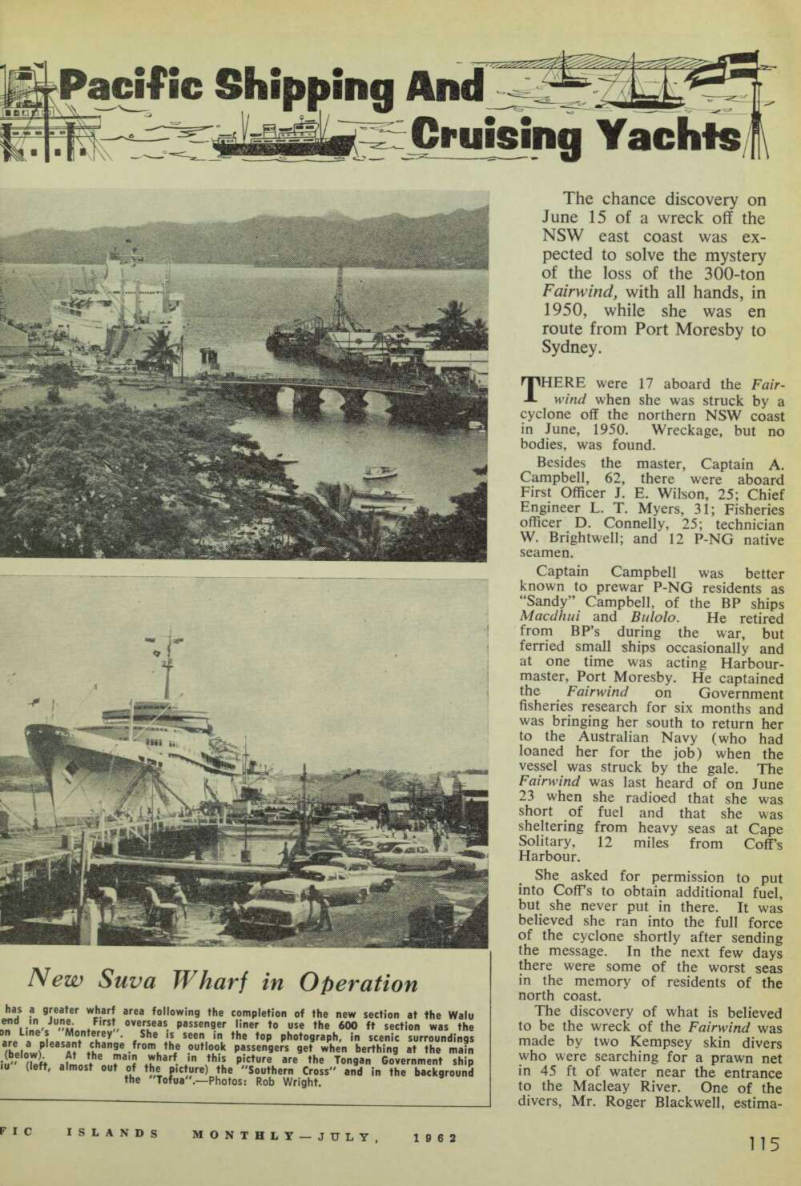
New Suva Wharf in Operation
has a greater wharf area following the completion of the new section at the Walu end in June. First overseas passenger liner to use the 600 ft section was the on L ine's "Mo n tere y". She is sèn in the top photograph, in scenic surroundings are a ple as ant chan ge from the outlook passengers get when berthing at the main (below). At the main wharf in this picture are the Tonga n Government ship [?]iu" (left, almost out of the picture) the "Southern Cross" and in the background the "Tofua".—Photos: Rob Wright.
ie length of the vessel as 80 ft, ;aid some of the timbers seemed I enough. A section of the boat been badly smashed. The two 5 prepared for a full scale water expedition later in the h, to be carried out with the of the Macleay fishing fleet.
That Yankee Saga
IN!; The story of the cruise Yankee threatens to develop a shipping saga. PIM thought it said the last word in June 103) when Yankee left Port sby for Indonesia with its third in. Trouble looked like being at id. But Yankee got as far as in, Northern Australia, where tayed for a fortnight instead of days, and as a result the new r. Captain P. J. Sullivan, re -1 and flew back to Cairns, ; he had joined her in April, ielay had upset his personal ar ments and he couldn’t wait any r, 0 other passengers and the also left at Darwin. When last of, Yankee was preparing to for Singapore, where owner Burke would meet her, as ed earlier. New captain was the nate, John Cronholm.
A Shot Across Her
S: There have been some in ing paragraphs in the PIM ship section recently about the kind ception mariners can expect in nunist Chinese ports. Last 1 master of a Japanese freighter the Australian Press about his iences in Indonesian waters. The r, Yashiji Hamaskima, of the hima Maru, 3,366 tons, said his was off the Halmaheras, en for Port Hedland, West Aus
tralia, when an Indonesian gunboat fired a shot across her bows and ordered the captain to follow her.
The ship went to Galela Bay, where the captain of the gunboat boarded the freighter, searched the ship and sealed the radio room. He was told the freighter had been stopped because she was in Indonesian territorial waters. Hiroshima Maru was held in custody for 10 days before being allowed to proceed,
• They’Ll Voyage The
OCEAN: Having got their feet wet earlier this year with the help of a specially-made raft, members of the Rarotonga Boys Brigade are now
planning for a longer voyage next year—either by raft or double canoe, in the old Polynesian fashion. The plan is to sail either the 110 miles from Rarotonga to Mangaia or 140 miles from Rarotonga to Aitutaki.
The experience this year was with a raft sailed from Ngatangiia to Avarua, on Rarotonga. It was built during a 10-day camp at Muri, Nga tangiia lagoon, and named Takitumu, after one of the canoes which carried the Maoris to New Zealand from Rarotonga in the 14th century. Taki tumu was 25 ft long, 15 ft wide, drawing 4 ft, and comprised two floats made from petrol drums, and a central bamboo deck. A sail of
it leaves, two outboard motors laddies provided the motive
Won A Dan In The Bsip:
:ientific expedition aboard the l vessel Noona Dan was ex to reach Honiara on July 20. to head for Rennell and Bel flands, then San Cristoval and a. An advance party was to in Honiara by air on July 16. jader of the Noona Dan expe- Dr. Torben Wolff, was in the ms in 1952 with a previous i research expedition in the graphic research vessel Gala- Dr. Wolff’s main job in the vill be to survey the large in- Le on Rennell with a portable ounder. The Noona Dan will to Honiara on October 1, and rs will fly home.
Iarge Means Cheaper
)L: The retail price of petrol asa, Fiji, dropped sharply by gallon, from 4/11 to 4/2 on 8 when the Shell Co. (Paci nds) Ltd., opened a new bulk am depot. At the same time le, sold in 44-gallon drums, d from 3/2| a gallon to 2/5i n. reason was that the company a new bulk storage depot, £30,000, on the banks of the River. The depot comprised ,000 gallon tank, two 26,000 tanks, plus ancilliary buildings, company has bought a barge, will be towed from Suva to by tug in 100-ton shipments, isly petroleum products had lelivered to Labasa by the laborious method of 44-gallon
drums.
The new system is expected to save petroleum consumers in northern Vanua Levu thousands of pounds a year.
• New Timber Wharf:
Karlander NG Line’s MV Slevik be came the first ship to berth along side Thompson & Wright’s new wharf at Cape Hoskins in May.
Slevik discharged logging equip ment and took on a full load of sawn timber and logs for Sydney.
Max Wright, of Thompson &
Wright, operators of the timber mill at the thriving community of Cape Hoskins, said there is 15 ft of water under the new wharf. Before its in stallation timber and logs were lightered or floated out to ships anchored in the bay.
Hereafter Karlander Line ships will use the wharf regularly to unload supplies and take on timber for southern ports.
• Sepik Damaged; Two
small boats played tag around the hull of departing MV Malacca in Simpson Harbour, New Britain, in May, the loser being the 45 ft work boat Sepik, which plies between New Britain and New Ireland ports.
Hit on the portside by the port’s tugboat Bake, Sepik suffered 14 smashed ribs, sprung decking and damaged deckhouse timbers. She was beached to avoid sinking and later towed to Hap King’s slips where she was laid up for several weeks.
Estimating damage at around £6OO, Sepik’s master and part-owner, Joe Chan, said the collision occurred when he went to pass along the Malacca’s portside and Bake sud denly rounded the stern in her path.
• Monterey Has Wharf
HONOUR: The Matson ship, Mon terey, was the first overseas liner to use the new 600 feet wharf at Suva.
She had a slight mishap as she was coming into berth when the bow touched a steel kerb plate, and caused superficial damage.
The Monterey at the time was in
RABAUL SCENE. A gay sight in Rabaul on the Queen's Birthday in June were the [?]s near the small ships' wharf, which were decorated with bunting and flags. Stern end in the foreground are the "Tilburra", "Mercy" and "Garua".
irge of the Suva Harbour (Captain E. L. James). The as behaving normally when Idenly lurched towards the apparently because a light y wind sprang up. in James said later that the nent of water may have had ect on his control of the ship. nterey was 7,000 tons dead md when she moved into the iarf, towards Walu Bay, »ns of water had to make r her. He said he was trying •ut the case of the Monterey lurching towards the wharf, five rubber buffers, about worth, which line the berth, minimised the effect of the Tiese took up much of the 5 Captain James eased the eds of Suva people, braving ents (it was a real Matson y, for Suva very seldom good weather for the Mari- Monterey) to watch the ' berth. The band of the ary Forces was in attendance a musical welcome.
Arge Follows Excess
G; The BSIP Marine De is reported to be “checking on ships coming into to make sure that they are r ing cargo or passengers in that on their certificates, dlows a case in the Central in which a Chinese 1 £5 after having pleaded carrying excess cargo in the g Lee. The MV Hung Lee
was carrying copra from the Eastern District to Honiara. A correspondent reported it was probably the first case of its kind to be heard in the Protectorate. • SEA FOX AGAIN: Now lying on a Darwin beach the US luxury yacht Sea Fox, once owned by actor magician John Calvert, is to be re built and sailed in the next Sydney- Hobart race.
She has been bought by Mr. R. A.
Carr, an Adelaide business man, who plans to spend at least £lO,OOO on repairs.
The Sea Fox’s timbers were sprung and other severe damage caused when she toppled over at Elcho Island three years ago after Calvert, Manila singer Pilita and five other members of the crew had been miss ing with the yacht for several days in the Arafura Sea and made head lines as a result.
The 110 ft Sea Fox was acquired by Darwin marine contractor Mr.
Carl Atkinson, who has sold her to Mr. Carr for an undisclosed sum.
• Maiden Voyage. Shaw
Savill’s one-class 22,000 ton Northern Star will reach Sydney on her maiden voyage from the UK on August 15.
She replaces the recently retired Dominion Monarch and joins her sister ship, Southern Cross, on the around-the-world service via Panama.
Northern Star will carry 1,400 pas sengers. She is fully air-conditioned.
• Red Spy Ships: An Ameri
can Defence Department spokesman
in June claimed that Russian ships are spying on the current US nuclear tests in the Pacific, Three Russian ships fitted with electronic gear were checking all tests in the Christmas Island area but they were outside the restricted area and the US had no power to stop them, he said. The Russians, who had ignored a warn ing of fall-out dangers, were “obtain ing valuable military information”.
He said the largest of the vessels was the Skokal, a 3,600 ton hydro meteorological ship, loaded to the Plimsoll with scientific instruments.
The two smaller ships were converted trawlers equipped to obtain auxiliary electronic data.
Meanwhile in Sydney in June some scientists forecast freak weather to follow the tests. They said they ex pected “freak storms, blizzards, torna does”, and a completely changed weather pattern over Australia. The news never disturbed the local popu lace. They had heard it before.
A bomb carried by a US Thor missile fired from Johnston Island in June went wrong and was destroyed in the air, pieces of it falling into the Pacific. The bomb was meant to be the first in a series to test a high altitude nuclear explosion. Two weeks later the Americans tried again. Result: ditto.
• New Commodore: The
British India Steam Navigation Co. has appointed Captain B. A. Rogers, commodore of its fleet, in succession to Commodore Bond, who is retiring. • NEW PORT: Karlander New Guinea Line Ltd. has added Gizo as a port of call in its freight service
PACIFIC VISIT. A caller at Suva in June was the United States "Spencer F. Baird". a floating laboratory, equipped with the latest electronics to take temperatures earth's crust at its thinnest point. Here she is seen in Rabaul in May, with her for lowering instruments to the seabed towering over Rabaul's main wharf. Details June, "PIM", p. 113 "Spencer F. Baird" is on a Pacific tour for the Scripps raphical Institute of the University of California, sponsored by the National Science Foundation of the USA.
ON THE BRIDGE. Latest photograph of Captain R. A. Frazer, master of the New Zealand Department of Island Territories' ship MV "Moana Roa", which recently visited the Northern Cooks. She was the first passenger ship to make the direct voyage from NZ since 1903.
en the Australian east coast and SIP. The Slagen made the first in June.
NEW SHEEP SHIP: With the ambi (ex Delfino ) just a dim ry as a South Seas sheep ship ing between Australia and the new sheep ship is shortly to '■ She will be the Trangie, a r banana carrier, currently d in New Orleans under the of Eros. She is 6,000 tons, oup of 60 NSW graziers need in Sydney in June that lad bought the vessel, would her in Sydney in the next lonths, and use her to export 100,000 sheep a year mainly entral and South America. e will also carry cattle. A ny named Rigryth Ltd. has ormed to carry on the busi- The company already has orders for shipments, most m from shareholders’ proper- The ship already has air con ig plant, which can be used as ventilation or for chilling ■ated cargoes. Chairman of l » Mr. B. F. Richardson, a of Trangie, NSW, said the ould probably make a round er y two months. The com mas “interested only in export jeding stock, not in carrying ibs for slaughter”.
Heck On Hiri ; New 60
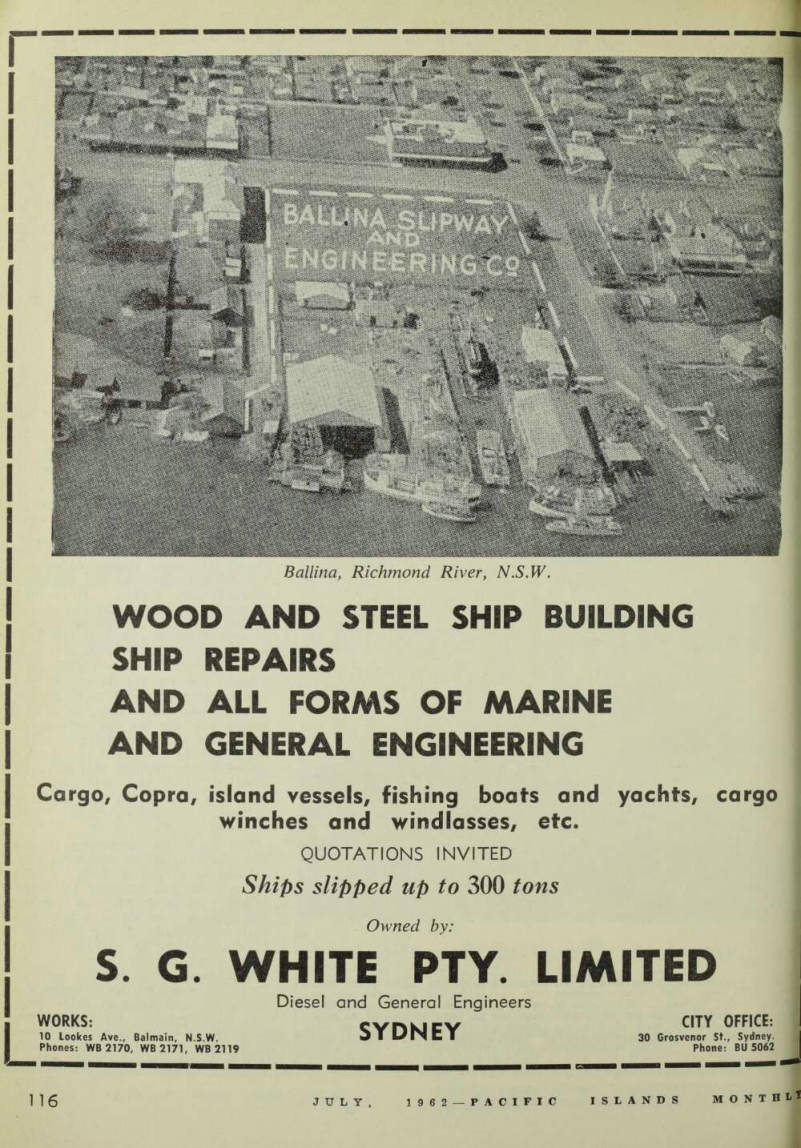
G Co-operatives’ vessel Hiri mpleted 200 hours of running beginning of June, and so 1 a visit from Mr. A. Pollard r fo T her builders, Ballina and Engineering Company, 0 make some routine adjust ed-June Hiri, which was ip from Sydney by a P-NG rew under Chief P-NG Lands isioner, Captain Ivan on was expected to set out first voyage into Eastern waters, including the zasteaux group.
Jva Interest In
L: Gretel, Australia’s speci ilt challenger for the US classic, America’s Cup, will 5 u B °™ , wishe * of the Royal icht Club when she goes into f September. In Sydney on *, the Suva club’s pennant ge was presented to Sir Frank chairman of the Australian s Cup Challenge Association ormer Rear-Commodore of (C, lan Mackinnon. The ;i °n followed a suggestion 1 u r "wM, hn Min ett, son of 1. H. Millett, who conducted
the Melbourne Hotel in Suva for many years. Incidentally, Gretel is pronounced Gray-tel. The yacht is named after the late Lady Packer.
• Aground Near Santo:
A South Pacific Fishing Company vessel (no name supplied) went aground in poor visibility in the Segond channel, near Monsieur Ratard’s plantation, on May 25, but she was refloated with the tide about 10 hours later, with only light damage to her hull. The vessel was loaded with fish at the time.
• Vanikoro Expedition:
Vila diver Reece Discombe, who
has quite a soft spot for Vanikoro, was reported headed that way again in June to look at the possibility of salyaging a cargo of scrap brass which the MV Milos jettisoned when she went on a reef about two years ago.
Discombe will probably make another visit there at the end of the year, too, this time as member of yet another expedition to search for the wreck of La Perouse’s second vessel, La Boussole. The Astrolabe has already been discovered and Reece Discombe has taken part in two expeditions to it. This ex pedition is being led by Monsieur
; , a vulcanologist who visited sw Hebrides a few years ago ho has already taken part in tpedition to Vanikoro. This s being sponsored by the » of La Perouse’s home town ace.
Is Boffins For West
*ALIA: A Naval communica itation costing a mere £A33 is to be erected by the States Government on North Cape, Western Australia, mal sums will be spent on ; and amenities for 450 many of them families. j of the station, according to ian Prime Minister Menzies announcing his Government’s il to Federal Parliament, is ide radio communications for 1 allied ships over a wide area Indian Ocean and Western ’ will be a complete antenna and high powered trans and receiving equipment, in special equipment to enable nications with atom-powered nes. will start “as soon as ” and will be at its peak from 1965, There will be employ er 1,000 people during the Mr. Menzies said a agreement was being worked :over the status of Americans U be working for the station is completed. Facilities at ion will be available to Aus forces. The new station y will be an important link in the South Seas.
Backing Stations:
he same time as Mr. Menzies ed plans for the US naval there was also an announce iat the US would return to time base at Manus, New -this time with a tracking for space flights. The US 3 put in a station at Buka gamville. The Manus site n in the offing for several °IM mentioned it as long i 1959. The Americans ed it at the time they put tracking station at Canton, y also considered putting a n at Honiara. Both Honiara nus were not needed, and in ►ject Mercury flights (man ce) the existing world-wide Juding the two in Australia ith Australia and Western 0 have apparently been There have been suggestions new Manus tracking station e used in conjunction with missile missile project to be
operated from Kwajalein later this year, but officialdom is keeping its mouth shut.
• French Cruiser Visits:
The French cruiser De Grasse re ceived a royal welcome at Papeete in June when she made a goodwill visit. At a reception on board, there were 400 guests including the French actress Martine Carol, who is currently living in Tahiti. She came aboard barefooted, with flowers in her hair, but nobody complained.
De Grasse was due at Noumea about June 25, which was the same day as a flotilla of Japanese warships, and later planned to visit the Loyalty
Islands and the New Hebrides, She will take aboard some naval reservists from Noumea for this cruise, including High Chief Boula of Lifou, who served for a number of years in the French Navy.
• The Dobiri Details: This
section reported last month (p. 101) how the Rarotonga-based Dobiri was the subject of some Search and Rescue flap for a few hours in May, but had turned up all right without an air search being required. The details: Dobiri left Rarotonga for Mangaia on a mercy mission in bad weather. The mission was expected to be a matter of life and death for
f two patients to be picked Vhen Dobiri got into the open was found the winds were jr than had been expected, eather got worse and at times was unmanageable. She got urse. Then the radio broke Dobiri kept going until the got a break in the weather urth day out, which allowed check his true position. She anchored on the sixth day out. ide the 110-mile return trip to nga with two sick patients in rs! The dangerously ill patient operated on in Rarotonga fully.
LAST CRUISE: The trans it Wanganella, which has )ld to a Hongkong firm which ver in October, was due to be the South Sea islands under :sent owners for the last time when she was to make an cruise from Auckland. She ie to leave July 5, returning ) after calls on Fiji, Samoa nga. Wanganella is owned by aith McEacharn Ltd., who Id her to Hang Fung Shipping ading Co. Ltd. She will begin East service for the new
South American Ser
MV Havfalk, first direct ship ustralia to the east coast ports h America, left Melbourne in ►he was farewelled by some icluding the Australian Minis- Shipping and Transport, Mr. an, and the Consul for Brazil »ourne, Mr. E. A. Gloor. tie inaugural voyage the MV carried steel, timber, coal, aral machinery, zircon sand ter Australian products. As • space for liquid and re ;d cargo the ship can provide ;s accommodation for 12 pas-
The MV Havfalk is operated by the Australia-South America Line which will provide a three-monthly service from Australia to the east coast of South America under a sub sidy arrangement with the Australian Government.
The Department of Trade has a small trade display aboard the ship featuring Australia’s rapid industrial development. The new direct shipping service will link major Australian ports with Buenos Aires, Montevideo, Santos and Rio de Janeiro.
News Of Cruising Yachts
• ISIS, 32 ft Sydney cutter for which Australian police were search ing after it left Sydney on May 19, (PIM, June, p. 141) turned up in good condition in Norfolk Island in June. Aboard were owner Walter Martindale, his 21-months-old daugh ter Liane, and two crew members, Derek Brewin and George McCaf ferty. The daughter was taken into custody on Norfolk Island by court order and later was returned to her mother, who flew to Norfolk Island for the reunion. The Martindales (who formerly lived in Tahiti) are estranged.
During the trip from Sydney, Isis hit four storms and during one of them the wind reached 60 m.p.h.
The cutter hove to during two of the storms but kept going through the other two.
The cutter put to sea again from Norfolk to escape bad weather on June 11. Mr. Martindale remained on Norfolk Island. Isis was driven 200 miles north with the two men aboard, and was feared lost, but turned up at Norfolk again.
• Fairweather, 58 Ft
schooner, left Auckland for New Caledonia at the end of May, with
[?]JL SURVEY. HMAS "Paluma", hydrographical survey vessel photographed in Rabaul, [?]s to completely re-sound the harbour within the next two months. Details were given in June, p. 141.
Mrs. William Adams as skipper, after Mr. Adams had flown back to the US for business reasons. Also aboard were sons Rick, 20, Jon, 17, Pat, 12, and daughter Sue, 12, plus Verne Hansen, 31, navigator, Harold Stephens, 35, journalist (from the schooner Nordleys), Melanie Cox, 19 and Ray Pettigrew, electrical en gineer. Fairweather had been in Auckland about five months, arriving via Fiji, and the family plans to cruise the New Hebrides after New Caledonia, thence the GEIC and Japan, From Japan they will head to Sumatra and the Mediterranean and so back to San Francisco. • MEDLEY, a 37 ft staysail schooner in first class condition, should now be in Papeete from Honolulu with owner-skipper Dean Harrel, Charles Tanner, Frank Wade, John Rowe, and Frenchman Jean Froment, who is already well known in Tahiti. • TATOOSH, a heavyweight 34 ft double ended ketch, arrived in Hawaii 24 days out of California, and by now should have departed for Papeete with owner Elmore E.
Brown and crew of two. • MAUI QUEEN, an 85 ft auxi liary vessel, captained by Edward Tremper, arrived in Honolulu after a rough passage from Kwajalein. After a haulout she will continue to the mainland US. 9 TAP AT SCO 11, a sloop of about 40 ft, owned and skippered by a Mr. Murray of New York, is at Honolulu on a round-the-world trip against the Trades. Having crossed the Atlantic and Indian Oceans, Mr.
Murray will leave Hawaii soon to complete the crossing of the Pacific. • MARI NERO, 38 ft Californian ketch which arrived in Auckland in December last year, was in May planning another cruise. Owner Floyd Christensen, his wife, Doris, and their two children Keith and Karen, with a new crew member, R. D. Wood, plan to sail to New Caledonia, Fiji, and New Hebrides, and then back to NZ. • M’S SANTANA, with Homer Parrish and family, was still in Singapore in June after her Pacific crossing of last year. A note from Mr. Parrish says that he has seen a lot of Ed Dreis and his 34 ft cutter BORACHITA, who were in Tahiti in October, 1960, at the same time as M’s Santana. They met again in Suva, Santo, Port Moresby, Thursday Island and finally in Singapore, where Borachita changed from cutter to ketch rig. Dreis lone-handed
through Indonesia for a time, but is currently en route for Japan with a young Japanese crewman who wants to return home. Homer Parrish pub lished a piece in PIM (Jan., p. 63) about his happy experiences in Indo nesian waters, which should be read by anybody headed that way. He found the Indonesians most hos pitable. • SVEA, 38 ft US ketch (last reported here in Nov., 1961) was in the news in June when it was reported a woman was lost over board on Svea’s voyage from Noumea to Port Moresby.
The skipper-owner of the ketch, American Robert Y. Kittredge, told Port Moresby police on his arrival on May 24 that the woman, Miss Patricia Ann Cleveland Crozier- Durham, had apparently fallen over board 90 miles off the Papuan coast on May 20.
Kittredge and the only other person aboard, a young New Zealander, Harold Hudson, had put the ketch about and conducted a search for the woman. They had been below and Miss Crozier- Durham had been on deck when the accident occurred.
Miss Crozier-Durham was the daughter of the late Captain Crozier-Durham and Mrs. Crozier- Durham, of Black Rock, Melbourne.
Reared amongst yachts at St. Kilda Miss Durham had a passion for the sea and in recent years was one of a syndicate operating a trawler off the Tasmanian coast.
On several occasions she had been one of a crew to sail small boats across the Tasman and was gener ally conceded to be fully conversant with the sea and its moods. She was also a good swimmer.
She joined the Svea in Auckland as a crew member hoping to take part in a 12 months cruise througn the Islands, the Red Sea and the Mediterranean. .
The Svea is described as weu found with a good motor, plenty of fuel on board, a rubber dinghy in case of mishaps and carrying emergency rations and shelten Kittredge’s original intention or sailing to New Britain after leaving New Caledonia was cancelled a favour of Port Moresby. It was f this voyage, during a heavy early morning swell, that Miss Crozier- Durham was lost. , Meanwhile the ketch is held up in Port Moresby and an advertise ment calling for a crew-member, man or woman, has appeared mtne local press. Destination is stated v be the Red Sea and Mediterranean.