Three Territories In First Trade Talks
pp. 23-169 · Read in the full issue
First Trade Talks
West Samoa, Fiji and Tonga in June had joint trade talks the first time. The talks centred around the possibility of
orting bananas to Japan.
MEMORABLE occasion,” is low the Premier of Tonga, Tungi, described the talks, were held in Apia. Prince took part in the discussions for Western Samoa was repre by the Minister for Finance, . F. D. Betham; and Fiji by :velopment Commissioner, Mr.
Bevington, and the manager Fiji Development Company, I. Firmston Williams, ier, Mr. Betham had visited where he had had talks with vernor, Sir Kenneth Maddocks, [r. Bevington. Mr. Bevington so flown to New Zealand for alks there. Bananas were the of discussion on each oc- Bevington had in May been an, where he had been told pan would buy all the bananas iji could supply (see p. 160), rice better than New Zealand’s at present takes bananas from imoa and Tonga), big South Pacific banana deal tried off by Prince Tungi, who iced in April that Tonga had nee which would allow the >m to sell to Japan bananas
worth seven million dollars a year, (PIM June, p. 17.) Fiji has very smartly got in on the band waggon, and after some initial dithering so has West Samoa. Real Samoan interest followed a visit by a Japanese businessman, Mr. T. Suzuki. . A . 0 , . , While in Apia Mr. Suzuki was con ducted round Samoan banana planta tlo"s Acting D * r l ct ° r ° f A .^ l ' CUl i G Mlnto ’ bad discussions Government officials, . “I am very hopeful of Japan buy ing Samoan bananas, and later when good relationships have been estab lished of buying other products such as more cocoa and copra from the South Pacific area,” said Mr. Suzuki.
He said that a decision on importing Samoan bananas should be announced before the end of July, “We have plenty of bananas to sell,” said Prime Minister Mataafa, adding that the decisive factor would be in the price offered, On a visit to Apia in June, Mr.
Ross Walker, the manager of Fruit Distributors Ltd., which under a Government monopoly handles the import of bananas and citrus fruit
(Continued on p. 166)
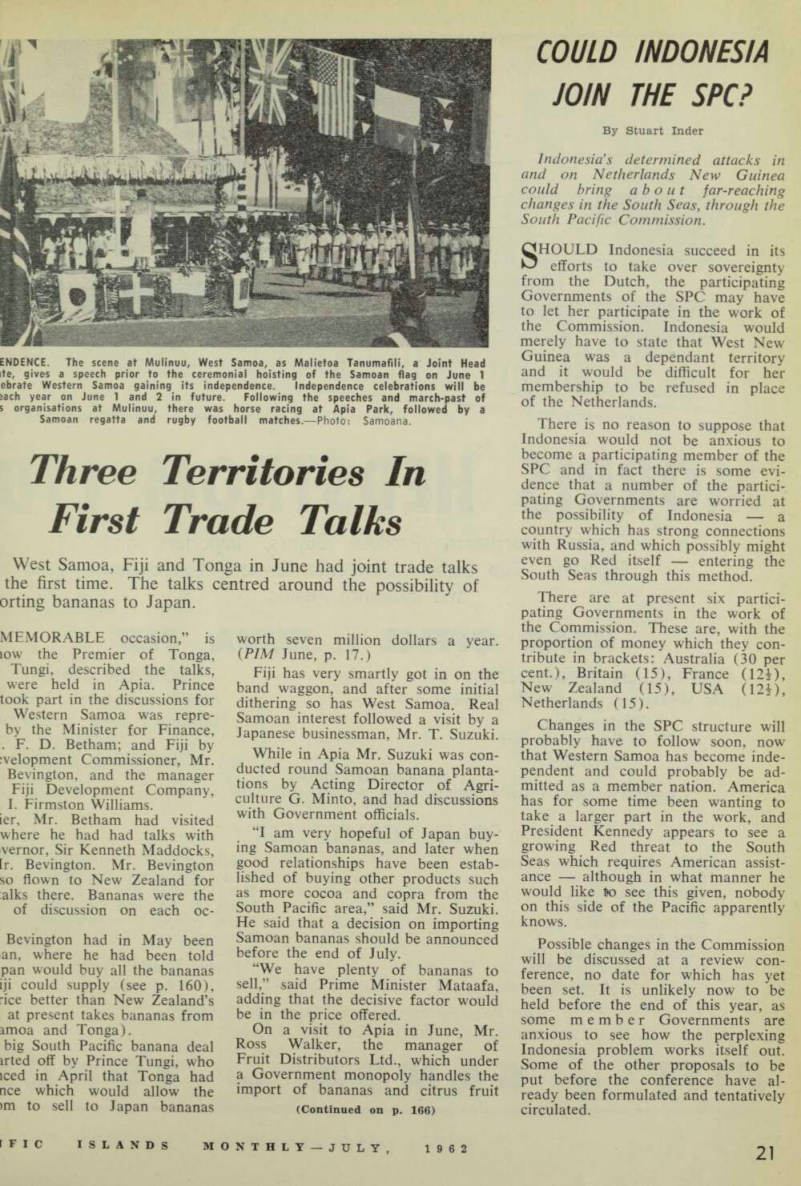
ENDENCE. The scene at Mulinuu, West Samoa, as Malietoa Tanumafili, a Joint Head [?]te, gives a speech prior to the ceremonial hoisting of the Samoan flag on June 1 [?]ebrate Western Samoa gaining its independence. Independence celebrations will be each year on June 1 and 2 in future. Following the speeches and march-past of [?]s organisations at Mulinuu, there was horse racing at Apia Park, followed by a Samoan regatta and rugby football matches.— Photo: Samoana.
into New Zealand, said he was not disturbed at the banana deals with Japan.
“I would not be surprised if in a couple of years nothing more is heard about the Japanese market,” he said.
Mr, Walker said that the Japanese fruit market was a very difficult one with the highest standards in the world, and he doubted whether Pacific producers could meet the standards required.
“We understand the difficulties fac ing growers in the Pacific area and make allowances by relaxing standards to assist growers after times of hurri canes, etc. I am sure the Japanese market would not be so easy,” he said.
However, later in the month, back in New Zealand, Mr. Walker was re ported to have changed his tune. He described the recent developments as a threat to New Zealand supplies.
Unless the New Zealand Govern ment gave Fiji and Tonga an assured market for a certain quantity of bananas each year, those islands were likely to look with more favour on the Japanese market, he said.
Western Samoa, which was not affected by the New Zealand import restrictions, now was supplying about three-quarters of the New Zealand banana requirements. (Over)
oduction from all the islands this had been heavier than usual, and and Tonga had surplus fruit.