Pago Conference
pp. 22-170 · Read in the full issue
The South Seas Will Meet At Pago Conference
Delegates from all over the Pacific will begin moving to wards American Samoa in early July, where they will attend the Fifth South Pacific Conference in
Pago Pago from July 18-30.
ABOUT seventy delegates will at tend the conference from 18 Pacific territories, including the inde pendent Kingdom of Tonga and the newly-independent State of Western Samoa.
From north of the equator, repre sentatives from Guam and the United States Trust Territory of the Pacific Islands will travel by way of Hawaii. Cook Islands’ delegates will ,fly from Rarotonga to Apia by RNZAF aircraft, and thence by air to Pago Pago.
Delegates from Tonga, Nether lands New Guinea, Papua-New Guinea, British Solomon Islands, New Caledonia, New Hebrides and Wallis and Futuna Islands, together with secretariat staff of the South Pacific Commission, will all travel by way of Fiji. Representatives from French Polynesia and Niue will travel to Pago Pago direct, the former by air, the latter by the Tofua. The Tokelau Islands delegate will travel by sea to Apia, and from there will fly to Pago Pago, as will the Western Samoan delegation.
The meeting will take place at Utulei village, about half a mile from Pago Pago, in buildings of the High School of American Samoa. Dele gates will be housed in three newly erected two-storey blocks. The con ference will meet in the new, cen trally-situated auditorium.
Facilities will be provided for ob servers and visitors, and nearby will be a Press room for newspaper cor respondents covering the meeting, and a temporary post office and bank.
For recreation, delegates will be able to play tennis, volleyball, basket ball or baseball. Of special interest to all attending will be the Pacific arts and crafts exhibition that will be mounted from exhibits sent in by participating territories.
A comprehensive programme of mainly traditional entertainments— kava ceremonies, Samoan dances, singing and feasting—has been ar ranged for delegates. A fautasi race on Pago Pago Harbour is planned (a fautasi is a longboat with about 40
oarsmen); and a visit will be made to the Van Camp Tuna Cannery nearby.
The Government of Western Samoa has also invited all those attending the conference to spend a weekend in Apia.
At the opening ceremony on July 18, conference members will be wel comed by the Governor of American Samoa, the Hon. H. Rex Lee, who will formally open the conference.
The Senior Commissioner for the United States on the South Pacific Commission, Dean Knowles H. Ryer son, will be its chairman.
Main topics that delegates will dis cuss relate to the economic and social development of the South Seas.
As at earlier conferences, discussions will be initiated by introductory papers which have been prepared by various delegations and which were circulated among them in advance for study. These topics, and the dele gations preparing the introductory papers on them, are: ® Methods of training Pacific Islanders in business methods and practices.— Kingdom of Tonga. • The needs for, and methods of, gaining interest and support for
steps to improve the quality o agricultural produce, includini standardisation and inspectioi schemes, and programmes to in crease marketing efficiency.- Papua and New Guinea. • The changing role of women i the South Pacific territories.- Cook Islands. 9 Ways of obtaining a reasonabl balance between social advance ment and economic developmer in South Pacific territories, wit due regard to labour problem and increasing population.- French Polynesia. • The importance of organise adult education schemes in Sout Pacific territories.— Netherlanc New Guinea. • The importance of relating educ< tion to the needs of a territory.- United States Trust Territory. I Following the last Conference hel at Rabaul, New Britain, in May-Jur 1959, delegates put forward a nun ber of proposals for the furth( economic and social development Jc the region. At the July conference progress report on action taken |b the South Pacific Commission Jo these will be tabled.
From the conference will emerg recommendations by delegates fc consideration by the South Pacifi Commission. Commissioners of th six member governments (Australi: France, the Netherlands, New Ze: land. United Kingdom and th United States of America), who wi attend the conference as observer will consider these proposals at special session of the Commissi) that will be held as soon as the coi ference ends.
First in 1950 South Pacific Conferences wei designed to get the peoples of tl South Pacific together to discu common problems. They are he every three years. The first held in Fiji in 1950, the seed in Noumea in 1953, the third aga in Fiji, and the Rabaul conferef was the fourth.
The first conference was morel less an experiment, with everybd nervous. But as the confereni have continued, the nervousness p disappeared and the Rabaul meetin was an excellent exchange of vie| and voted a great success. Out| the Rabaul conference came £ suggestion for a South Pacific Gaffl' —and the first will now be he in Suva in 1963. It is expected! become the Olympics of the Soui Seas.
Early reports indicate that P Fifth Conference at Pago willßj strongly covered by the Amerift
(Continued on p. 167)
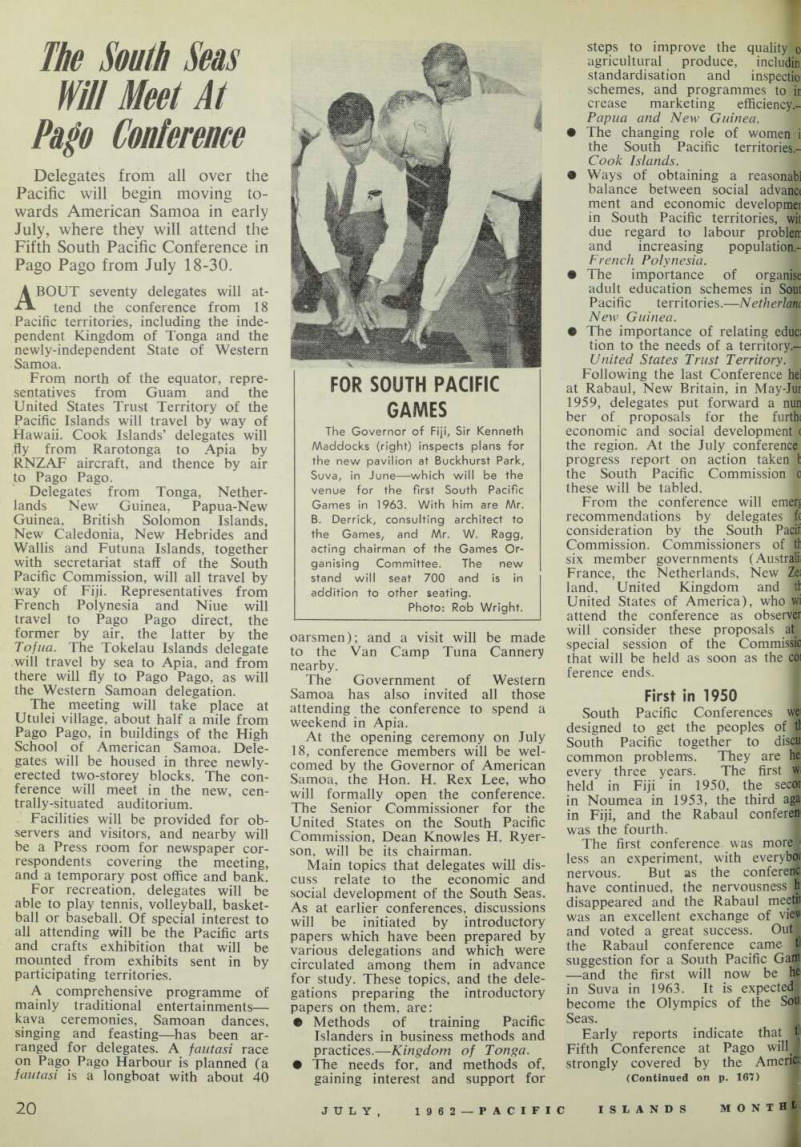
For South Pacific
Games
The Governor of Fiji, Sir Kenneth Maddocks (right) inspects plans for the new pavilion at Buckhurst Park, Suva, in June—which will be the venue for the first South Pacific Games in 1963. With him are Mr.
B. Derrick, consulting architect to the Games, and Mr. W. Ragg, acting chairman of the Games Or ganising Committee. The new stand will seat 700 and is in addition to other seating.
Photo: Rob Wright.
radio and Press. This is the first time a South Pacific Conference has been held on American territory and the Americans intend to make the most of it. American Samoa has been given a much-needed face lift recently, and delegates who have known it in previous years will find Pago Pago much improved, and a different atmosphere prevailing.
There will also be a wide Aus tralian and Commonwealth cover age. The Australian Broadcasting Commission will send a team of three, Mr. Arthur Cooke, its Diplomatic Correspondent in Can berra, Mr. Jim White, a Talks officer and Mr. Robert Feeney, a cine cameraman. The team will distribute television material around the Commonwealth and reports will go over Radio Australia. AAP-Reuter is sending a senior journalist from Melbourne, who will give an inter national coverage.
Here are the main participants, in cluding delegates, alternates and advisers:
American Samoa: High Chief S. P.
Aumoeualogo, Mrs. Arieta Mulitauaopele, Dr. Paul Qodinet, Mrs. Saeuteuga L.
Scanlan.
BRITISH SOLOMONS: Francis Bugotu, MLC, Mariano Kelesi, MLC, M. B.
Hamilton.
COOK ISLANDS: Mrs. Poko Ingram, MLA, Sadaraka Metuakore Sadaraka, William Estall, MLA.
FIJI: James Madhavan, MLC, Ravuama Vunivalu, MLC, John Anthony Moore, MLC, Adi Laisa Ganilau, Miss Satya Devi Bali.
French Polynesia: Jean Amaru,
Mrs. J. Mazellier.
Gilbert And Ellice Islands: Te
Babera Kirata, Te Ruotake lantin, Tupua Leupena, R. J. S. Hutchinson (who is also adviser for the New Hebrides).
GUAM: Pedro Martinez, Ricardo J.
Bordallo.
NAURU: John Agege, James Apegam Bot, Raymond Gadabu.
Netherlands New Guinea: Markus
Kaislepo, Herman Womsiwor, Miss Neeltje Urbinas, Fredericus Poana, Saul Hindom, Pieter J. Merkelijn.
NEW CALEDONIA: Raymond Kolndredi, Mrs. Sophie Waia Enoka.
NEW HEBRIDES: Philip Ho, R. J. S.
Hutchinson, Maxime Carlot, Bernard Hebert (also advser to Wallis and Futuna Islands).
NIUE: L. R. Rex, A. Strickland.
PAPUA-NEW GUINEA: Miss Nedulo Boko, Miss Lucy Saikaso, John Guise, MLC, Anton Kiari, Elliott Elijah, Gala Gala Rams, Robin Kumaina, John Parinjo, Jure Makill, Sinaka Goava, Miss Pat Ure, Kevin Sheekey.
TOKELAUS: Tauiliili Lepaio, TONGA: Dr. S. Tapa, T. T. Simikl.
Trust Territory Of The Pacific
ISLANDS: Raymond J. McKay. William Allen, Thomas O. Remengesau.
Wallis And Futuna Islands:
Sosefo Makape, Atelea Matetau.
WESTERN SAMOA: Masiofo Fetaui Mataafa, Asi Vui Tuiataga Leavasa, Afamasaga Samuelu Will, Tuatagaloa Leutele, T, S., MLA.
OBSERVERS: The Most Reverend George Pearce, S.M., representing the Apostolic Delegation to Australia, New Zealand and Oceania; Dr. Lawrence O. Roberts, repre senting the World Health Organisation; Dr. Alexander Spoehr, representing
Hawaii’s East-West Centre and Frederic Duclos Barstow Foundation; Mr. William J. Mullahey (of PAA), representing the Pacific Area Travel Association; Dr.
Roland W. Force, representing Bernice P.
Bishop Museum, Hawaii.
Among the more interesting names are:
Markus Kaisiepo, A Dutch
New Guinea leader who is Vice Chairman of the New Guinea Council and has attended all the previous conferences.
Herman Womsiwor, Also A
member of the Netherlands New Guinea Council, who has attended a meeting of the General Assembly of the UN on behalf of NNG, and who is a leading Papuan business man.
JOHN GUISE, an elected member of the P-NG Legislative Council, who is New Guinea’s only full time politician. He is part-European.
ANTON KIARI, a leading native of Buka, Bougainville, which in recent years has been something of a trouble spot for the Admini stration. At one stage Kiari himself added to the problems.
Mrs. Poko Ingram, A Mem
ber of the Cook Islands’ Legislative Assembly and a women’s leader and Rarotonga businesswoman.
Ravuama Vunivalu, A
Fijian member of the Legislative Council and President of the Fijian Peoples’ United Party. He is a District Officer.
Adi Laisa Ganilau, A Lead
ing Fijian, is the wife of Ratu P. K.
Garni au, Acting Secretary for Fijian Affairs.
Dr. SIONE TAPA, who trained
in Suva, New Zealand and London is Tonga’s Chief Medical Officer.
Masiofo Fetaui Mataafa
is the wife of West Samoa’s Prime Minister, Fiame Mataafa.
Hon. Tuatagaloa Leutele
TEO SIMAILE is the West Samoan Minister of Education. He will be adviser to the West Samoan dele gation.