Patrol Officers Who Have Proved
pp. 51-55 · Read in the full issue


New Guinea Standards Are High’ and . . .
Themselves Should Be Trusted
By Eric Feldt
The judgment in the Alder case will clear the air for those nembers of the District Services who are bringing what is left >f New Guinea’s uncontrolled areas under the law. The decision s no surprise; the law of self-defence is what it always was. If ; patrol, going about its lawful occasions, is attacked, it can re in self-defence.
IE recently raised argument that a patrol is a trespasser and ild ask the murderer’s permission nter his village in order to arrest can now be treated with the don which such gibberish de es. tie whole question was thrashed in the ’twenties and it only comes iow because the field staff is the m of its own efficiency. Because 5 per cent, (or more) of cases, tration is made peacefully, some lists lacking in experience assume it can be done in all cases, remember an experienced officer lose years who held that opinion he was, in spite of his skill patience, wantonly attacked; I
particularly recollect his embarrass ment when he reported that he had opened fire. But the classic case was goldminer Baum, who had wan dered in uncontrolled areas for 20 years, holding that if you did not harm the natives, they would not hurt you. Then he tried it with the Kukukukus in the early ’thirties and was murdered.
The truth is that there are some recalcitrant tribes who will not respond to peaceful methods. These are not necessarily confined to those who have no knowledge of Euro peans and their weapons; on the Middle Sepik in 1924 there were many returned labourers who fought against patrols. As with other human beings, natives are not all the same.
The law of self-defence is clear and I do not think there is any need to alter it.
It does not mean that an officer must wait until he is shot at before he can defend himself. In the case of individuals in other communities, if one man draws back his fist pre paring to hit another, the other may, in ring parlance, beat him to the punch if he can, and it is still self defence. Similarly, if natives, by overt actions, demonstrate that they are about to attack, the patrol is entitled to defend itself by opening fire.
An experienced officer will know when an attack is coming; inexperi enced officers should not be in charge of a patrol. (I do not know if the Chief Justice traversed this point in his judgment, but the principle was set out in the old District Standing Instructions issued in General Wis dom’s time.) Further, the officer in charge has a duty to protect the lives of his police and carriers and should not expose them to unnecessary danger.
I know that there are arguments that a patrol should be given greater latitude. An officer, living alone for
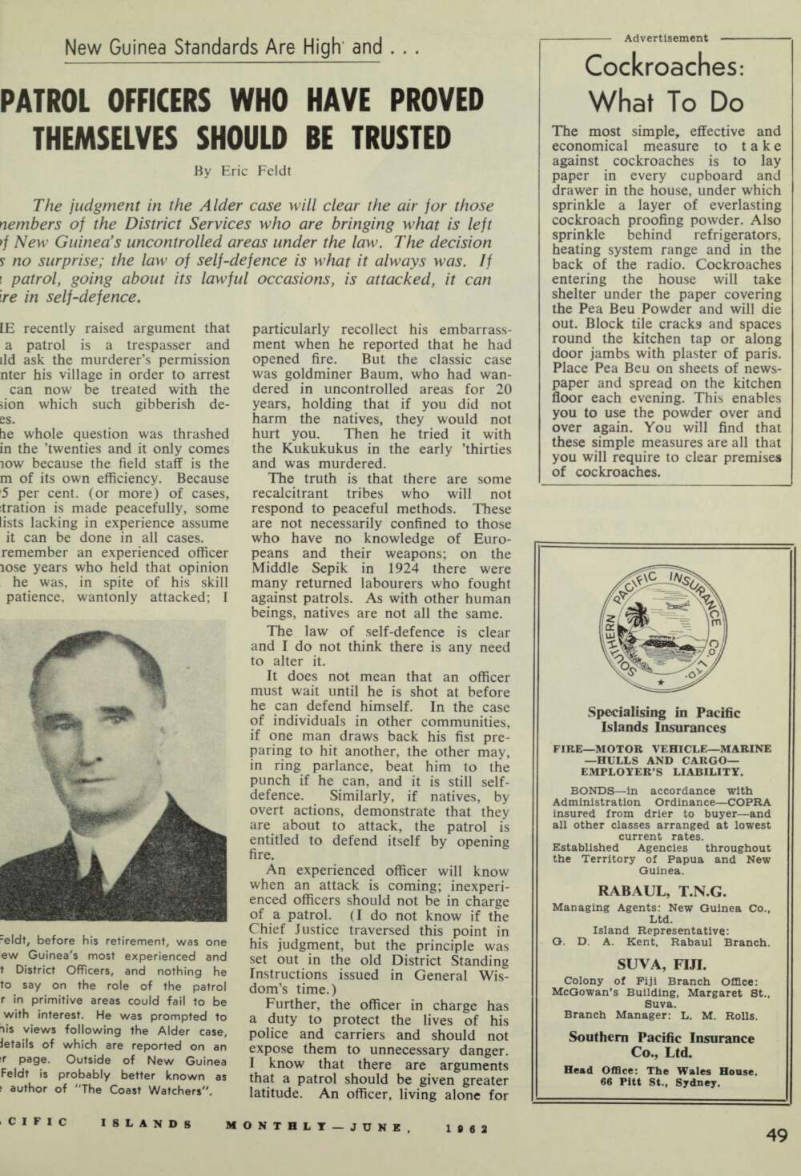
[?] eldt, before his retirement, was one ew Guinea's most experienced and [?] District Officers, and nothing he to say on the role of the patrol [?] in primitive areas could fail to be with interest. He was prompted to [?]is views following the Alder case, [?]details of which are reported on an [?] page. Outside of New Guinea Feldt is probably better known as [?] author of "The Coast Watchers".
long periods, goes a little off balance his health is below par; he has beei on patrol for weeks perhaps, witl poor sleep and constant discomfort he has been wet through and ha climbed mountains all day, Thei he is met by armed natives who re ject all peaceful overtures. He i given more than a man should b called upon to bear. This is al true, but if the officer cannot tak that and still keep his head, h should not be in the field staff, bu be pushing a pen somewhere else.
If there is no need to alter th law, there is need for intelligen administration of it. The Crimina Code was not designed for these cob ditions, and it should be interpreter in the light of experience in Papua New Guinea.
If a patrol opens fire, this is nc prima facie evidence that the patrc has committed a crime. On the othe hand, it must be reported as, if is not known, it endangers the ne? man who goes there. There is onl one worse crime against one’s felloe officers, and that is not reporting retreat in the face of oppositio without a fight, as that endangei the next man still more. When n ported, it should be investigated b a senior officer, departmentally, an patrols sent back to the area unt it is pacified.
Trust Destroyed
I knew of one station where th Policemaster privately interrogate the native police after every patn in order to find out if any irregularit had occurred. This despicable pra( tice destroys all trust in the fiel staff and encourages the manufactui of false evidence. It should neve be allowed.
The law is clear that if, for ii stance, a house is being used as strong point in a fight, the house ma be destroyed in order to bring th fight to a successful conclusion, Bi fire must cease when there is no fu: ther resistance.
There is never any doubt on th point as the natives disappear in flash. But there is no justificatioi in the view of old hands, for bun ing houses as a reprisal. It punish* women and children, the sick an the old, much more than the health bucks who are the opposition.
The objective of the patrol is 1 bring the natives under control i quickly and with as little loss ( life as possible, and there is no moi sense in burning a village than thei would be for strikers to burn dow the factory in which they hope t work later on at better wages.
The morale of the native polic
a on patrol is an important fac- If police feel that they cannot nd themselves, they will become ire of themselves, and will betray ■ nervousness. It is extraordinary well other natives will sense othing leads so much to success peaceful penetration as a patrol ig confidently with the attitude: want to be friends but if you anything, we’ll fix you in short r.” I knew a case, many years when native police whom I knew told me that, with another offi who issued one cartridge only he sentry, they had made up minds to run away and let him ;illed if they were attacked. On other hand, police must be well plined. heavy responsibility is placed an officer leading a patrol in ile country and he should be ed as one who is equal to it. cult situations arise in which he : make a snap judgment. is natural for the men of a ge to line up armed when they strangers approaching, but gen y a peaceful entry can be made, etimes they are lined up, in
primitive Kukukukus with their bark [?] were photographed at the time of the murder referred to in this article. They [?]ust as primitive today in some areas— as Patrol Officer Alder found.
themselves what to do, and mall act may precipitate a fight. young skite may fire an arrow ;o show what a big man he is. officer must then instantly de if that will start a fight or if n be disregarded. If he opens no one else can ever decide icr he was right or wrong, e law of self-defence is satis ry as it is, but it would help ire were legal provisions cover the forcible bringing in of ;s for taming where they are r recalcitrant. Experience has n that this is the best way to them under control. After fence in a peaceful community, can be sent home and their nee will bring the others under 01.
Betimes large numbers must be ducated, e.g., the Kukukukus.
Baum’s murder, 1 took prison nd held them under remand for hs, justifying my action by say hey did not know the nature le proceedings against them as were no interpreters, which the letter of the law, but bad none the less. In this educa l process, they must be taken from home so that they have ope of escaping. For instance, laua was not far enough away he Kukukukus. wever, whatever the law, the ing of primitive natives under ol will depend for its success ly on the character and integ of the officers who carry out •atrols. The native police will ieir part. (As Napoleon said generals—there are no bad i, only bad patrol officers.) ere is the danger that a young r may feel that he has failed he visits a village and the itants all run away, and try to lore; but his seniors should be to curb undue zeal without effing his enthusiasm, very high standard is required those who do not measure up should be transferred to other
work.
Those who have proved themselves should be trusted.
Menyamya In
The Thirties
Aviator “Bunny” Hammond In Sydney recently retired from his last aviation job—that of boss of Adastra Airways. This naturally reminded “PIM” of Mr. Hammond’s early con nection with New Guinea flying, and we asked him for this photo of one of Holden Air Transport’s DH50’s Just after it had landed at Menyamya, in the Kukukuku country, with supplies for Keith McCarthy’s exploratory patrol in the early Thirties. Mr. McCarthy, now P-NG Director of Native Affairs, selected the Menyamya site—and was attacked and wounded for his trouble. Some of his patrol were killed.