Faults in 'The System'
pp. 45-46 · Read in the full issue
Patrol Attack Case Reveals Faults in 'The System'
From a Port Moresby Correspondent
The judgment on New Guinea’s Alder case by Papua-New Guinea’s Chief Justice, Mr. Justice Mann, illuminates many problems that have been concerning New Guinea patrol officers for some years.
THE judgment deals with the re sponsibilities of a patrol officer when attacked by hostile natives in a primitive area.
In his judgment Mr. Justice Mann acquitted Patrol Officer Otto Kenneth Alder of a charge of having unlaw fully burned native houses while on a patrol amongst the primitive
Kukukuku. The judgment was de livered in April. Earlier, a charge against Alder of having wounded a native during the same patrol had been withdrawn by the Administra tion. (See PIM, April, p. 21, and earlier issues, for the details.) The Alder case created wide in terest in the Territory.
Mr. Justice Mann, in his judgment, said Alder had been accused of setting fire to two men’s houses in the Sebanumu and labwiara hamlets (in the restricted area of Kainantu sub district) on May 26 and 27, 1961.
Alder, who was stationed at Wone nara, had been investigating a murder at Sebanumu, which he had reached after climbing a 1,000 ft. ridge. He had found all the houses in the lower part of the hamlet empty and after checking carefully to avoid surprise attacks, he had climbed further, only to be attacked by natives using arrows from higher ground.
The arrows, with palmwood heads, were known to be extremely dan gerous, and had a penetrating power at close range superior to a .303 rifle bullet. Alder and his police had stood their ground, and Alder had gone forward trying to persuade the attackers to stop shooting. When he
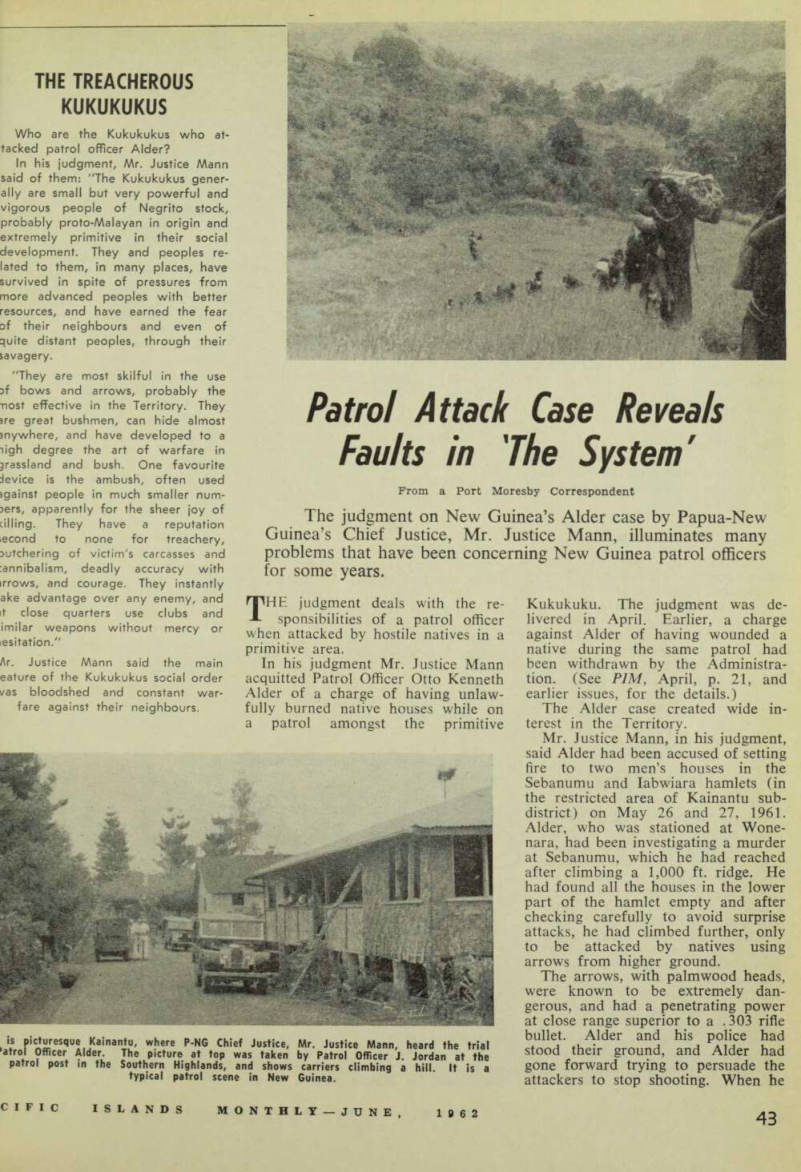
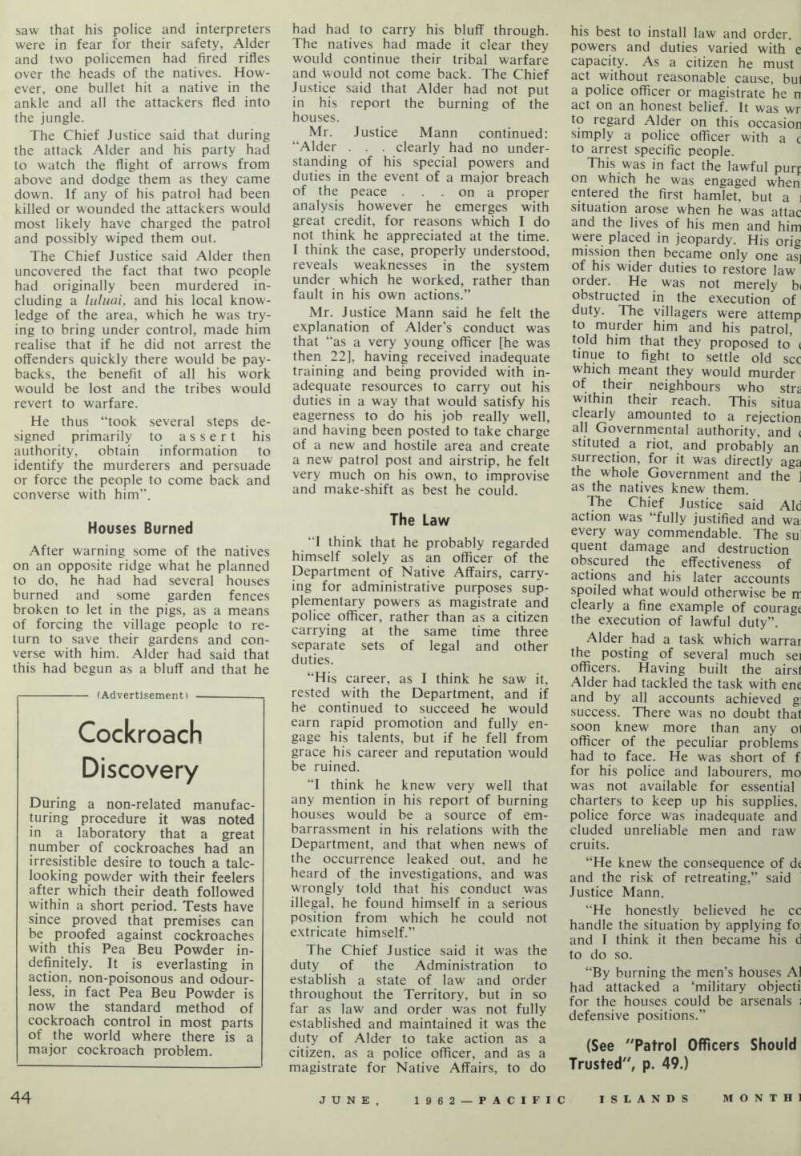
is picturesque Kainantu, where P-NG Chief Justice, Mr. Justice Mann, heard the trial [?]atrol Officer Alder The picture at top was taken by Patrol Officer J. Jordan at the patrol post in the Southern Highlands, and shows carriers climbing a hill. It is a typical patrol scene in New Guinea.
saw that his police and interpreters were in fear for their safety, Alder and two policemen had fired rifles over the heads of the natives. How ever, one bullet hit a native in the ankle and all the attackers fled into the jungle.
The Chief Justice said that during the attack Alder and his party had to watch the flight of arrows from above and dodge them as they came down. If any of his patrol had been killed or wounded the attackers would most likely have charged the patrol and possibly wiped them out.
The Chief Justice said Alder then uncovered the fact that two people had originally been murdered in cluding a luluai, and his local know ledge of the area, which he was try ing to bring under control, made him realise that if he did not arrest the offenders quickly there would be pay backs, the benefit of all his work would be lost and the tribes would revert to warfare.
He thus “took several steps de signed primarily to assert his authority, obtain information to identify the murderers and persuade or force the people to come back and converse with him”.
Houses Burned After warning some of the natives on an opposite ridge what he planned to do, he had had several houses burned and some garden fences broken to let in the pigs, as a means of forcing the village people to re turn to save their gardens and con verse with him. Alder had said that this had begun as a bluff and that he
had had to carry his bluff through.
The natives had made it clear they would continue their tribal warfare and would not come back. The Chief Justice said that Alder had not put in his report the burning of the houses, Mr. Justice Mann continued: “Alder . . . clearly had no under standing of his special powers and duties in the event of a major breach of the peace . . on a proper analysis however he emerges with great credit, for reasons which I do not think he appreciated at the time.
I think the case, properly understood, reveals weaknesses in the system under which he worked, rather than fault in his own actions.”
Mr. Justice Mann said he felt the explanation of Alder’s conduct was that “as a very young officer [he was then 22], having received inadequate training and being provided with in adequate resources to carry out his duties in a way that would satisfy his eagerness to do his job really well, and having been posted to take charge of a new and hostile area and create a new patrol post and airstrip, he felt very much on his own, to improvise and make-shift as best he could.
The Law “I think that he probably regarded himself solely as an officer of the Department of Native Affairs, carry ing for administrative purposes sup plementary powers as magistrate and police officer, rather than as a citizen carrying at the same time three separate sets of legal and other duties.
“His career, as I think he saw it, rested with the Department, and if he continued to succeed he would earn rapid promotion and fully en gage his talents, but if he fell from grace his career and reputation would be ruined.
“I think he knew very well that any mention in his report of burning houses would be a source of em barrassment in his relations with the Department, and that when news of the occurrence leaked out, and he heard of the investigations, and was wrongly told that his conduct was illegal, he found himself in a serious position from which he could not extricate himself.”
The Chief Justice said it was the duty of the Administration to establish a state of law and order throughout the Territory, but in so far as law and order was not fully established and maintained it was the duty of Alder to take action as a citizen, as a police officer, and as a magistrate for Native Affairs, to do
his best to install law and order, powers and duties varied with e capacity. As a citizen he must act without reasonable cause, bul a police officer or magistrate he n act on an honest belief. It was wr to regard Alder on this occasion simply a police officer with a c to arrest specific people.
This was in fact the lawful purp on which he was engaged when entered the first hamlet, but a i situation arose when he was attac and the lives of his men and him were placed in jeopardy. His orig mission then became only one as] of his wider duties to restore law order. He was not merely bi obstructed in the execution of duty. The villagers were attemp to murder him and his patrol, told him that they proposed to < tinue to fight to settle old see which meant they would murder of their neighbours who stra within their reach. This situa clearly amounted to a rejection all Governmental authority, and ( stituted a riot, and probably an surrection, for it was directly aga the whole Government and the ] as the natives knew them.
The Chief Justice said Aid action was “fully justified and wa; every way commendable. The sul quent damage and destruction obscured the effectiveness of actions and his later accounts spoiled what would otherwise be ir clearly a fine example of courage the execution of lawful duty”.
Alder had a task which warrar the posting of several much sei officers. Having built the airst Alder had tackled the task with ene and by all accounts achieved gi success. There was no doubt that soon knew more than any ol officer of the peculiar problems had to face. He was short of f for his police and labourers, mo was not available for essential charters to keep up his supplies, police force was inadequate and eluded unreliable men and raw emits.
“He knew the consequence of de and the risk of retreating,” said ' Justice Mann.
“He honestly believed he cc handle the situation by applying fo: and I think it then became his d to do so.
“By burning the men’s houses A 1 had attacked a ‘military objecti for the houses could be arsenals ; defensive positions.” (See "Patrol Officers Should Trusted", p. 49.)