Hectic Honolulu
pp. 76-77 · Read in the full issue
Where Do We Go From Hectic Honolulu
By Eugene Rossencourt
Honolulu is fabulous, nay, fantastic: there is probably n other place• quite like it today in all the world—the sirangel flavoured “pidgin-English” speech, the modernly odd ps 3 chology, the distinctively insular customs, the comings an goings and doings of its multi-racial, unilateral population, th tinselled new prosperity of the white-sanded, coconut-palme Waikiki beach and hotel district.
BUT Honolulu is no-man’s paradise.
Its lusty sweetness is gone. I have been living in this wondrous city for seven continuous years, right in the heart of fancy-free Waikiki where a broad sampling of its island’s half-million population is on moving display by day and by evening. At Honolulu’s University of Hawaii I have endeavoured to teach good English speech, and I have taught English and Spanish at one of the high schools. I have played a ukulele and sung with the brown beachboys under the coconut trees, and I have been to the Governor’s mansion. I have known the people.
The little city is growing hectic: overcrowded, overmotorised, over priced, overbooming, overbeaming, overbearing—and more than just a little schizoid.
More Cars Than Anywhere Big, bustling, Hometown Chicago never seemed hectic or stifling or in ordinately brassy to me, somehow, nor have other vibrant cities on five continents the world over. But there’s something inordinate about Honolulu: it’s a bit of too much in a bit of too little.
There are more automobiles in Honolulu today per area and per head of population than anywhere else in the world—and that’s an awful lot of eyesore cluttering the view of otherwise attractive scenery, and an awful lot of nose-sore smothering the smell of otherwise sweet flowers.
Likewise there are more radio stations than anywhere else in the USA, per head, selling a commercial bill of goods and rock-n’-rolling the city silly.
The motorisation and commen sation of this erstwhile paradise— to mention the shattering so economic, and political upheaval the past 20 years—have made busy-bee people rather more terested in the sweetness of m( than in the sweetness of honey, the native folk are getting fat sassy—and so are the non-natives, that matter.
The population of the seven o inhabited islands of Hawaii is h
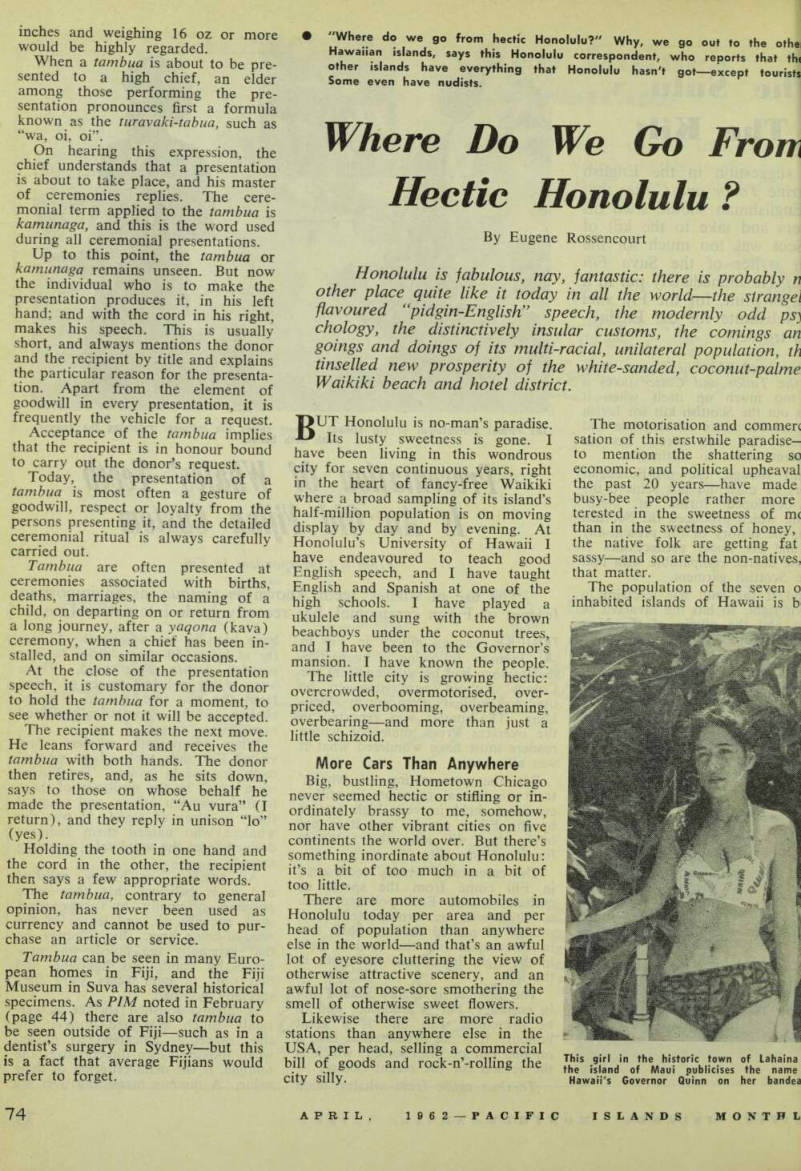
This girl in the historic town of Lahaina the island of Maui publicises the name Hawaii's Governor Quinn on her bandea
lated as more and more of the i eo flocking to the city to comin what local people call “the ilulu rat-race for the fast buck”. a result the City and County lonolulu ’ reaching out over a j island’s area of 589 square ' w j t h a present population of 194 already contains 80 per cent. [6 total population—on less than cr cent of the total land area ie state le fast buck implies a fast autole and a fast girl. But in today’s fiulu there are far more fast mobiles than fast girls—and this nected circumstance makes the race oddly more hectic, for both
the local males and the large surplus of male military personnel, Fast or slow or medium-paced, there just aren’t enough girls to go around, in this semi-tropical goldrush town, all of which keeps the Honolulu newspapers on their toes with rather bizarre stories of female teasers and male rapists.
And so we look for escape to the yet-peaceful, mildly-populated neigh hour isles: with their great volcanoes, their magnificent configuration of stupendous cliffs and deep old valleys and green-clad peaks and precipices, their bright quiet beaches and, above all, their people who have not for gotten how to smtle at a stranger.