Presentation 01 Whales’ Teeth
pp. 75-76 · Read in the full issue
Is An Old Fijian Custom
From a Correspondent in Fiji The use of whales’ teeth, known as tambua, as an important feature of Fijian ceremonial, has recently made international news.
was all about.
But the presentation of whales teeth on formal occasions is still a ceremony held in very high esteem by the Fijian people, and it is not likely they will alter their attitude for some time yet.
The ceremonial whales’ teeth used in Fiji come from the sperm or cachalot whale. Each polished tooth is fitted with an ornamented cord, usually of plaited coconut fibre; and in ceremonial use the cord is held in the right hand, and the tooth in the left.
The tambua is highly valued not in currency, but in tradition, and to be presented with one is a great honour. It is not permitted to take a tambua out of the country, which is the reason for the recent outcry.
Tambua made from whales’ teeth
teeth, for use in trading> T h e Fijians were struck by the similarity of these tQ their wooden hua-ta, and adopted them in p i ace 0 f WO od. It was the whalers w ho named them tambua, derived f rom the word tabu, meaning sacred.
All tambua are highly polished and it [ s believed that they were po ii s h e d originally by using coral sand> COCO nut oil, and leaves of the masi-ni-tabua tree. But it may be that originally the polish was pro duced by continuous handling and that only in later years were they specially polished, A highly polished surface is cer tainly much esteemed today; but size, especially thickness as judged when looking down directly over the tambua, is the mam criterion ot tneir value. A tambua measuring over six
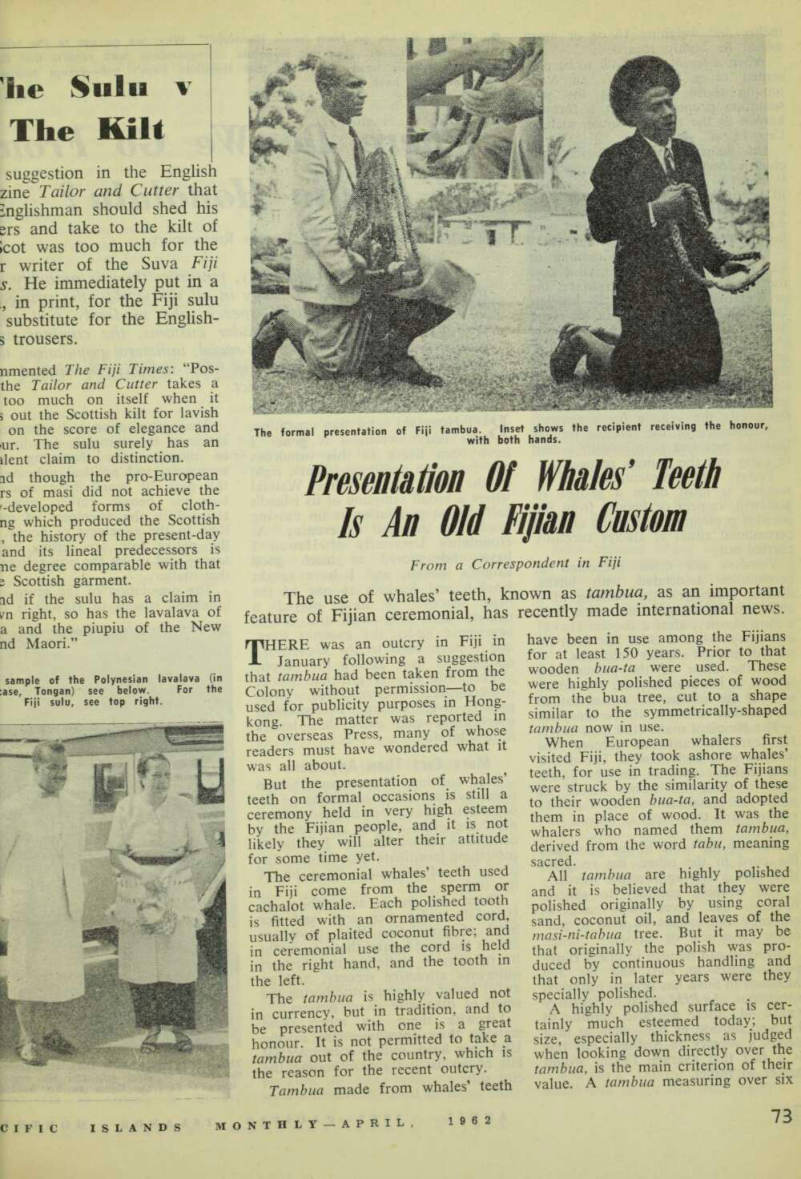
The formal presentation of Fiji tambua. Inset shows the recipient receiving the honour, with both hands.
inches and weighing 16 oz or more would be highly regarded.
When a tambua is about to be pre sented to a high chief, an elder among those performing the pre sentation pronounces first a formula known as the turavaki-tabua, such as “wa, oi, oi”.
On hearing this expression, the chief understands that a presentation is about to take place, and his master of ceremonies replies. The cere monial term applied to the tambua is kamunaga, and this is the word used during all ceremonial presentations.
Up to this point, the tambua or kamunaga remains unseen. But now the individual who is to make the presentation produces it, in his left hand; and with the cord in his right, makes his speech. This is usually short, and always mentions the donor and the recipient by title and explains the particular reason for the presenta tion. Apart from the element of goodwill in every presentation, it is frequently the vehicle for a request.
Acceptance of the tambua implies that the recipient is in honour bound to carry out the donor’s request.
Today, the presentation of a tambua is most often a gesture of goodwill, respect or loyalty from the persons presenting it, and the detailed ceremonial ritual is always carefully carried out.
Tambua are often presented at ceremonies associated with births, deaths, marriages, the naming of a child, on departing on or return from a long journey, after a yaqona (kava) ceremony, when a chief has been in stalled, and on similar occasions.
At the close of the presentation speech, it is customary for the donor to hold the tambua for a moment, to see whether or not it will be accepted.
The recipient makes the next move.
He leans forward and receives the tambua with both hands. Hie donor then retires, and, as he sits down, says to those on whose behalf he made the presentation, “Au vura” (I return), and they reply in unison “lo” (yes).
Holding the tooth in one hand and the cord in the other, the recipient then says a few appropriate words.
The tambua, contrary to general opinion, has never been used as currency and cannot be used to pur chase an article or service.
Tambua can be seen in many Euro pean homes in Fiji, and the Fiji Museum in Suva has several historical specimens. As PIM noted in February (page 44) there are also tambua to be seen outside of Fiji—such as in a dentist’s surgery in Sydney—but this is a fact that average Fijians would prefer to forget.
• "Where do we go from hectic Honolulu?" Why, we go out to the othei Hawaiian islands, says this Honolulu correspondent, who reports that the other islands have everything that Honolulu hasn't got—except tourists Some even have nudists.