Cruising Yachts
pp. 97-111 · Read in the full issue


Pacific Shipping And Cruising Yachts
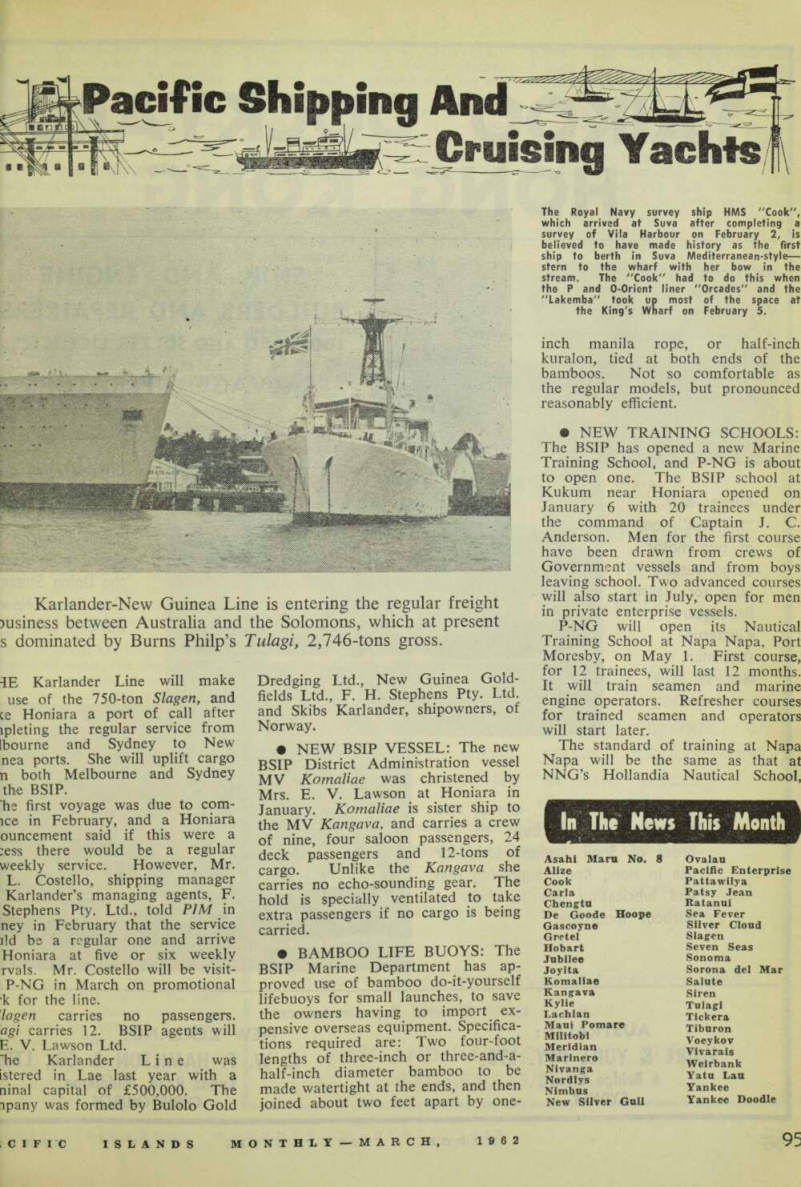
Karlander-New Guinea Line is entering the regular freight msiness between Australia and the Solomons, which at present s dominated by Burns Philp’s Tulagi, 2,746-tons gross.
■IE Karlander Line will make use of the 750-ton Slagen, and ce Honiara a port of call after ipleting the regular service from [bourne and Sydney to New nea ports. She will uplift cargo n both Melbourne and Sydney the BSIP. ’he first voyage was due to corn ice in February, and a Honiara ouncement said if this were a :ess there would be a regular weekly service. However, Mr.
L. Costello, shipping manager Karlander’s managing agents, F.
Stephens Pty. Ltd., told PIM in ney in February that the service ild be a regular one and arrive Honiara at five or six weekly rvals. Mr. Costello will be visit- P-NG in March on promotional k for the line. lagen carries no passengers. agi carries 12. BSIP agents will E. V. Lawson Ltd.
"he Karlander Line was istered in Lae last year with a ninal capital of £500,000. The ipany was formed by Bulolo Gold
Dredging Ltd., New Guinea Gold fields Ltd., F. H. Stephens Pty. Ltd. and Skibs Karlander, shipowners, of Norway. NEW BSIp VESSEL: The new BS j P district Administration vessel MV Koma i iae was christened by Mrs. e. V. Lawson at Honiara in j anuary . Komaiiae is sister ship to the MV kangava, and carries a crew of nine four sa i oon passengers, 24 deck passengers and 12-tons of cargo Unlike the Kangava she carr j es no echo-sounding gear. The hold is spec ially ventilated to take extra passe ngers if no cargo is being carried. ’ „
• Bamboo Life Buoys: The
BSIP Marine Department has ap proved use of bamboo do-it-yourself lifebuoys for small launches, to save the owners having to import ex pensive overseas equipment. Specifica tions required are: Two four-foot lengths of three-inch or three-and-a half-inch diameter bamboo to be made watertight at the ends, and then joined about two feet apart by one
inch manila rope, or half-inch kuralon, tied at both ends of the bamboos. Not so comfortable as the regular models, but pronounced reasonably efficient.
• New Training Schools:
The BSIP has opened a new Marine Training School, and P-NG is about to open one. The BSIP school at Kukum near Honiara opened on January 6 with 20 trainees under the command of Captain I. C.
Anderson. Men for the first course have been drawn from crews of Government vessels and from boys leaving school. Two advanced courses will also start in July, open for men in private enterprise vessels.
P-NG will open its Nautical Training School at Napa Napa, Port Moresby, on May 1. First course, for 12 trainees, will last 12 months.
It will train seamen and marine engine operators. Refresher courses for trained seamen and operators will start later.
The standard of training at Napa Napa will be the same as that at NNG’s Hollandia Nautical School,
The Royal Navy survey ship HMS "Cook", which arrived at Suva after completing a survey of Vila Harbour on February 2, is believed to have made history as the first ship to berth in Suva Mediterranean-style— stern to the wharf with her bow in the stream. The "Cook" had to do this when the P and O-Orient liner "Orcades" and the "Lakemba" took up most of the space at the King's Wharf on February 5.
!i has trained two groups of men since 1960 as part of -P-NG co-operation. No further from P-NG are be sent to ndia. Private enterprise trainees eligible for the Napa Napa es.
The Cook Again: Back In
arly in February was the Royal survey ship, HMS Cook. She :d from Vila in the New des where she had surveyed Harbour. 2 Cook will survey Wainunu Vanua Levu, and complete a y, started last year, of the waters of Taveuni. ; is expected to visit the Gilbert Ellice Group before June, and ;hen return to Singapore. The has almost become part of the scene. She has been regularly i waters since 1957. s members of the crew have to regard Suva as a sort of d home. Even the “return to pore” could be no more than ise, and it is fully expected she eturn to Fiji some time in the ; Cook is carrying on the work d by early explorers and navi i, such as Bligh and Cook, many cases, detailed surveys of waters have not been made since 9th century. From the Cook’s y numerous uncharted hazards pping will appear on charts for rst time. nass of detail has been gathered, lepths of water, the rise and fall les, the position of reefs, out of coral and rock and a great of other data have been re d. ile working in the Gilbert and Group she found three islands , although recorded, had not their positions properly fixed, spent three days at each island mrately determine their position :es from stars. ; Cook has such a heavy pro ne of survey work that it will ier years to complete it.
Vila Survey Com
ED: HMS Cook, before leav )r Suva at the end of January, leted her survey of Vila >ur, and collected what was lly stated to be “much useful nation” on the site for the new . There is a chance new charts ila Harbour will be prepared result of the survey.
Vila Success. The 9,000-
Swedish cargo vessel Carla, developed a crack in her
plates when off Vila in late January (reb., p. 128) was finally patched up with local help and sent on her way. She had aboard a cargo of pine logs and was en route from NZ to Japan when she began to ship 10tons of water an hour in No. 2 hold.
Marine engineer W. Geappen and deepwater diver Reece Discombe sealed the crack and Carla sailed with an extra auxiliary pump . . . just in case.
• Dust To Dust: The Aus-
tralian cruiser Hobart was sold to the Japanese firm of Mitsui and Co. m February for £l7o,ooo—for scrap.
She will be broken up in Osaka and
Kobe. The Japanese firm was the highest tenderer of 11 received, Eight came from overseas buyers,
• New Union Ships: Aus
tralian shipbuilding will get a much needed shot in the arm following the announcement in February that the Union Steam Ship Company of NZ will order two new ships from South Australia’s Whyalla shipyards, Each will be a twin-screw 3,500-tons gross vessel for the Sydney-Hobart and Melbourne-Hobart cargo trade, • TAR BABIES: In Noumea they are only just recovering from the four-day visit on January 22 of
HMAS Gascoyne, which is o scientific cruise with a party of tralian scientists. But the ex weren’t the trouble, said P Noumea correspondent Fred I (a blown-away Australian), wh< ported: “It all started with invasion of about 30 Gascoyne ings of a town nightclub, v was holding a ball for tourists ab the visiting German tourist !
Seven Seas. When a row broke the police were called, but there only a youth-sized patrol to ( man-sized job so the situation got out of hand. When the p appealed for help to some Caledonian natives, the ratings firmly thrown out. But some tinued their brawl in the street a half-a-dozen in their white tro uniforms rolled on the road which just happened to have given a lavish, sticky coating ol This spectacle was described 1 local newspaper as a “comic of the affair”. A general a was sounded in Noumea and p and soldiers were despatched tc scene, only to find the birds flown. It is not reported caused the war, unless it was ceiling of the prices”. • SMUGGLERS: Vila cap a smuggler—its first for years February 1. He was a Chinese man from the MV Chengtu, objected to being searched in Customs shed, punched the Cus Officer and jumped into the harl getting rid of a small packe watches en route. He was fined for the punch and £25 for smuggling.
• Nivanga Arrives:
GEIC Colony ship Nivanga ar at Tarawa from Hongkong February 3 on her delivery vo She immediately discharged 41 of explosive for reef blasting o tions (see below). This was si on Bikeman, one of the Ta islets, which has now been dec a closed district.
• Betio Improvemei
Mr. D. Cooper, the man who been responsible for the compl of the Betio Harbour and Bi boat anchorage scheme in the G went home to England in January. Mr. Cooper was resi engineer in charge of the £l5( project. Only the dredging rem and the PWD expects to finish by September.
• Engineers For G 1
Meanwhile, the GEIC expecte(
come at long last in February the it Royal Engineers who will have rge of the reef blasting operations und the Colony in the next few nths. The party was to arrive RNZAF aircraft. In command the engineers will be Captain T.
Hardy.
'he engineers are also experienced i divers and have been trained a team. They will blast channels und 11 islands, at a cost of ,500, and the job will take about 5 months. Nui will probably be first job done. Full details of blasting schedule were published °IM, Sept., p. 103.
> Minesweeping, Too?
iru News, an Administration news 2t, reported in January that INZS Lachlan is to carry a party Naval divers to the Gilberts to ir minefields laid by the US forces the war. The report said 280 ics were laid. We have no other 'S of this.
> Tuna Chances: “We Are
/ encouraged so far”, said Mr.
J. Wattle, Gisborne (NZ) man r of J. Wattie Canneries Ltd., r the company’s fishing boat 'yn made her third experimental to seek tuna fishing grounds the NZ east coast. The com y is attempting to find out where
the tuna are, and the best way of catching them in NZ waters.
• Venezuela Contacts;
Santo and Vila in February had a visit from the Swedish vessel MV Star Stone, which uplifted 5,000-tons
of copra for Venezuela under a contract signed some months ago.
• Final Command: When
the freighter Sonoma left Sac Francisco late in January for Sydney via South Pacific ports, her mastei was Captain John Berendsen, captain of the port at San Francisco foi Matson for the last 14 years, Captain Berendsen—who will have completed 50 years of maritime ex perience in May—took command of the freighter to make one last voyage before retirement. He went to sea from his native Germany at the age of 16.
• Yet Another Aground:
There are so many Japanese fishing vessels in the South Pacific these days that it’s no wonder they regu larly sit on reefs. Latest to do it is the 100-ton Asahi Maru No. 8 off Korolevu, Fiji, in February—the second Jap vessel to run aground or that side of the Viti Levu coast ir three months. She was abandoned but there is hope that she can be salvaged.
• And Another; The
Japanese have no copyright on reef sitting, of course. The French Gov ernment ship AUze, ex-Tonga
Fiji's "Yatu‘ Liu", which went aground or a reef in a lagoon near Vanua Balavu, Lau in January, on one of the Suva slipways after she had been towed to Suva.
istered ketch Trade Winds, went ound in Vila, removing some ds of copper sheeting. In Febru she was on the Japanese slip at to.
> And Yet Another!:
anwhile, Vacuum’s 720-ton oil ker Pacific Enterprise went ound on February 10 on a reef Malo Island, near Santo, NH. came off the reef after she had isoned about three hundred tons fuel, and went straight to Vila, ire Mr. Reece Discombe carried an underwater survey of her 1. The ship’s master, Mr. derick Moore, reported that three Jes of her propeller are cracked I torn.
"he Pacific Enterprise later sailed Suva, where she was slipped.
» The Bottle Man: Jim
>rtall, who practically ran this ?ping section of PIM before he k to wandering the high seas a r ago (last heard of from Aden, Christmas), will be pleased to >w that one of his bottle-messages come home to roost. He is the rld’s greatest tosser-overboard of ssages in bottles, and last year nched 17 on the way between w Zealand and Hongkong, That 5 from the old Maui Pomare, n being delivered to the Far >t for new owners.
Hie message that has just turned is from an earlier tossing —it nt overboard from the 126-ton ch Trade Winds ( ex-Aoniu ) of nga registry, on March 28, 1960,
when the vessel was at position 25 deg. 37 minutes S latitude and 177 deg. W longitude, on a voyage between Auckland, NZ, and Nukualofa, Tonga.
Approximately 1,200 miles and 20 months later it was found on the beach at high water mark, at Cape Bayes, New Caledonia, by a chief of the local Pambou people.
He seems to have taken it to the nearest post of the Gendarmerie Nationale, who sent it to Marine headquarters in Noumea. They, in turn, were kind enough to send it on to Captain Athol Rusden, now master of Sorona del Mar, which
operates out of Vila, New Hebrides, but who was Captain of Trade Winds at the time the bottle was set adrift.
He sent the message on to us—and so the circle is complete, except that we have still to catch up with Jim Shortall who started it all and who might be anywhere from the China Sea to the North Atlantic but doubt less is still tossing bottles.
Bsip Fish Prospects:
BSIP Fisheries Officer M. L. Aylett has reported that his investigations of Protectorate fisheries possibilities reveal there are frequent schools of deep-sea fish of the tuna families in
bottle-message man —J. P. Shortall. See story below.
,reas at all times, and he recom- Js test fishing with live bait. ; has also reported on the pects of selling shark flesh in itity, to outside markets (which are not stated by our source), tie says that prospects are “most uraging”, both for fresh fillets dry salted shark flesh.
BULK OIL: Shell Islands ager S. A. J. Walker in February ed the Shell Company’s £llO,OOO oil installation at Honiara, and i on the job he announced a of 4id a gallon in local petrol •s, a drop of 6d in distillate and a gallon in kerosene in 44-gallon is. It turned out that the petrol -tion was for wholesale prices he Shell depot, for Honiara »es next day reduced the retail by 3d, not 4Jd. The garages lined they had been running on ery small margin of profit on >1 sales”.
Check On Levuka Ser-
E: Levuka people reacted igly to a sudden decision by the Marine Board to cut the number assengers and amount of cargo Levuka-Natovi service launches, ee and Ovalau, could carry. But Marine Board acted within its s, after receiving many com ts from the travelling public, le main complaint against the ne Board would seem to be the absence of public relations, e is no doubt that its action ht the Levuka people by sur , whereas an advance announce setting out the reasons for the
decision would have been accepted in the proper spirit.
Explained the acting president of the Marine Board (Captain Peter Hough): “We are, at long last, doing something about the conditions under which the passengers have travelled between Levuka and Natovi”. [At Natovi, near the Queen Victoria School on Viti Levu, is the jetty for the launches which connect Ovalau and Viti Levu.] The safety angle figured pro-
minently in the board’s decision. The number of passengers for each launch has been cut by about a quarter, but if the launch proprietors wished to carry more passengers then they would have to cut the amount of cargo.
The decision was badly timed, for it came into operation just when hundreds of children were on their way to start the new school year. The changes also affected the deliveries of food. Several firms were unable, be cause of the cut in cargo space, to provide Levuka with meat and vege tables from Viti Levu, apart from making use of trips about every 10 days by the Ratanui.
The board’s action had an amusing sidelight. Police were detailed to count the number of passengers.
While they counted, many passengers hired a private launch and sailed it blithely past, overloaded!
• Joyita’S New Owner: Vis
count Maugham, new owner of the Joyita, which he bought in January, plans to have the ship towed from Nasova Beach, Levuka, to Japan to be rebuilt. Viscount Maugham, better known as the author Robin Maugham
RABAUL TROUBLE. On her first trip to Rabaul, the new "Weirbank", became involved with the "Pattawilya" en route to Hongkong with a cargo of timber. The "Weirbank" sustained damage to her bow and is seen here being welded. The visiting Dutch vessel "De Goode Hoope" was used as a platform for the job.
RUSSIANS AGAIN. The Russian meteorological research ship "Voeykov" at Suva on February 12 She spent three days there to replenish supplies, after carrying out research work in the Pacific. The "Voeykov" was in Suva last year, and shortly after this visit she headed back for Vladivostock, via New Zealand.
and a nephew of W. Somerset Maugham, visited Fiji last year to collect material about the Joyita mystery.
The Joyita, 70 tons and 75 ft., be came news when she went missing on a trip from Apia to the Tokelaus in October, 1955. Her crew and passengers were never seen again, and the Joyita herself was found derelict, and half-submerged, about 90 miles north of Udu Point, Vanua Levu.
Sold in Suva in 1956 to a group of Vanua Levu planters she started to trade between the capital of Fiji and Savusavu, but on her first voyage she went on the notorious Horseshoe Reef
in the Koro Sea. It was many months before she started to trade again, and when she touched a reef near Makogai and started to take in water her owners had her beached at Nasova, and left her there.
According to Captain Stan Brown, master of the Maroro, the hull of the Joyita is in remarkably good con dition. Her twin-screw engines have been sold to Patterson Bros., Levuka, operators of the Levuka-Natovi launch servcie.
Lord Maugham, according to the Brighton Evening News (UK) is thrilled with his purchase. He sold his film rights to the story about the
Joy it a mystery before he arrived Fiji last year, and he is now worki on his novel about her.
“Apart from the enormous fur shall have of owning her, I thinl have pulled a very wicked trick an American film company,” L( Maugham said. “I believe they si a man out to Fiji to get the sto but now, of course, they can’t near the boat because it belongs me.
“I managed to buy it very cheaf too.”
Lord Maugham can have the Joy as far as Fiji seamen are concern They are in no doubt that the s is jinxed. A correspondent says if i ever sails again in Fiji waters “th will be any amount of trouble recn ing a local crew”. • A NEW ONE: Another ri vessel has been added to the fl of the United States Pacific Islai Trusteeship Territory. She is 175-foot, 500-gross-ton Militc stationed at Truk.
The vessel, completed late last y by the Tokushima Shipbuilding c Industry Company of Tokushir Japan, is powered by two A 1 Imperial diesel engines. She 1 accommodation for 12 cabin and deck passengers, Militobi is seventh vessel in the Trust Territi fleet, and will be used as field 1 vessel.
• Scholarships: The Uni
States Trusteeship Territory of Pacific Islands is offering yoi Micronesians the opportunity obtaining merchant marine licen as deck or engineering officers.
High Commissioner M. W. God announced in Agana on January that students will be sent to
The "Joyita" is soon to be moved from beach at Nasova. She has new owners
ted States Merchant Marine demy at King’s Point, New York, attend its four-year course, duates receive the degree of iclor of sciences when they comtraining. The second year is it at sea as a cadet aboard a chant marine vessel. Candidates t be between 17 and 22 years ige. rust Territory headquarters also 3unced that two Micronesians, io Elanzo, of the Marshalls, and iio Ksau, of Palau, had been :ted for two-year scholarships at Philippines Nautical School, ly City, in the Philippines.
ews of Cruising Yachts
NORDLYS ’ owner-skipper E.
De Koning got quite a surprise n his 71 ft American schooner tied in Auckland in January ' her cruise from California via Islands {PIM, Feb., p. 111). He id he had put his big vessel only yards from the American 40 ft kee Doodle, which he owned for t years until he sold her to Jack ston in 1960. Yankee Doodle i a two-year pleasure cruise with Marstons and was last men id in PIM in September (p, 113) n she struck a reef in Fiji. dlys expects to leave NZ in ch, minus two crew members, t port of call is not stated.
NIMBUS, 40 ft American ketch, in Rarotonga on February 13, Pago Pago next port of call, left San Pedro, California, in
June, 1961, sailed down the Mexican coast and then out to the Marquesas and Tahiti, visiting various parts of French Polynesia before heading for the Cooks. Aboard are Captain Bruce Wiker; mate Don Grief with wife Mary; engineer Will Burlingame; radioman Terry Hartman and sail master Chris Hopmans. • SALUTE, American sloop owned by Capt. Edward A. Fink, of Long Beach, California, gets a men tion this month because of the four line letter received by PIM saying: Sirs—The Pacific Islands Year Book
is a real great publication. I have read it from cover to cover and find going over it brings information and pleasure. Please let me thank you for a treasure I will keep aboard “Salute” for as long as I own her Thanks, captain. • West Australian salesman David Bunton, 23, of Cottesloe, in February was busy rigging a new 30 ft trimaran—three hulls—which he plans to sail around the world.
He thinks he might start by sailing from WA to New Guinea, and then go east-about. The trimaran is
d to be the only one in Aus- Apparently they are about ome fashionable, for PIM last (p. Ill) reported on an ind-built one, Ruvic, which was Jd to cross the Tasman to lia in February, and also make d tour.
• YANKEE, the famous 96 ft brig now owned by Captain Mike Hurst and which has been wandering about the Eastern Pacific lately turned up at Honiara, BSIP on February 12, en route to Cairns and java. • MERIDIAN, with the Staffords, was in Honiara on February 9 after a look at Vanikoro. Somewhere along the way she damaged her rudder—we haven’t heard how— and Richard hoped to have her slipped and repaired at Tulagi.
• Silver Cloud, 35 Ft Nz
yacht, arrived back in Auckland in February after a two-year 11,200 mile
South Seas cruise, the latter part of it along Australia’s Barrier Reef. • GRETEL, Australia’s entry in the America’s Cup races off Long Island Sound > New York, next September, was launched in Sydney Harbour on February 19. She’s about 70 ft long, but details are being kept secret for the time being. She is the first 12-metre yacht built in Aus tralia. The yacht is owned by a syndicate, which has been getting experience on Vim, a one-time winner chartered from the States. Both will be shipped to America in May. In 111 years’ history of the race no challenging nation has defeated the American
der, and there has been ious interest in the challenge in alian yachting circles over the 2 months. The Australian entry r first ever.
TICKERA, converted 51-year :etch, was due to leave Port ide in late-February on a e to New Guinea. Skipper is Salmon, who is travelling with vife Norma and seven Port ide youths, all under 20, as Mr. Salmon wants to do some s trading, probably on the and plans to barter goods for artifacts which will be sold in ielaide shop to be opened by dness associate, Edgar Long- SIREN, owned and skippered 'on Silk after being recondi in Rarotonga, in January be longlining experiments by ;ement with the Cook Islands’ nment. The Government is ing diesel fuel, longline fishing and the services of Fisheries Ron Powell. Siren has been ig Rarotonga’s coasts trailing dine, and first reports seem al that there are plenty of 0 be got in the Cooks. See ic Report” for more details.
KYLIE, 39 ft yawl, with Harry s atsy Fink, planned to leave y for NZ via Lord Howe Island 1 of February. They might stay le NZ winter and leave for i 1963.
SEA FEVER, 42 ft ketch, with and Margaret Alexander, also iney, had a get-together with and New Silver Gull. They
have made TV appearances and written some radio scripts on yacht ing life. Larry hoped to do some schoolteaching in February. © TIBURON, 40 ft US ketch, was last reported in Pago Pago, arriving from NZ and Tonga. • MARI NERO, 38 ft US ketch with the Christensons, is still in Auckland, installing a new diesel, and plans to leave for Tahiti in April or May.
O NIMBUS, 37 ft US cutter with Bill and Marie Bodenlos, was in San Diego in February on the start of a cruise to the South Seas planned for four years. Heading for Panama and out to Galapagos and Mar quesas. • AGNES, auxiliary ketch owned by Taveuni (Fiji) planter Edward Douglas, is reported to be for sale.
The schooner "Nordlys" in Moorea. She is now in New Zealand.
See p. 105.