Angau
p. 59 · Read in the full issue
[?]Elped Form
By Eric Feldt.
W. L. Townsend went to the \tory first for the Expro Board )21, one of the inexperienced and lined ex-soldiers who took over olantations and businesses of the nans.
EY were sent to jobs as they ar rived, and Townsend found him the Cashier in a German store id a desk, with “Kasser” in linent letters over it. The name [See Tolala’s column, p. 38.] ion afterwards, he was transferred he Administration as a patrol ;r. I first met him when we to the Sepik in 1924. (Walstab, harge, and Stan Christian, were other members.) lose were tough times. We sd at Ambunti, and formed a i there to put down the head ing, which was then rife. It was -water, and the mosquitoes were lyriads.
Passer’s” best-remembered remark ic time—made one evening when vere slapping ourselves and curs the natnats —was that, “Anyway, leels of your boots beat them”, e left after some weeks; but re ed, later, in charge of the District, e were both promoted to ADO ?25, and to DO, in 1932; and our ces ran parallel for years there ■ because, as we were the youngest s, we got the hardest jobs. He ved me twice at Salamaua when ;nt on leave. e was a better - than - average :eter, but lived mostly on out ons, where he could not get a e. eorge Townsend was a very inde lent man. He kept his private life limself, and did not court popu y—he even seemed to disdain oval. Because of this, he was i misunderstood; but no one ?ted his integrity or his devotion uty. A good test of a man is to >n patrol with him. Another is to ; him relieve you in your job, then take over from him again, er these tests, “Kasser” came out per cent. i the early days of the Jap war, r nsend had a large part in the lation of ANGAU.
Having the initial duty of applying military rule to civilians, he naturally trod on a few toes and, in con sequence. I heard him blamed for all sorts of things with which he had had nothing to do whatever.
Soon afterwards, he transferred to FELO, where his experience was of great value and, for his services, he was awarded the OBE.
After the war, he joined the United Nations staff. Having experienced two wars himself, he pinned his faith to UNO, to keep peace in the future.
To doubters, he replied that it was at least better than the old system which had led to two wars, and he devoted his time, in retirement, to promoting the idea of UNO —he gave innumerable lectures and addresses.
His death was sudden and un expected. He always had kept him self fit, and looked good for many years yet. The sympathy of all Old- Timers goes to his widow, son and daughter.
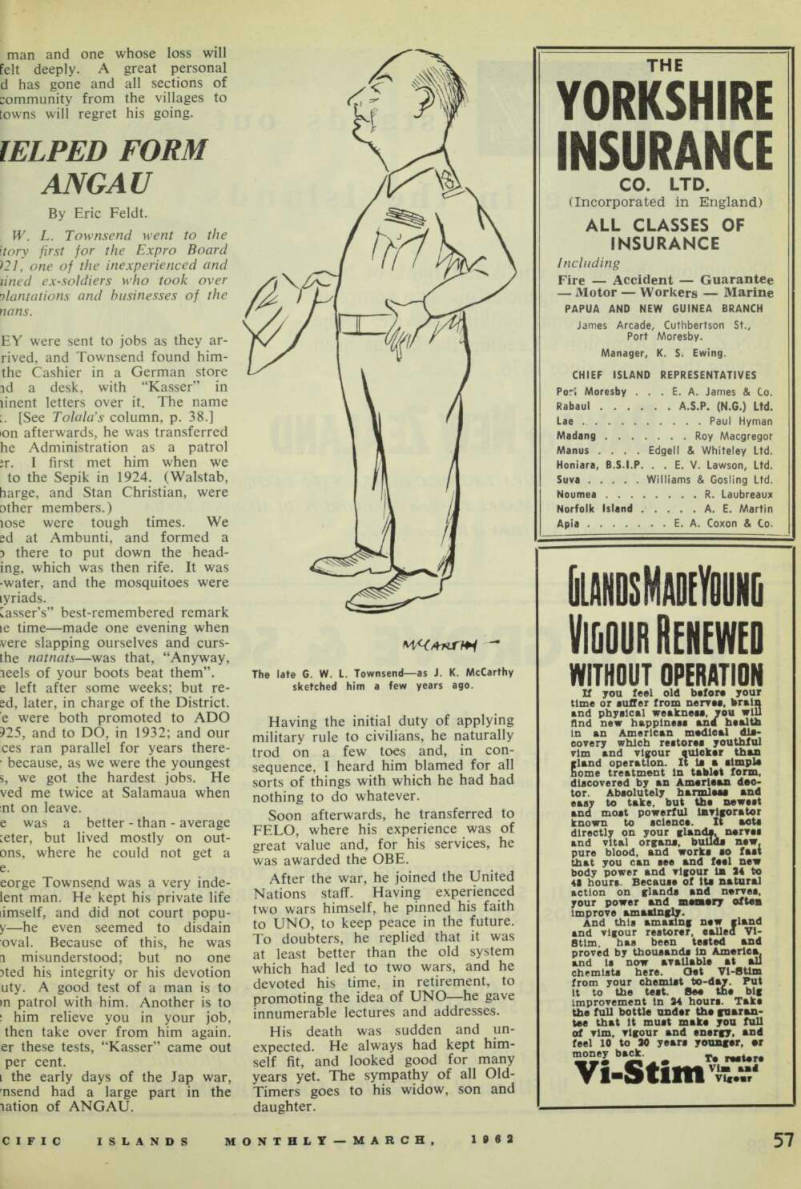
The late G. W. L. Townsend—as J. K. McCarthy sketched him a few years ago.