Bureaucrats
pp. 57-59 · Read in the full issue
E Hated Red
Tape And
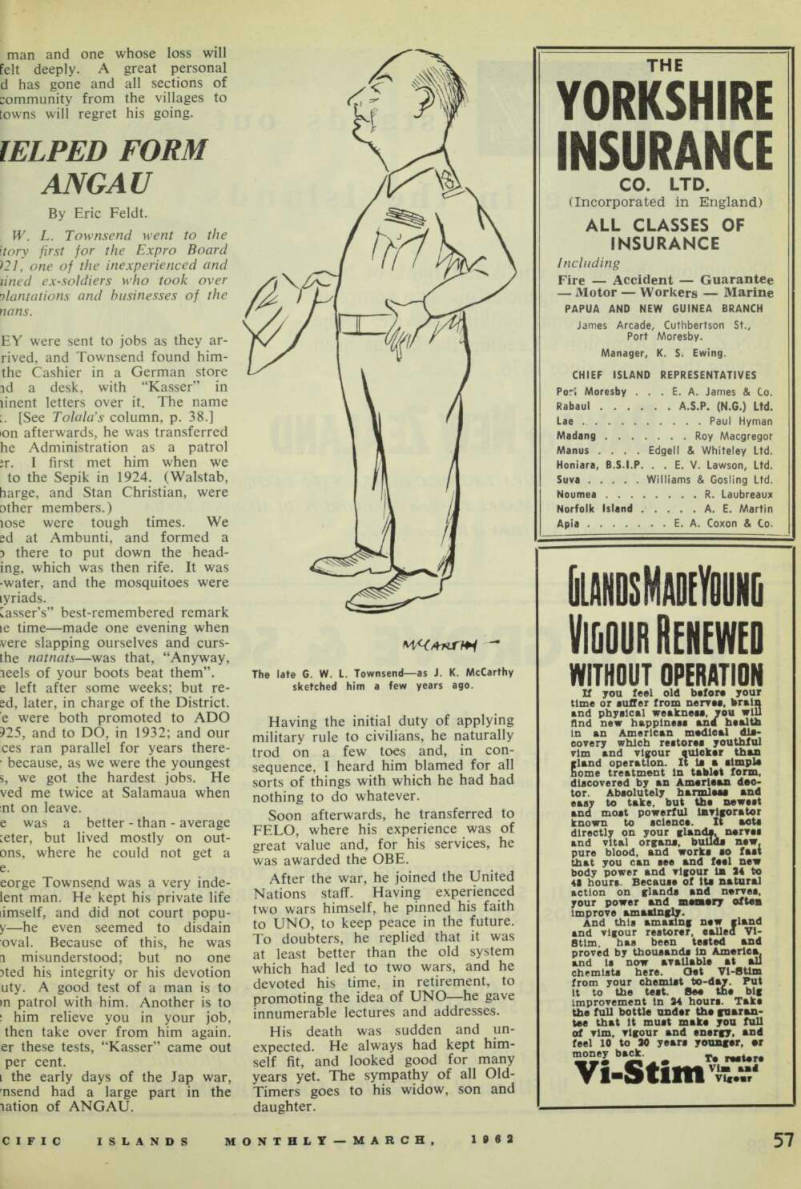
When Mr. G. W. L. Townsend died in Palmwoods, Queensland, on ebruary 9, it brought to an end a lifetime of work for Papua-New luinea. “PIM” published Mr. Townsend’s obituary in February, but in le following columns we publish tributes from two men who knew f m well — Mr. J. K. McCarthy and Mr. Eric Feldt.
By J. K. McCarthy, MBE, MLC
Officer then and I had just taken over as ADO Aitape. Just before I arrived a trader and recruiter had died at Aitape and his estate was being wound up.
The usual notice of the trader’s death had been sent to Rabaul, and to my surprise the authorities there sent an immediate reply. The radio gram read, “Please take steps to collect from the estate the sum of £5/3/10 owing for hospital expenses”.
7 air haired in his younger days I rather short in stature, with ertain curtness in his speech,
issa” Townsend always came
the point of things in the rtest possible way. He hated tape and the devious circum ution of bureaucracy and was sessed of a caustic wit when occasion warranted it. Physic
r and mentally vigorous, he
1 no time for the false in
ectuals who gave opinions
tn their office chairs.
S a young man he served in the AIF and as a gunner had re ed his commission. He came to v Guinea in the early 1920’s as a nber of the staff of the Expro ition Board—an organisation that in charge of operating expro ted German plantations until they e disposed of by tender to Aus ian purchasers. ransferring to the New Guinea ninistration as a patrol officer, vnsend served in many districts of Territory. On the Sepik River, vnsend carried out many of the ial patrols and explored great areas that unknown country. The hardy dhunters of the Middle Sepik e the first to appreciate his worth tie name “Taunsin” is still re iibered by them. ervice in the Morobe District, dur the booming goldfield days of imaua and Wau followed, and as District Officer Townsend was of t quality represented by Eric Feldt Ted Taylor. Like them he was mtially an outstation man with few longings for the larger towns, had the luck to serve under him many occasions, commencing in 2 at Kainantu and Otibanda, and 1935 at Aitape. that time the new headquarters ion was being established at wak. Townsend was District
Townsend arrived at Aitape the next day and I pointed out to him the unsympathetic attitude of the Rabaul Treasurer.
“I’ll reply to that,” snapped “Kassa”.
He scrawled a signal: “It is the custom of this district to wait until a body is cold before cutting it up.”
The authorities couldn’t get him to apologise, although they tried for a long time.
In 1939 I visited the Sepik on a special task which entailed walking from Maimai to the newly-opened station at Maprik. On arrival at Maprik, Ken Bridge, the ADO, ex pressed himself as worried about the
non-arrival of a cadet patrol off] who was walking in from Wew It was known that the young n had left Wewak some weeks bef( and Bridge was concerned about safety, for the journey was ordina one of four or five days.
“Kassa” Townsend, District Off] at Wewak, had flown into Maprik Kevin Parer’s Moth during my v “I’m worried about that new cadi said Bridge. “You say he left We\ three weeks ago—l hope nothing happened to him.”
“Have you ever met him?” as!
Townsend.
“No,” said Bridge.
“Well then, you’ll be surprised his shape and size,” replied “Kass He appeared to get away from subject. “You know,” he contini “that the native people are short proteins—their diet is faulty and t are eternally hungry for meat?”
“Yes,” said Bridge, “but about cadet?”
“Well then,” said Townsend, “1 cadet is the largest and fattest ce I have ever seen, and it wouldn’t i prise me if they have killed and ea him!”
A Clear Thinker The cadet turned up at Mapril few days later and he was certai rotund—the largest cadet pa officer ever to be seen in New Guii and during the years that passed he not lost his condition. I will not j his name for he is still with us in Territory.
“Kassa” Townsend was due to tire when the Japanese war occun Returning to New Guinea as a m< in the Army, “Kassa” did much organise the Native Affairs field s into the Army and establish the fo dations of what was to be ANG in later years.
It was owing to his efforts 1 small ships came to my help w the evacuation of the Rabaul garri was being carried out in 1942. I everything else he did, he did it v —seeing the essential problem quic and giving clear orders to solve it.
Townsend later joined the 1 Eastern Liaison Office, an organ: tion that was responsible for the < semination of information and pro ganda for the native people in Japanese occupied areas.
Amongst the men who served un him in FELO were G. A. V. Stan! the distinguished geologist and w known resident of Port Moresby; gallant Leigh Vial and Gerry Keo the two last named as officers in RAAF who lost their lives in crash Altogether a remarkable and 1
man and one whose loss will Felt deeply. A great personal d has gone and all sections of community from the villages to towns will regret his going.